

I’ve said to him many times that he is never so eloquent as when he’s describing something he despises."
–Helen, a character in Bruce Norris’s The Infidel
|
Illustration by Joseph Adolphe
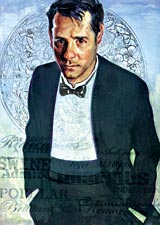 |
| "I want to depict everyone as slightly ridiculous," Norris says, "but that’s because I think I’m hugely ridiculous." |
For a man accused of endangering the mental well-being of six-year-olds, Bruce Norris is astonishingly popular. His colleagues in the theatre admire him. The Joseph Jefferson Awards Committee has honored him. Critics respect him. Even the one woman in the world with an airtight case for hating him—the stage auteur Mary Zimmerman—loves him. More than one person I talked to called him a genius. Three, in fact. And the actress Laurie Metcalf allows as how "he’s a critter, all right."
"I think Bruce is the goods," says Martha Lavey, the artistic director of the Steppenwolf Theatre Company and Norris’s great professional patron. Sara Garonzik, the producing artistic director of the Philadelphia Theatre Company, calls him "one of the most original voices writing in American theatre today."
The only outright detractor I encountered was Norris himself.
A performing-arts polymath whose acting credits range from Broadway to the role of the stressed-out, stuttering teacher in M. Night Shyamalan’s The Sixth Sense, Bruce Norris badmouths Bruce Norris—often savagely and in public—every chance he gets.
And yet it would not necessarily be right to consider that proof of self-loathing. Because, in fact, Norris stands ready to badmouth practically anybody and anything—especially if, like him, it smacks of bourgeois hypocrisy. "I want to depict everyone as slightly ridiculous, but that’s because I think I’m hugely ridiculous," he declares with characteristically wry charm, his voice and manner suggesting a Wasp Woody Allen. Given that we are all swine—and cannot really help being swine—the only morally valid response is to acknowledge it. So he does.
At 46, Norris’s growing notoriety as a brilliant, remorseless social satirist is well on its way to superseding his established success as an actor. In five plays written and produced since 1999 (including The Unmentionables, scheduled to première at Steppenwolf on June 29th with a cast that features Ora Jones, John Mahoney, Laurie Metcalf, and Amy Morton), Norris has established a reputation for bloodletting with a smile and a classical sense of dramatic structure.
That reputation took both a leap and a beating last summer with Steppenwolf’s première production of The Pain and the Itch, Norris’s pitch-black farce about an upper-middle-class politically liberal family with an ugly secret that will not stay hidden. Their panicked attempts to ignore the obvious result in (a) mayhem and (b) a chain of events that lead, absurdly but inevitably, to the death of an innocent. The charge of messing with six-year-old psyches stems from casting two little girls in this show who alternated playing four-year-old Kayla, the daughter of the family. Not only were the child actors expected to participate in the hysteric vulgarity of a breathtakingly dysfunctional household but they also had to physicalize Kayla’s mysterious, dramatically significant genital rash-i.e., scratch their crotches a lot.
Chris Jones, the theatre critic for the Chicago Tribune, took exception. "There’s something cheap about using a child as merely some kind of victimized vessel for adult failings," Jones wrote in a Sunday commentary. "I could not watch . . . any of the scenes involving this child-without my head popping out of the play and into the world of the little actress. What did she know? What did she feel? What was she told?"
Fair-minded to the point of diffidence, Jones’s essay was followed five days later by a ham-handed Chicago Sun-Times piece on the same subject. Under the headline "Child acting or abuse?" the reporter Misha Davenport named the little girls (which Jones had refrained from doing) and, while quoting only one theatregoer, claimed that "some" had objected to Steppenwolf’s handling of the children.
Something bad hit the fan. Jones told me that after the Sun-Times story appeared, the mother of one of the Kaylas "called up very upset. I remember her saying to me, ‘You Google my daughter’s name and you get "child abuse." How do I erase that?’" The play’s director, Anna D. Shapiro, was hit hard as well. "I didn’t like what I was being accused of," she says. "I have six nieces and nephews who are the most important people in the world to me, and I did not have a thick skin about that."
Norris, meanwhile, was annoyed that the controversy he had hoped to incite had misfired. Very much like the family in The Pain and the Itch, he felt, people were using a specious issue—child protection—to avoid dealing with the real one: "Is something about the way we’re living problematic?" When the Jeff Committee gave The Pain and the Itch an award for best new work of the 2004-5 season, Norris began his acceptance speech with a jab. "You know, normally when you abuse little girls you do prison time," he said, laying his trophy on the lectern. "So this is much better."
"What an astonishing volume of horseshit people expect you to swallow. Do you know what I mean? What a staggering, towering load of pure unreconstituted crap."
–Purdy, a character in Norris’s Purple Heart
Bruce Norris comes from Houston, where his family attended the same Episcopal church as George H. W. Bush. He discarded his Lone Star accent in junior high, he says, because he was "ashamed to be from Texas." The middle child between his younger sister, Jana, who grew up to be a veterinarian, and his older brother, John, a news correspondent for MTV, Bruce discovered the theatre at about the same time as he dropped his twang. "I’m extraordinarily lazy by nature and it’s a lazy person’s job and so I totally gravitated," he says. "I liked everything about the theatre. The first time I ever made out was in a carpool for a production of The Sound of Music. I made out with one of the other von Trapp children."
Norris’s mother—Margaret Jane Tatum Norris, known to her friends as Jane—"wanted to be an artist but gave it up to have kids," Norris remembers. "She encouraged dissent and subversion at every turn. She wanted us to be expressive and questioning rather than obedient, and she was also very unhappy and basically drank and smoked herself into an early grave."
His father, John Edward, an internist, became a "born-again, serious Christian" after Jane’s death in 1987. "Before her death," Bruce offers, "he was just an average run-of-the-mill control freak." Needless to say, he wasn’t any too enthusiastic about Bruce’s love of the theatre.
And apparently he still isn’t. At a recent family gathering for père Norris’s 80th birthday, Bruce says, "my father told me he felt I was writing plays that harm society. I didn’t really have an answer. You’re shocked when your father tells you that you’re hurting the world. It’s a very tough relationship. I try to decode his condemnations of me. I try to decode them as concern. He has told me on many, many occasions that I’m going to hell. I assume that means, ‘Take care of yourself.’ I don’t have much evidence to support that position, but I’m trying to optimistically think of him as concerned."
Damnation notwithstanding, Norris acted, sang, and danced his way through adolescence, working professionally on the local stage and in television. From high school he went to Boston University, where he studied scenic design, then transferred to Northwestern University.
|
Photograph: Louis Lanzano/
Associated Press 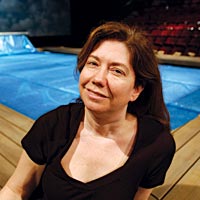 Mary Zimmerman in New York for The Metamorphoses |
Which is where he met Mary Zimmerman.
"I remember what I call the first moment I saw him, although I’d known him for a year," says Zimmerman, the Tony Award–winning adapter and director whose own brilliance has been authenticated by a MacArthur Foundation "genius" grant. "I was waiting to rehearse with him and he came around the corner—it was a very windy day—and he kind of turned to face the wind, turned into profile, and I just felt like I was in a falling elevator. . . .
"He was always the most vivid personality, always the funniest person, the most charming, the most handsome. He dated everyone. Julia Louis-Dreyfus was one of his girlfriends, and I had a deep desire not to get in line."
Instead, Zimmerman "schemingly" invited him to take a room in the big apartment she was renting with some other students. "And then, during the course of the next few weeks or months," she recalls, "we became boyfriend and girlfriend." They were 19 at the time; they would stay together for the next 16 years.
Norris will not talk about the circumstances of his breakup with Zimmerman—in part, I suspect, because they are so embarrassingly banal. Zimmerman, however, is blunt. "He had an affair with someone I knew very well," she tells me. "And they had it for three years and lied to me about it for three years."
Zimmerman goes on to describe the "colossally damaging" consequences of this betrayal, her voice shaking at times, although a decade has passed. But then she ends up with something genuinely unexpected. Something that suggests the uncanny loyalty, delight, even sense of destiny that surround Norris for all that he badmouths the world and himself: "I think we fell in love over talk, and that really never stopped and hasn’t stopped to this day. We still talk three, four times a week. In fact, the proudest accomplishment of my life by far"—says the woman who made her adaptation of Ovid’s Metamorphoses a hit on Broadway-"is that I’m friends with Bruce. That may sound doormatty, but we are a comfort in each other’s lives."
|
Photo: Robert Levy Photography and The Joseph Jefferson Awards Committee
 |
| Norris accepting a Jeff Award for The Pain and the Itch as a best new work of the 2004-5 season. |
"Ya’ll got your rules. Gotta have rules. Civilization grind to a halt no rules."
–Larry Cox, a character in Norris’s We All Went Down to Amsterdam
Norris closed his Jeff Award acceptance speech by thanking his "great, dear friend Martha Lavey, who sort of dragged me out of the gutter . . . and gave me something to do with my time." The gutter she dragged him out of was his continued misery over the breakup with Mary Zimmerman; the something she gave him was the opportunity to write a script as part of Steppenwolf Theatre’s New Plays Initiative.
Norris had already written a few things—among them, The Actor Retires, designed as a vehicle for his own performing skills; Up Against It, an adaptation of a Joe Orton screenplay, mounted by the Lookingglass Theatre Company; and The Vanishing Twin, "a Gothic burlesque with loud rock music," also mounted by Lookingglass. But Lavey opened the way for the sustained effort and exploration that have turned Norris into an honest-to-God playwright. Starting with The Infidel—about a state supreme court judge whose illicit affair has turned obsessive—Lavey’s Steppenwolf has stuck by Norris even when others (like the Philadelphia Theatre Company, which initially commissioned The Pain and the Itch) have stepped back. "Martha has been in the shadows of every good thing that’s happened for him in the last few years," says Anna Shapiro, the director.
Hepburn thin and Hepburn cultivated (it doesn’t matter which Hepburn you picture, though I would say Katharine in The Rainmaker fits best), Lavey sees Norris as more than a talented writer. She also considers him an excellent dinner companion. And she understands that the same traits inform both roles: an original mind and a subversive sensibility. "That is one thing that I admire about Bruce as a person in the world and as an artist: he’s constantly flirting with [controversy]," she says. "He will throw out an opinion or state an idea or insist upon an analogy that is so bracing, because part of his m.o. in the world is to be a provocateur."
Indeed, Norris remarks with evident pride, "Martha has referred to me as a ‘perseverator’: I enjoy things that are hectoring and terrierlike [and] refuse to drop the topic. I’ve driven people away from dinner tables. If I get something stuck in my ass that I refuse to let go of, it’s horrible—and yet it’s thrilling for me to hammer someone." Thrilling? "To have them cave. Just to scourge them of their folly."
Note the biblical diction, the touch of the angry prophet. Norris may be more his father’s son than he cares to believe. In any event, the impulse to scourge apparently runs deep. He says he even does it in his sleep. He recently had a dream, he reports, that he was having an argument with a professor in a classroom and was being so noisy about it that he drove people out of the room.
All this would make Norris look like nothing more than an unusually clever bully—a talented snot, awash in adolescent rage at the awful stupidity of it all—were it not for the fact that he whips himself, along with everyone else. "Where do I get off pretending to be a sort of ethical scourge?" he asks. "I’m a slimebag. I’m a terrible, awful person." His only saving grace, in his view, is that he is willing to admit it.
The artistic result is a series of plays in which no one stays clean. This bleak egalitarianism finds its ultimate expression in The Pain and the Itch, which may very well be a masterpiece. Combining the social acuity of a Wilde and the political scope of a Shaw with the lewd convolutions of Desperate Housewives, this play locates the Ship of Fools in a city duplex. It is telling that the one character who sees through a great deal of the ugliness, and might therefore be thought of as a surrogate for the author, turns out to be the biggest scumbag of all.
Where does a vision like this come from?
For Lavey, it has to do with Norris’s moral and intellectual rigor. "Bruce has always been a person who is engaged, and interrogates very deeply how to be in the world," she says. "He’s suspicious of received truths." In short, he sees things as they are.
For Anna Shapiro, it is more personal than that. "In Bruce’s thinking people will inevitably fail you," she tells me-and it is hard to dispute her when you consider his parents: the loving but self-destructive mother, the father right out of East of Eden. But certainly things have improved since he left Texas. What about the adoration of friends like Lavey and Zimmerman? Of Shapiro herself, who is currently staging her fourth Norris play and regards their collaboration as "the most rewarding artistic relationship" of her life? Why such a vast gap between the loyalty he clearly experiences and the mendacity that saturates his plays? "He lives in the pain of that gap," Shapiro says. "The truth is, obviously he has been let down-and more to the point, he has let down others. He has disappointed in his life, and he is in pain-no matter how much he jokes about it. . . . He’s driven to look at that."
|
Photography: Michael Brosilow
 |
| Norris with Anna D. Shapiro, the Pain and the Itch’s director |
"But don’t you see the rather comic dimension of it all? You don’t? Look, you want to be more like us . . . but we’re a bunch of assholes."
–Cash, an American-born character in The Pain and the Itch, to an African-born taxi driver"
Norris does not earn much income as a playwright. Living alone in two meticulously kept rooms in Brooklyn Heights (he moved east after breaking up with Zimmerman and has not shared a household since), he maintains his "time-wasting" lifestyle by acting in "the occasional episode of Law & Order or something like that." A couple of years ago he played Jack Black’s brother in School of Rock-a role that was eliminated from the film but made him "an astonishing amount of money."
This is "someone who has only held a straight job for a few weeks in his whole life," Zimmerman says. He was a pro going into college and started getting cast as soon as he graduated. By 1987, he had understudied Matthew Broderick in the Broadway production of Biloxi Blues and starred in his own (short-lived) TV sitcom, The Popcorn Kid.
He likes his current, minimal approach to acting because it frees him from worrying about the economic consequences of writing his plays. He may have to start worrying soon, though. In September, Playwrights Horizons will mount The Pain and the Itch, giving Norris his first New York production and the validation that comes with it.
In the meantime there is The Unmentionables, which offers a first of its own in that it is Norris’s first play set outside the United States-in an unnamed West African nation not unlike Equatorial Guinea.
Even so, Americans and their collective neuroses are still the dominant focus. Especially their need to be seen as noble no matter how monstrously they behave. Unfolding over the course of a single night, the script anatomizes corrupt Yankee industrialists alongside holier-than-thou Yankee do-gooders in the context of a country where people are poor, resources are rich, and enforcement gets rough at times. "Either [the American characters] have decided to go there to make money but are telling themselves it’s for the good of the community, or they’ve gone there to do good for the community but in fact are trying to gratify their own egos," Norris explains. "So it’s all about what people intend and what they say they intend."
And who pays, of course, when everything gets screwed up. There are no pure acts, no altruistic gestures, and certainly no heroes in Norris’s theatrical world. He is the bard of unintended consequences—every attempt to do right becomes its own punishment and nobody but nobody comes away untainted. Not even little Kayla. Which is why Norris’s satire can seem as deeply sad as it is hilarious. I asked Norris if it was possible for an American to lead a moral life. "Not really," he replied. "You could move. But where would you move to? I think ethical behavior should extend as far as your arm. You can try your best to do things that are ethical beyond that radius, but I think ultimately it’s kind of hopeless because human nature is indifferent to something like ethics. That’s sort of what The Unmentionables is about. To go around with a plan how to make the world a better place usually results in the opposite. You’re best to go to your grave having made no difference at all. That’s about the best you can do."