

 |
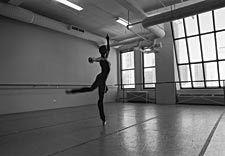
| Kathleen Thielhelm rehearsing in a Joffrey Ballet studio at 17 North State Street |
At the Centre East theatre in Skokie, rehearsal for the Joffrey Ballet ends promptly at 4:30 p.m. The dancers-lithe, lean, beautiful young men and women-grab their jackets and quickly head out of the theatre; they have to be back here in two hours for tonight’s special performance. Trailing behind the dancers, two men also emerge from the darkness of the theatre. One is Gerald Arpino, 83, the legendary choreographer and cofounder, along with Robert Joffrey, of the ballet company. Wrapped in a Hugo Boss overcoat and with his brush-cut hair dyed mahogany, Arpino conveys both flamboyance and seriousness of purpose. Next to him is Jon Teeuwissen, 47, a taller figure with dark hair, cherubic cheeks, and an excellently cut sports coat. Calm and confident, Teeuwissen (pronounced Tay-vissen) is rapidly becoming something of a legend himself. Combining an accountant’s training with dance company management experience, he has been the executive director of the Joffrey since December 2001, and he is widely credited with reviving-against all odds-the financially flailing company.
Settling into seats at a nearby restaurant, the two men begin to discuss the Joffrey’s upcoming 50th anniversary celebration-a weeklong extravaganza of events occurring in Chicago in mid-June. It is a particularly poignant anniversary, since a few years ago it appeared that the Joffrey was on the brink of shutting down forever.
“What?” says Arpino, his soup spoon pausing in midair. “There was never any possibility that the Joffrey was not going to exist. Never.”
Teeuwissen smiles. “We certainly faced a number of difficulties,” he says.
That is an understatement. When Teeuwissen arrived, fresh from his 14-month stint as the general manager of the American Ballet Theatre, the Joffrey was hemorrhaging money, its audiences were shrinking, and its patrons were frustrated and angry. Financial and administrative crises were everyday occurrences; staff members arrived and departed as if at an airport. And most crucially, after moving to Chicago ten years ago, the Joffrey had maintained its artistic edge but had lost its identity. “The first question that confronted me wasn’t ‘Is the Joffrey going to close?'” says Teeuwissen, “but ‘When is it closing?'”
“Jon,” says Arpino with the forced patience of someone speaking to a child, “the Joffrey is never closing.”
Not now it isn’t. Reasonably solvent for the first time in decades, vibrant with an active board and a rapidly growing subscription base, the ballet company has much to celebrate. In a turnaround so remarkable that students at Northwestern University’s Kellogg School of Management now use it as a case study, the Joffrey is back on its feet. Much of the credit belongs to Teeuwissen, but others played important roles as well. Like any good dance, the revival of the Joffrey Ballet has been an esprit de corps effort.
Robert Joffrey was born in Seattle, Washington, in 1930. His father was an immigrant from Afghanistan; his mother was an Italian American. And his birth name, before he changed it in his teenage years, was Anver Bey Jaffa Khan. As a teenager he started studying tap dance, but soon turned to ballet. At the Mary Ann Wells School in Seattle, he studied alongside Gerald Arpino, a fellow student who would one day become his company’s codirector and choreographer.
By 1948, Joffrey had moved to New York City. For the 1949 ballet season, he joined Roland Petit’s Ballets de Paris. And in 1953, he opened a dance school called the American Ballet Center; by then, he had already created his first major ballet, Persephone. Joffrey’s vision of ballet was a uniquely American one, with an emphasis on strong, athletic men and dynamic, emotional dancing; he liked to fuse classical elements with modern cultural references. It was a vision he shared with Arpino. Seven years older than Joffrey, Arpino had grown up on Staten Island, New York; after a stint in the U.S. Coast Guard, Arpino embraced the ballet, even though his Italian family felt that having a ballet-dancing son was a disgrace. “My mother used to say novenas that I’d be saved from dance,” he says.
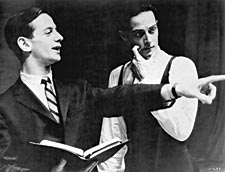 |
| Robert Joffrey (left) and Gerald Arpino, founders of the Robert Joffrey Ballet, in the 1950s |
Instead, in 1956, he and Joffrey formed the Robert Joffrey Ballet, with Arpino as the chief choreographer. While Joffrey stayed in New York, teaching ballet to make money, Arpino took the six-dancer troupe on the road. Their first performance was at Frostburg State Teachers College in Maryland. After that, the troupe continued their travels, driving across the country in a station wagon, unloading the car and rosining the stage themselves; after the show, they would frequently join the audience and answer questions. At the time, small companies often toured the heartland, performing scaled-down versions of classical ballets. But what set the Joffrey apart was its repertoire of original and vigorous dances.
The Joffrey’s first performance in a major city was in Chicago in 1957. A snowstorm made the dancers late arriving at the Eighth Street Theatre, but the audience waited. A winning review from the respected Chicago Sun-Times critic Glenna Syse helped establish the Joffrey as a leading national and eventually international company. It became the first American company invited to tour the Soviet Union and the first to perform at the White House. Together, Joffrey and Arpino extended the company’s repertoire beyond their own creations, reaching out with commissions for ballets-sometimes a choreographer’s first-from Alvin Ailey, Laura Dean, Mark Morris, and Twyla Tharp. Joffrey and Arpino also daringly resurrected or reconstructed “lost” works from the early 20th century, including Vaslav Nijinsky’s Le Sacre du Printemps, Kurt Joos’s antiwar ballet The Green Table, and George Balanchine’s Cotillion. Dancers from the Joffrey’s original Astarte (1967), a psychedelic rock ballet that filtered sixties counterculture through the myths surrounding an ancient Babylonian fertility goddess, ended up on the cover of Time magazine.
“You know, many people felt-and perhaps still feel-that ballet isn’t a very masculine art,” says Arpino. “But it’s hard work to lift 100-pound ballerinas in the air with one arm and to make it look easy. I always felt if we could emphasize the athleticism of our style of dancing, then the men would come to see us. And if the men came, then the whole family would come.” So over the years, advertisements for the Joffrey downplayed jetés for almost sportif images, particularly of the male dancers. “We had so many places to go and so many dances to do,” says Arpino. “It was a wonderful time.”
Then in 1988, Joffrey died of complications from AIDS and the company began to flounder. In the competitive New York arts world, the Joffrey had always trailed behind the New York City Ballet and the American Ballet Theatre. “There simply isn’t enough support anywhere, even in New York, for three major ballet companies,” says Teeuwissen. “And the Joffrey had more of a grassroots base, not the society base that belonged to the other companies.” Debt mounted and chaos on the board of trustees ensued. In 1990, Arpino was even tossed out of the Joffrey during a bitter takeover attempt that was then overturned by the trustees, who reinstated him within a few months. Increasingly, it was apparent that the Joffrey’s original mission-to tour the country, taking great ballet to smaller towns-was no longer relevant. “Now there is cable TV,” says Teeuwissen. “And even small towns tend to have a local ballet company. They may not be as good as Joffrey dancers, but they are the local talent and so they have the built-in support of the community.” Clearly, the times had changed, but the Joffrey had not.
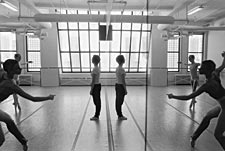 |
| Ballet master Charthel Arthur (right) with Heather Aagard (foreground) and Thielhelm |
After Bob Joffrey died, there was nothing but craziness,” says David Kipper, a Chicago psychiatrist who held a seat on the Joffrey’s board. At the time, the Joffrey had bicoastal offices-one in New York and one in Los Angeles. By the time the bitter infighting was over and Arpino had been reinstated as the creative director, every employee in the two offices had resigned. “Both coastal boards dissolved, and there was a total vacuum of leadership,” says Kipper. “I was asked to assume the presidency of the board and see what I could do for the company.” Kipper found the task almost overwhelming. “The critical excellence of the company was there, but there was no administrative infrastructure whatsoever,” he says. “By 1990, it was clear to me that the Joffrey was dying.”
Kipper called a strategic planning meeting in New York, asking for the input of many people involved in the arts, but not necessarily ballet. At the end of that meeting, the Joffrey board reached three conclusions: the mission of being a touring company was no longer applicable; the Joffrey needed to move out of New York because there were too many companies competing for the same audiences and money; and the Joffrey had to change into a “homegrown” company with its own citywide base of support.
“We knew we were looking for a city where there is a large consumption of culture,” says Kipper, “a town with at least one orchestra, one opera, and one major museum.” That way, the Joffrey could benefit from the existing cultural support. Kipper set up a committee that, in turn, evaluated various American cities on a ten-point system. In the end, it came down to two: Los Angeles and Chicago. “On paper, both cities looked equal. But with L.A., particularly at that time, you had earthquakes and fires happening. And frankly, I was pushing for Chicago because I lived there.”
Chicago won. To move the costumes and sets from New York, Kipper’s wife, Barbara Levy Kipper, enlisted the help of her family business, the Charles Levy Circulating Company. The Levy trucks moved the selected costumes and sets to Chicago, and everything else belonging to the company was sold. “We liquidated all the rest and paid off the debts,” says David Kipper. “So in September 1995, the Joffrey arrived in Chicago debt free but totally penniless.” The immediate need was to build support, and that proved a daunting task.
“We were forewarned that coming to Chicago would be suicide,” says Kipper, “because Chicagoans don’t support ballet.
I said, ‘Well, we’re half-dead already; we might as well try.'”
“You know, historically Chicago has been a bit of a crappy town for ballet,” says Maureen Dwyer Smith, a Lake Forest philanthropist who is a Joffrey board member of long standing. “There was Ruth Page’s company and then Maria Tallchief’s company, but neither lasted very long.” In the past, Chicagoans have tended to support modern dance, and there were already numerous established dance companies here.
For the next several years, the Joffrey would, in the words of The Wall Street Journal, “make just about every mistake possible.” At first, to avoid looking like an interloper, the board tried to negotiate a merger with an existing dance company. Talks were conducted with Ballet Chicago, a school and troupe that emphasizes the Balanchine method of dance. But the Joffrey and Ballet Chicago were not a good match; besides, Arpino was arguing strenuously against a merger with another company. “Finally, on the strength of a one-vote majority, the board voted not to merge, but rather to pursue our fate by ourselves,” says Kipper. Next, the name of the company was changed to Joffrey Ballet of Chicago; the intent was to show the company’s dedication to its new hometown. But the name change confused both consumers and potential donors, many of whom assumed this troupe was a road company extension of the New York Joffrey.
“To the credit of the people who brought the Joffrey to Chicago, they kept fighting the odds,” says Pamela Strobel, who was an executive with Commonwealth Edison at the time. She joined the board shortly after the Joffrey moved to Chicago. “I recall those board meetings vividly,” she says with a laugh. “The beauty of talking about the company and the agony of dealing with the finances.” By now, the Joffrey was rapidly incurring new debt, yet incoming financial support was low. There was no stable performance space; the company bounced around from the Shubert to the Civic Opera House to the Rosemont. And without a stable home, no subscription base-the core of fundraising for all performing arts-could be built. Meanwhile, the position of executive director seemed to be equipped with a revolving door.
By 1999, the company’s leadership had made some progress. The board of trustees, which consisted of fewer than ten members when the Joffrey moved to Chicago, was growing. With the help of the board members Bruce Sagan, a real-estate developer, and Stephen Neumer, a lawyer, Strobel oversaw the Joffrey’s acquisition of a former ComEd building at 6 East Lake Street, a gift that was worth $4 million. “The intention was that we would raise money and renovate this building as our permanent home,” says Strobel. A capital campaign was launched, and more than $1.4 million was raised for the renovation.
Strobel became the chairperson in 2001, a period that she remembers as “the lowest of the low times.” The stock market collapsed following the terrorist attacks of September 11th. The capital campaign came to a screeching halt, and most of the burgeoning support the Joffrey had built began to disappear. “We had to convert some of the capital campaign gifts into operating funds,” says Strobel. “We even had discussions of whether we could put on The Nutcracker. The stress level was off the charts.” But then slowly the Joffrey’s fortunes began to reverse. First, the board realized that the former ComEd building was an asset they could use; a line of credit was established, using the building, and that covered the operating costs for the end of the year. And then the board of trustees hired Jon Teeuwissen.
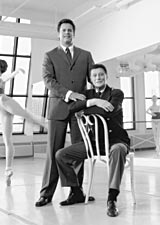 |
| Jon Teeuwissen (standing), the executive director of the Joffrey, and Arpino, the artistic director, with (from left) Aagard and Thielhelm |
Teeuwissen grew up in Teays Valley, West Virginia, the son of a Dutch and Indonesian acoustics engineer. He saw his first ballet-Swan Lake-when he was 19 years old. Although he took dance classes in college, Teeuwissen never considered a career as a performer. Instead, he majored in accounting at West Virginia State University and went on to own successful dance supply companies in West Virginia. Eventually, he moved to New York, becoming the dance manager of the Dance Theatre of Harlem. From there, he became the general manager of the American Ballet Theatre. By now, Teeuwissen was gaining a reputation in the dance world for his ability to help struggling companies by combining his financial acumen with a knowledge of the dance world.
When he was approached to become the Joffrey’s executive director, he did not hesitate, even though the company’s situation was dire. “Well, I like a challenge,” he says with a smile. “Besides, the chance to work with Mr. Arpino, one of the founders of the company, is priceless.”
In December 2001, when Teeuwissen was appointed, he was the seventh executive director of the Joffrey in six years. The company’s debt had climbed to $3 million, and the Joffrey was still bleeding money. Some patrons were angry that their capital campaign donations had been used for operating costs, although they had given their permission, as required by law.
First, Teeuwissen addressed the lack of a performance space. “He worked very hard to negotiate a multiyear contract for the Joffrey to perform at the Auditorium [Theatre of Roosevelt University],” says Strobel. With a regular home base, Teeuwissen could then start building annual subscription sales. He also restored confidence in the Joffrey’s donors. “I simply talked to them in a very straightforward manner,” he says. “It never hurts to tell the truth.” It also helped that Teeuwissen was rearranging the dance company’s schedule for practicality. He reduced its elaborate precedent of creating four major productions annually. “The way it was, with two different production schedules twice a year, we were asking people to come two weeks in a row, spring and fall,” he says. “It was asking too much from our audiences; plus, it didn’t make financial sense for us.” Instead, he initially cut the spring and fall seasons to one week each, then added a weeklong winter program. (The new schedule eventually proved so successful that now each of the three seasons runs for two weeks.) Teeuwissen also eliminated the poorly attended Thursday shows while increasing the number of weekend performances. And he cut some prices, marketing attractive three-show packages as cheap as $50. His changes paid off. For the 2005-2006 season, subscription renewal rates were up 75 percent.
Another important change Teeuwissen made was dropping “of Chicago” from the company’s name. Then he decided to replace the taped music the Joffrey danced to with live accompaniment by the Chicago Sinfonietta; he persuaded the Chicago Community Trust and the Joyce Foundation to underwrite the switch to live music. Another payoff: during Teeuwissen’s reign, corporate donations have increased 73 percent, and foundation donations are up 88 percent. But he was not working this magic by himself. Before his arrival, Maureen Dwyer Smith had started organizing a women’s board, which began contributing both crucial word of mouth and active fundraising; in five years, the women’s board became the largest donor to the Joffrey (see sidebar on page 91). At the same time, Strobel began some heavy recruiting for the board; she also helped establish giving guidelines for trustees, requiring each member to make an annual gift of $15,000. In the past five years, the board has grown to 76 members.
One of the biggest changes for the Joffrey occurred thanks to a corporate grant from Boeing. “That grant allowed us to do extensive market research and rebranding studies,” says Teeuwissen. “And what we discovered is that our core audience is women from 35 to 55 years old.” Out went the advertisements emphasizing the athleticism of the male dancers; in came rebranding campaigns that were geared toward tapping into women’s “inner ballerinas.” Part of that rebranding outreach includes new affinity groups that feature professional women as keynote speakers before performances.
And in 2005, the Joffrey sold the old Lake Street ComEd building at the peak of the real-estate boom for $6.1 million. “That allowed us to pay off all remaining debt,” says Strobel, “still leaving us a significant amount of money to invest for the future.” At the end of fiscal 2005, Teeuwissen had a surplus of $300,000, compared with the $2-million deficit he had faced when he arrived in 2001.
Today, the Joffrey’s future is promising, and that is a happy ending right out of a fairy tale like The Nutcracker. Strobel has turned the chairmanship of the board over to two very accomplished men: Ronald V. Waters III, the chief operating officer of the William Wrigley Jr. Company, and William Daley, former U.S. secretary of commerce and the brother of Chicago’s mayor. In a new mixed-use building to be constructed at 8 East Randolph Street, the Joffrey will have more than 45,000 square feet of rehearsal and office space. The building will be called Joffrey Tower. And in June, the six-day celebration of the Joffrey’s 50th anniversary will take place. Most of the events, which will include kids dancing in Crown Fountain at Millennium Park, will be free. “It seems only right,” says Teeuwissen. “This city has given so much to us, we feel we should give something back.”
Photography by Jeff Sciortino
A Chanel army takes charge
|
Courtesy of the Joffrey Ballet
 |
|
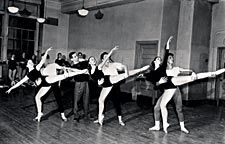
Joffrey teaching in New York in the 1950s
|
“You know how that television show The View begins, with Barbara Walters saying, ‘I had this idea for a show,'” recalls Maureen Dwyer Smith, a Lake Forest philanthropist. “Well, I had this idea for a board. I imagined women of all ages and experiences working together.”
And so the Joffrey Ballet Women’s Board was born in 2000. When Smith came up with her plan, she was already a founder of the Joffrey’s board of trustees. “I saw it through all its twists and turns, and the days when it was ‘Can everybody just throw in $1,000 to get us through the week?'” she says. “It was a mess.”
At the start, Smith recognized a major issue. “There was no buzz about the Joffrey,” she says. “The Joffrey had the most perfect dancing, performances of the highest quality. Yet zero buzz.”
A women’s board, Smith thought, would not let this civic opportunity “fritter away. We needed recognition first and then money. There are a lot of ways to raise money, but buzz is not particularly easy to create. With a women’s board, there would be people at dinner parties and at luncheons throughout the city talking about the Joffrey.” Women’s boards are a Chicago institution; they are not powerful in the civic and arts charitable scenes of New York and Los Angeles. At one time, they represented a social outlet for wives who were not considered powerful or prominent enough to hold regular board seats. But over the decades, Chicago’s women’s boards have morphed into fundraising dynamos.
Smith started by calling a few friends. Renee Crown, the wife of the financier Lester Crown, was first, Smith says, because “I thought maybe one of her daughters-in-law might be interested.” But Crown herself said she wanted to get involved. “Renee doesn’t mind getting her hands dirty, and that’s what we needed: women who would take on projects and who would make those painful phone calls asking for money.” Next Smith called Shirley Ryan, the wife of Patrick Ryan, the chief executive officer of the Aon Corporation, and then Bonnie Deutsch, a philanthropist. “People joined and then they asked their friends to join, and it just turned out to be a great group of strong women,” says Smith. “We might look like the Chanel army when we meet, but we range from women who bring their babies all the way to women whose age I am not allowed to discuss.”
Her original goal was to recruit 50 people. Today, the Joffrey Women’s Board has 168 members. They are asked to pay annual dues of $200 to cover the cost of luncheon meetings; they are also “strongly encouraged,” in the words of Smith, to become a member of the Joffrey Circle, for a donation of $1,000 a year. But unlike trustee members, who have an annual giving requirement of $15,000, the women’s board does not require any other financial gifts from its members. Yet it has become the largest donor to the Joffrey, raising a net total of $1.9 million annually. “Some people may think, Oh, the ladies give the parties,” says Smith, who is now the chairman emeritus of the women’s board, “but we are quite a force.” Teeuwissen agrees. “The women’s board is a true powerhouse for the Joffrey,” he says.
|
Photography: Jack Mitchell
Courtesy of the Joffrey Ballet  |
| Lillian Wellein in Pas des Déesses in the 1950s |
Much of the money is raised by the annual spring gala, hosted by the women’s board. But the women’s efforts don’t stop there: the Family Night in December includes a dinner at The Chicago Club and a performance of The Nutcracker. Deborah Beitler, an active volunteer in Highland Park, oversees Destination Dance, an annual fundraising jaunt for women’s board members to check out another town and another ballet company. “Recently, it was a trip to see the Miami Ballet, along with a party at a fabulous house that had been in Architectural Digest and the requisite shopping afternoon,” says Smith. “Just a wonderful weekend in South Beach that helps the Joffrey.”
For the 50th anniversary this year, the women’s board took on a commemorative project. “We talked about paperweights and things like that,” says the board member Kathleen Klaeser, the wife of the businessman Dennis Klaeser. “But we had all these years of fantastic photographs by Herbert Migdoll, who had officially recorded the Joffrey since the 1950s. So I suggested we do a book.”
The result is The Joffrey Ballet: American Classic ($50), a 160-page photography book that will be available by the end of May exclusively through the Joffrey. “Going through the thousands of photographs was an intense experience,” says Klaeser, who with fellow women’s board member Kim White, the owner of the Libertyville bookstore Crocodile Pie and the wife of Miles White, the chief executive officer of Abbott Laboratories, oversaw the book’s production. “Of course, photographs, like all art, are subjective and everyone had an opinion,” Klaeser recalls. But eventually the final cuts were made; the result focuses on images taken by Migdoll, who is renowned for his ability to convey movement in dance photographs. The book also includes photos taken by Barbara Levy Kipper, a board member.
“We had some generous underwriting, and InnerWorkings, a print management company, donated most of its expenses,” says Klaeser, “so we should be able to turn over all of the money generated by the sale of the book directly to the Joffrey.”
–M. F. C.