

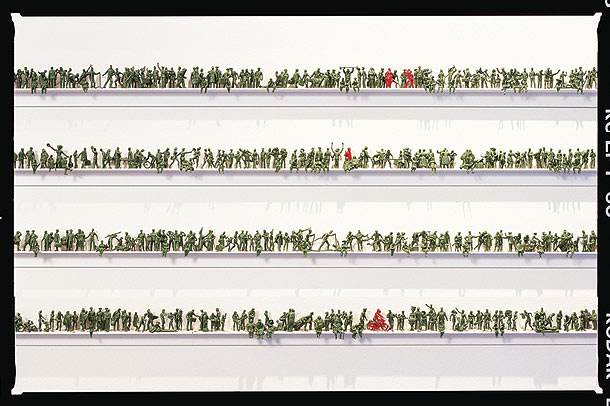
No two figures in Guy Limone’s AIDS memorial work are the same.
From the entryway of this duplex penthouse in a lakefront high-rise, the view-down a wide hallway and through the living room-is from here to eternity, and on days when the sky is blue and the clouds are cumulus, the mood is light and buoyant. From 1980 to 1993, the space, a rooftop addition to the Mayfair Regent Hotel, was occupied by the French restaurant Ciel Bleu. Even before that establishment closed and developers began converting the building to condominiums, the current owner, an art collector who prefers not to be named, had been tracking the property. A determined visionary, she saw herself at the top of the gracious vintage building, on the best block in the city, with expansive interiors and multiple outdoor gardens.
Commercial spaces had always appealed to her. “They were more creative because they didn’t have a self-conscious person saying residentially, domestically, I could never do that,” she says. Halfway through the project, she married another art collector; together, from their previous marriages, they have six children and 12 grandchildren. For years, she had collected ceramics, modern and contemporary paintings, sculpture, and antique furniture. His interests were modern paintings and works on paper, African sculpture, art glass, and snuff bottles. They both owned photographs, by such masters as Brassaï, Weegee, and Man Ray. “So it was a good match,” the husband says. After the couple married, they sold some work and began collecting together-among their new acquisitions were major paintings by Yves Klein and Cy Twombly and, on a smaller scale, more than 100 enameled cigarette cases.
She was more intimately involved with the initial space planning than he, and willing to experiment to find the best solutions. A friend suggested making temporary walls out of white cardboard to study the effect of different placements. “That gave us an idea of light, shadow, room sizes, of how we would walk through the apartment,” she says. “And I think we got it right.”
Making sure that happened were Dan Wheeler, a principal of Wheeler Kearns Architects, and the project architect, Mark Spencer, along with the interior designers Leslie Jones and Nina Wong from Leslie Jones & Associates. A number of factors, Wheeler says, make the project successful. “The building is beautifully situated, and good decisions were made in terms of maximizing what the site had to offer.” The variation in ceiling heights from a low of six feet eight inches in the private areas to 11 feet in the public rooms creates a contrast that makes the spaces memorable, as do the artwork and the enviable outdoor access. “You have very caring clients,” Wheeler says, “who appreciate architecture, art, and material possessions.”
* * *
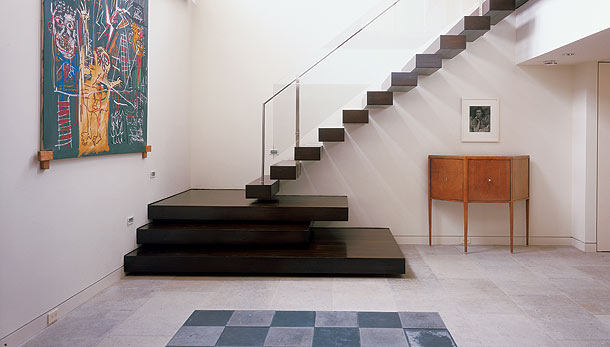
In the foyer, a painting by Jean-Michel Basquiat hangs across from a cantilevered staircase. The checkerboard surface is by Carl Andre, and above a console by Émile-Jacques Ruhlmann is Migrant Mother, a Depression-era photograph by Dorothea Lange.
Even though the clients are collectors, they did not want a loftlike feeling. “We live alone,” she says. “We didn’t need huge rooms, but we needed space to hang art, a place that felt comfortable.” They wanted to avoid the long, narrow hallways that are typical of vintage apartments. There were also a number of inherent challenges that had to be dealt with-the floors were five inches out of level, and the shape of the building was skewed, quirks that were resolved by the architects and the structural engineer. Among the owners and the design team, the sense of possibility always trumped any temporary setbacks. The property was clearly a prize.
Not long after she bought the space, the client asked the architect John Vinci of Vinci/Hamp if her windows could be larger. During the conversion to condominiums, the developer of the landmark building had hired Vinci to restore the exterior and redesign the lobby. Since the rooftop property was an addition, it was not subject to the historical precedents that applied to the rest of the building. “I didn’t do anything magical,” Vinci says. “I just made the proportion of glass to masonry larger. It was no big deal.”
|
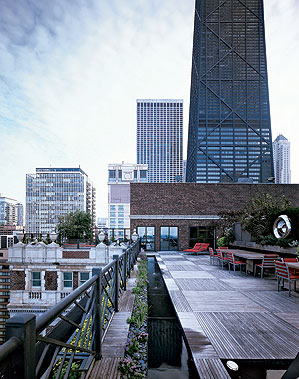
But the views are. When the photographer Catherine Opie was working on her 2006 exhibition and book, which captured the city in different seasons, after visiting this apartment she looked no further for a Chicago point of origin. From the start, just off the elevator and into the entryway, the proportions of the space are pleasing-generous yet intimate, sophisticated yet inviting. A bushhammered limestone floor defines the foyer, and wings on either side, where the ceiling heights are lower, comprise the master suite, offices for the couple, and guest rooms. On the right, a cantilevered stairway in rich Brazilian walnut is tucked against a wall, its structure visible through an outer railing of glass. Placing the stairway there, Wheeler explains, made it clear that this was not a single-floor apartment. “It was something that was important to all of us as a design team,” he says, “and in this location we could use the double height to bring daylight into what would have been a dark space.”
Illuminated in the foyer is an elegant composition of art and objects: the Depression-era portrait Migrant Mother by Dorothea Lange hangs above a console by Émile-Jacques Ruhlmann; other walls hold a painting by Jean-Michel Basquiat and a photograph by Gilbert and George; on the floor are sculptures by Louise Bourgeois and Sol LeWitt and, in contrasting squares of lead and magnesium, a checkerboard surface by Carl Andre.
“My job was a kind of balancing act,” Jones says, “trying to work in and properly place pieces that [the client] had, because she had an amazing collection of art and antiques-some of which she already owned and some of which were purchased for this apartment.” Jones also custom designed furniture for the project and recommended fabrics that were both visually appealing and tactile. “I wanted the feeling of natural textures, interesting textures unexpectedly used,” she explains, “and a sense of luxury without being ostentatious.”
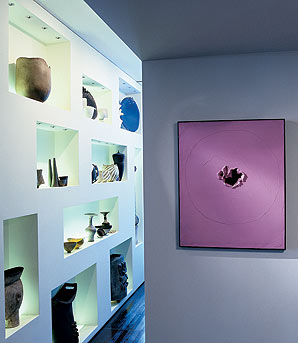
Another kind of surprise is around the corner from the foyer-across from the coat closets that line one wall of an open room are a series of niches custom designed by Mark Spencer and Nina Wong to accommodate work that the client collected when she was a partner in a ceramics and photography gallery, now owned by Martha Schneider. Among the artists represented here are Dame Lucie Rie, Hans Coper, and Gale Golovan Rattner.
|
The floors in the public areas-library, living and dining rooms, kitchen, and powder room-are Brazilian walnut, with thin inserts of nickel. “After space planning,” the wife says, “our concern was how to make this a 21st-century apartment. Materials were very important to us. Using the nickel looked toward the future but referred to the past. We wanted new materials, or old materials worked in new ways.”
The hallway leading from the entry to the living and dining rooms is wide enough to accommodate a group of art aficionados on a house tour-or the promenade of a larger party-size crowd. At the time this project was under way, glass that could convert from opaque to clear with the flip of a switch had just become available in floor-to-ceiling panels, and to brighten the hallway, Wheeler and Jones suggested using it for the outer walls of the library. Inspired by Pierre Chareau’s Maison de Verre in Paris, Wheeler designed tall metal shelves for the room to hold the couple’s collection of art books; a framework of sycamore spans the inner walls and the ceiling-a U-shaped liner that reappears in the kitchen and the powder room. “This does remarkable things for the apartment,” says the client. “It warms it up tremendously. And the doorways are wide. So we have defined spaces, but they’re not very enclosed. We tried to do two things at once.”
Jones designed a sofa for the room and had it covered in gray-green cashmere. To make a coffee table, the owners topped a wrought-iron base found in Europe with cast glass. Across from a pair of Jean-Michel Frank club chairs that were reupholstered in soft sheepskin is a high-backed 1930s French train chair from the Alan Koppel Gallery. High on a shelf, at rest for the moment, is the metronome to which Man Ray affixed a photograph of a former lover’s eye. On a tour through the apartment, the owners complement each other as they talk about their collections, imparting biograph- ical information about the artists, historical context, methods, and meaning.
“This is by a French artist named Guy Limone,” the husband says, pausing in front of a series of ledges in the hallway lined with tiny figures reminiscent of plastic toy soldiers. “There are 1,000 pieces here. Six of them are red, and the statement was, in the year 2000, when he made this piece, out of every 1,000 people in the world, six had AIDS. Sadly, the number is probably higher today. But what’s amazing about this is that no two figures are the same.”
|
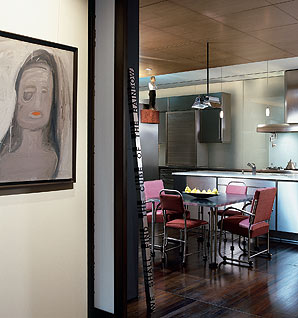
The self-portrait by Eva Hesse, near the entrance to the kitchen, the wife explains, came from the Richard Gray Gallery and was a gift to the artist’s psychiatrist-and, judging from the image, perhaps an admission that all was not well. There is even space here for do-it-yourself art. In the kitchen, a Wheeler design in stainless steel, sycamore, and marble, sections of two walls are slate. Supplied with colored chalk and erasers, the grandchildren are free to experiment.
The large room to the north, overlooking the Oak Street Beach, was tricky to plan, Jones says. Included in the 26-by-52-foot space are the living and dining rooms, as well as music and game-table areas. “We wanted to define major seating groups, rather than letting this be a sea of furniture,” Jones explains. She achieved an arrangement that was distinctive and fluid, with regions subtly demarcated by the placement of a pair of tall arcing lamps, a Rulhmann sideboard, a low, curving bookshelf by Pierre Chareau. To provide the flexibility for entertaining that the owners required, Jones designed a round dining table with leaves that fold out from the center, a set of chairs covered in pony skin, and a day bed in raffia, just the right height for perching and, uninhabited, for not obscuring the view. To provide extra seating, extensions and supports were fabricated for an art deco desk from Rita Bucheit, and the windowsills were lowered and widened to accommodate guests.
To compensate for the lack of wall space, the owners display some works in the room on easels bought from the late dealer B. C. Holland. At intervals Jones installed silk curtains in a dark olive black and a charcoal gray as a backdrop for frames. A midnight blue painting by Yves Klein and a Francis Bacon study for a portrait of his lover John Edwards are two of the large-scale works here, although the couple routinely lend art to exhibitions, so the arrangements are never fixed for long.
Jones was unaware of the couple’s enameled cigarette cases when she designed a coffee table for this room with upper and lower tiers of glass-a perfect place for the collection. The couple do not smoke; they appreciate the boxes solely for their artistry-whether the images are biblical or secular, abstract or figurative.
“We started with plain ones that had moiré patterns,” the husband explains. “And then we got into some scenes, and then we got into nude or seminude women-what you might call pinup pictures.”
“Odalisques,” says his wife.
* * *
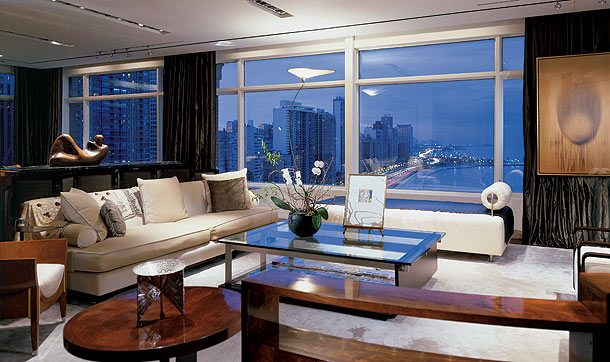
The interior designer Leslie Jones created the day bed in the living room. FP 2, a fire painting by Yves Klein, is nearby. The work on the easy is by Roy Lichtenstein.
They spend as much time as they can on the adjoining decks upstairs-one for large-scale entertaining; the other, more informal and family oriented, both collaborations between Wheeler Kearns and the landscape architect Maria Smithburg. “Again, it goes beyond the typical architectural assignment,” Wheeler says, explaining that the sculpture by Alexander Calder, situated at the far end of the reflecting pool, required the structural reinforcement of the roof. A sculpture by Anish Kapoor, its finish as highly polished as The Bean’s in Millennium Park, nestles among junipers and a redbud tree. A dog run along one side of the smaller deck allows for at-home romps by the couple’s Weimaraner.
“We’ve got birch trees,” the wife says. “We’ve got two Japanese maples. We have hydrangea. The trailing geraniums we adore. It’s all beautifully lit at night.” Equipped with wheels, the outdoor furniture-chairs, chaises, and tables by the Chicago designer Michael Heltzer-is always good to go. “During the day, when we’re out here,” she says, “we move it to follow the sun.”
Photography by Nathan Kirkman