

On Saturday, June 26, 2004, Barack Obama sat in a recording studio in Chicago to give his party’s response to President Bush’s weekly radio address. The speech offered the new Democratic Senate candidate from Illinois one of his first big moments on the national stage. In his remarks-written entirely by his longtime media adviser, David Axelrod, and by his chief press aide, Robert Gibbs-Obama criticized Bush on a litany of economic issues, from rising health-care costs and unfair tax policies to job outsourcing. The eloquent and well-argued talk hit all the right Democratic buttons. And the radio waves showcased Obama’s trademark baritone-deep in pitch, authoritative and reassuring in tone.
But Obama thought the address came off flat. Something was missing. “It was good, but it was nothing awe inspiring,” recalls Gibbs. “It was kind of obvious that he was recording the words of somebody else.”
So it was not exactly a surprise when, one week later-after John Kerry’s campaign manager, Mary Beth Cahill, called Obama and told him that he had been picked to deliver the Democratic National Convention’s keynote address-Obama gave his aides a firm directive: he would write the speech himself. “One thing that he was very clear about telling us,” says Gibbs, “-and I think it was largely out of that experience of the weekly radio address-was he wanted to write this speech and write it in a way that was personal.”

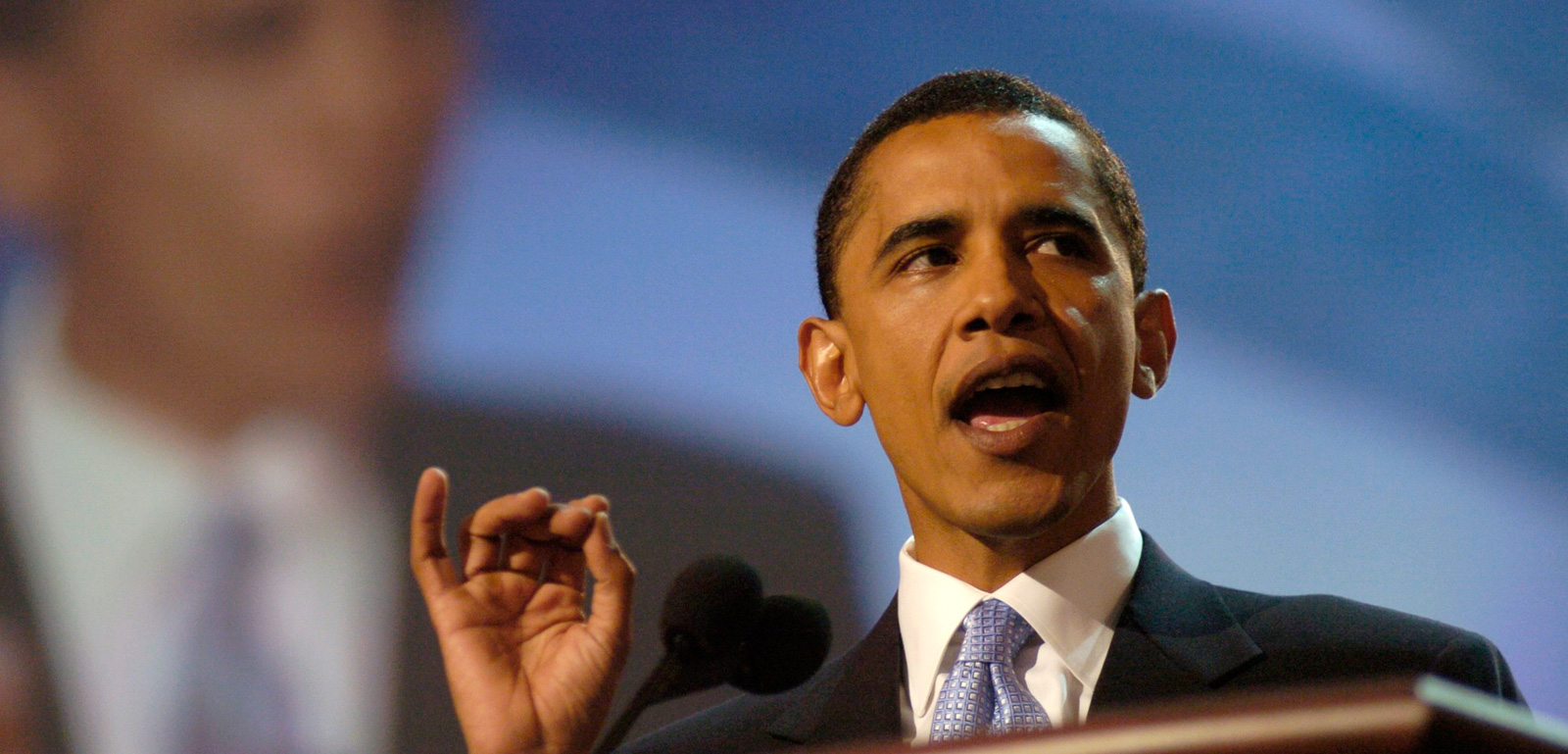
The keynote speech that Barack Obama delivered on Tuesday, July 27, 2004, galvanized the delegates who packed Boston’s FleetCenter and electrified a nationwide television audience. The 2,297 words uttered over 17 minutes changed Obama’s profile overnight and made him a household name. Before the speech, the idea of Obama running for president in 2008 would have been laughable; he was a lowly state senator from Chicago’s Hyde Park, and while he stood a good chance at winning his U.S. Senate race, he would enter that powerful body ranked 99th out of 100 in seniority. After the speech, observers from across the political world hailed the address as an instant classic, and Obama was drawing comparisons (deservedly or not) to Martin Luther King Jr. and John F. Kennedy.
None of this happened by chance. Obama’s selection as keynote speaker was carefully plotted by all sides for maximum effect, and the speech itself was no outpouring of inspiration scribbled on the back of an envelope. Obama labored over it for weeks, harvesting lines that he had already tested on Illinois crowds. He is said to have been furious when one of his best remarks was cut by Kerry’s speechwriters. And even after all the preparation, the editing and vetting by aides to Obama and Kerry, and the three run-throughs at the convention, the speech almost didn’t take flight-on the dais, Obama was slow to hit his stride. But once he got going, the speech-and his career-took off: “Without that Boston speech, there’s a question whether Barack would be running [for president] today,” says his fellow senator from Illinois, Dick Durbin. “His public image changed because of that speech.” Valerie Jarrett, a veteran Chicago politico and one of Obama’s longtime friends, puts it more succinctly: “It changed his life.”
Though getting picked to give a major speech at a national political convention offers up-and-coming politicians a glorious launching pad, it’s an opportunity with a mixed history of payoffs. Franklin D. Roosevelt enhanced his ambitions with his rousing speeches nominating Alfred E. Smith in 1924 and 1928. In 1948, Hubert Humphrey stepped into the national spotlight with an impassioned platform speech on civil rights. More recently U.S. Rep. Barbara Jordan, the first black woman to deliver a keynote address, wowed the nation in 1976 with a stirring speech that many historians say is one of the best in convention history.
But a rousing speech is not a ticket to later electoral success. New York Gov. Mario Cuomo’s presidential aspirations flopped, despite his widely praised 1984 stem-winder “A Tale of Two Cities.” In 2000, four years before Obama’s speech, another promising African American Democrat, Rep. Harold Ford of Tennessee, gave a well-received keynote. He lost his race for the Senate last November. And, of course, even a convention speech that bombs doesn’t necessarily throw a candidate off track. Bill Clinton’s rambling, 32-minute introduction of Gov. Michael Dukakis in 1988 earned its loudest applause when he uttered “in conclusion.”
All of the above examples involve Democrats, and, for whatever reasons, Democrats over the years seem more likely to have delivered memorable (both good and bad) convention speeches. Indeed, when 137 leading communications scholars were asked in 1999 to name the top 100 speeches of the past century, their list included 13 convention speeches, 11 of which were delivered at Democratic conventions.
Obama’s people were no doubt pleased when Kerry invited their man to give the keynote, but the honor comes with the sort of baggage familiar to the Cubs: no Democratic keynoter of the past century has made it all the way to the presidency.
Talking to reporters on the first morning of the convention, New Mexico’s Gov. Bill Richardson, the convention’s chairman, tried to promote the lineup of prime-time speakers. He ticked off the names of those scheduled for the first night-political heavyweights who included Al Gore, Jimmy Carter, and Bill Clinton. “You’ll see exciting speeches the second day,” he continued. Then, drawing a blank, he hollered to a nearby aide, “Who are they?”
One was Obama, who was little known outside Illinois before the convention. As the Philadelphia Daily News headlined on the morning of his keynote address: “Who the Heck Is This Guy?” Obama admitted in interviews at the time that he was “totally surprised” by the speaking invitation. (Through his spokesman, he declined to be interviewed for this story.) As he put it in his book The Audacity of Hope: “The process by which I was selected as the keynote speaker remains something of a mystery to me.”
A closer look, however, reveals less mystery and more politics.
On March 3, 2004, the day after John Kerry effectively locked up the presidential nomination with victories in nine of the ten Super Tuesday states, he began putting his imprint on the July convention in Boston by tapping veteran Massachusetts political operative Jack Corrigan to run the four-day event. By early summer, Corrigan and a group of about a dozen convention organizers that included Kerry’s media adviser, Robert Shrum, had started discussing the potential roster of speakers. In a series of meetings and conference calls over several weeks, the names of various keynote contenders were tossed about. Today, the convention planners say they were looking for an attention-getting lead-in to the night’s main attraction, Kerry’s wife, Teresa Heinz Kerry. “There was a huge, long list that spanned all across the party,” recalls Mary Beth Cahill. “Everybody had their favorite.” The roster, insiders say, was soon narrowed down to a short list that mainly included Democratic governors from key battleground states that were likely to decide the presidential race: Jennifer Granholm of Michigan; Janet Napolitano of Arizona; Tom Vilsack of Iowa; Mark Warner of Virginia; and Bill Richardson of New Mexico.
Obama made the cut, though some planners worried about his thin political résumé and, to a lesser extent, the fact that he and Kerry were somewhat at odds over the war in Iraq. (In 2002, Kerry voted to authorize military action against Iraq; Obama opposed the war from the get-go.) Obama detractors felt that he should get a prominent speaking role but not the keynote, according to interviews with knowledgeable insiders.
Kerry and his aides first began to zero in on Obama after Kerry’s two-day campaign swing through Illinois in April. Stumping together at a vocational center on Chicago’s West Side and at a downtown fundraiser at the Hyatt Regency Chicago, Kerry came away impressed with the charismatic political hot shot. Watching Obama address the donors who filled the hotel’s ballroom, Kerry’s national finance chairman, the Chicago investment banker Louis Susman, told Kerry: “This guy will be on the national ticket someday.” To which Kerry replied, according to an account in the Chicago Tribune: “Well, I have a way in mind for him to be at the national convention this year. He should be one of the faces of our party now, not years from now.”
Corrigan says he had already heard good things about Obama, including from a friend who had been a law-school classmate of Obama’s and recalled the stirring speech that Obama made when he was elected editor of the Harvard Law Review. Meanwhile, several of Obama’s top advisers were also making the case for him. Darrel Thompson, Obama’s campaign chief of staff, says he met with Kerry’s two deputy campaign managers to press for the keynote slot for Obama, or, short of that, for a prime-time spot, when the TV networks would be airing the speeches live. David Axelrod and David Plouffe, an Axelrod partner who now manages Obama’s presidential campaign, also lobbied Kerry staffers. “We wanted to let them know that Barack would give a great speech,” says Thompson.
Insiders say the list was narrowed by mid-June to two finalists: Obama and Jennifer Granholm, the attractive young governor of Michigan. Sitting around the conference room at Kerry’s campaign headquarters in downtown Washington one afternoon, Cahill finally chose Obama. “I was pretty convinced he was going to be the best,” says Cahill. And Kerry? “He was fine with it.”
It’s difficult to know what role Obama’s race played in getting the keynote slot (Granholm is white). Corrigan and other former Kerry officials say that Obama’s African American background was one of several attributes that made him appealing, along with his eloquence, his youth, and his optimistic message. Still, at the time of the announcement, black leaders were criticizing Kerry for not doing enough to reach out to African American voters, whose support would be crucial to winning the presidency.
Senate politics played a role, too. With Democrats needing to pick up just two seats to gain control of the Senate, Obama’s campaign was crucial because a Republican-held seat, Peter Fitzgerald’s, was up for grabs. On June 25th, Obama’s Republican opponent, Jack Ryan, dropped out of the race, and state and national GOP leaders floated big-time names as a replacement, from former governor Jim Edgar to ex-Bears coach Mike Ditka. The Democrats hoped that giving Obama the high-profile speaking slot would scare away potentially tough Republican challengers. “We really wanted to get Fitzgerald’s seat back,” says Cahill. (In the end, the best the GOP could come up with was the fiery right-wing radio host from Maryland Alan Keyes, whose candidacy was announced about one week after Obama’s convention speech. Obama won the election easily with 70 percent of the vote.)
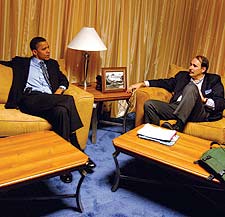
Obama received the good news from Cahill just before the start of the July 4th weekend, more than a week before Kerry’s campaign publicly announced him as the keynoter. In The Audacity of Hope, Obama recalls being in a car heading from Springfield to Chicago for a campaign event when Cahill called him on his cell phone. After he hung up, he turned to his driver and said, “This is pretty big.”
Soon after, Axelrod discussed the speech with Obama: “Almost immediately he said to me, ‘I know what I want to do-I want to talk about my story as part of the American story.’ He had a very clear concept in his head,” Axelrod recalls.
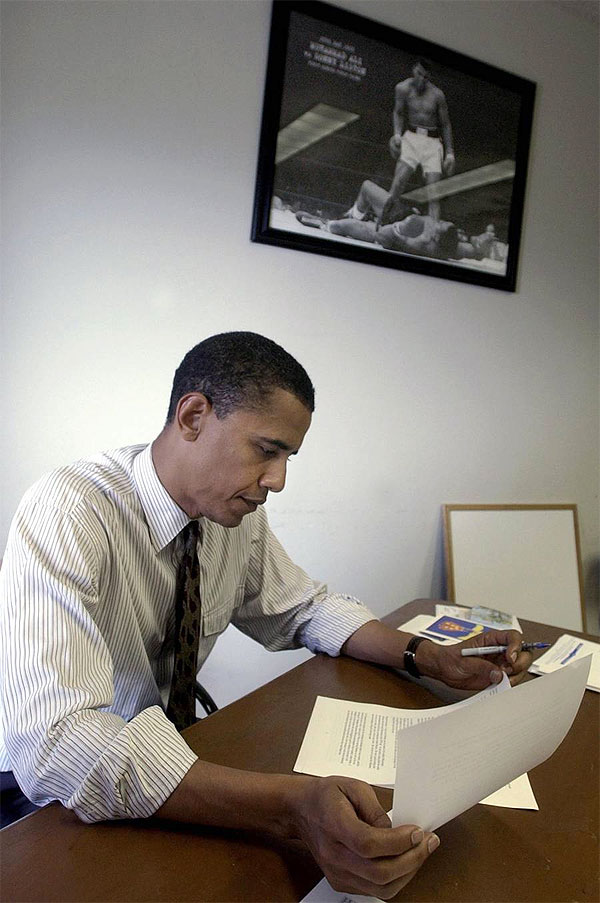
Obama composed the first draft in longhand on a yellow legal pad, mostly in Springfield, where the state senate was in overtime over a budget impasse. Wary of missing important votes, Obama stayed close to the Capitol, which wasn’t exactly conducive to writing. “There were times that he would go into the men’s room at the Capitol because he wanted some quiet,” says Axelrod. Once, state senator Jeff Schoenberg walked into the men’s lounge and found Obama sitting on a stool along the marble countertop near the sinks, reworking the speech. “It was a classic Life magazine moment,” says Schoenberg, who snapped a picture of Obama with his cell-phone camera.
Obama scribbled down ideas on scraps of paper whenever inspiration struck. He also read transcripts and watched reels of film highlighting past keynote speeches that Gibbs, his communications director, had put together for him. David Katz, a former Obama campaign aide, says Obama spent a couple of weeks working late at night a few hours at a time. “We’d finish [the senate day] at 9 or 10 p.m., and he’d write till 1 or 2 in the morning,” recalls Katz. Axelrod says Obama “does a lot of composing in his head, so by the time he sits down to write, it’s a matter of transcribing his thoughts to the written page.”
In fact, not only had Obama thought out a lot of the speech in advance; he had been road-testing much of it for months on the campaign trail. In that sense, it became a greatest hits collection of rhetoric drawn from his stump speeches. “It was, basically, a variation of his canned speech,” says Dan Shomon, the political director of Obama’s 2004 Senate campaign.
In The Audacity of Hope, Obama recalled working on the speech in his hotel room, jotting down notes for a rough draft while watching a basketball game on television. The eureka moment, he wrote, came while he was thinking about some of the real-life stories that he had heard on the campaign trail, and he remembered a phrase that his pastor, Rev. Jeremiah A. Wright Jr., had once used in a sermon: “the audacity of hope.” That linchpin phrase, he decided, summed up exactly what he wanted to say. He turned off the TV and started to write.
Axelrod was vacationing in Italy when a faxed copy of Obama’s first draft arrived. “I remember being in the hotel room,” he says, “and I’m reading one page, then the next page, then handing them to my wife, and I quickly realized: This is an incredible speech-this is really literature.”
While his aides knew that the speech was exceptionally good, they also knew that, at roughly 25 minutes, it was way too long. Convention officials had initially told Obama and his staff that he would have just eight minutes. “We can’t do a keynote in eight minutes,” Axelrod told them. The Obama team were told to try their best to shorten it, or convention speechwriters would do it themselves.
For the next two weeks or so, Gibbs says, Obama and a small circle of aides spent many of their waking hours going over the speech line by line, trying to find paragraphs, passages, or even just words that could be cut. John Kupper, a principal at Axelrod’s consulting firm who helped edit the speech, says Obama was gracious but not always receptive to their edits. “I would take things out of the speech and send it back to Barack,” he says. “Invariably, the speech would come back with most of my cuts restored.” Adds Gibbs, “There were some sacrosanct lines where he was like, ‘Look, I’m not cutting that; OK, so we can get 30 seconds by taking out that paragraph, but the speech doesn’t work without that paragraph.'” In the end, though, there was no way of getting around cuts.
What wound up on the chopping block? Obama’s campaign declined to release Obama’s original version of the speech, so the details are sketchy. Axelrod and others say that the cuts were minimal. By shortening some passages of Obama’s biography, lopping a few anecdotes, and tightening language throughout the speech, Obama and his aides shaved off roughly eight minutes. When all was said and done, says Kupper, “we threw ourselves at the mercy of the Kerry people and said, ‘We’ve got a 17-minute speech.’ And, frankly, after they saw it, I think they recognized what we recognized, that it was a very good speech, and they became less concerned about the length.”
Giving a speech at a political convention is a tightly controlled process, coming under the watchful eyes of convention organizers and a team of professional speechwriters who read, edit, and fact-check every speech-from the prime-time addresses to the three-minute homilies in the daytime when the hall is mostly empty. At the 2004 convention, Vicky Rideout, a former speechwriter for the 1984 Democratic vice presidential candidate, Geraldine Ferraro, oversaw the group of 15 or so speechwriters-mainly ex–Clinton White House writers and Capitol Hill pros. Working from a windowless FleetCenter room dubbed the Boiler Room, the wordsmiths and spinmeisters vetted around 200 speeches. They wrote some speeches entirely, and trimmed or tweaked others. Most of all, they made sure the speakers kept their speeches short, on message (meaning focused on Kerry and vice presidential candidate John Edwards), and positive-no personal attacks on Bush.
Around the first week of July, Rideout called Axelrod and Gibbs to discuss Obama’s speech and to offer her help. “They told me that [Obama] was going to work on some thoughts and we’d talk again in a week or so,” she recalls. “Then a couple weeks went by.” Rideout says she got a little nervous when Obama did not turn in the speech promptly. For the next several days, she says, she traded messages with Obama’s staff: “They kept telling me it was coming any second.” When it did not come a few days later, she followed up again. “I was like, ‘OK-I really want to see it now,'” she says. To her relief, Rideout says, Obama’s campaign turned in the speech around July 20th, a week before the convention. “I knew everything was going to be OK as soon as I saw it,” she says.
Still, says Rideout, the speech needed trimming and editing. “There was not a lot of Kerry stuff in the first draft,” she says. “We had to pump up the Kerry-Edwards stuff and downplay some of the Illinois stuff.”
In retrospect, says Axelrod, “the need to edit the speech actually helped it. The truth is, there was some excess in the speech that hurt the flow a little bit. There was a little more detail about his life than we had time to share. So, the process of editing was really a positive.”
Because the state budget impasse didn’t end until late on Saturday, Obama and his entourage arrived in Boston by chartered plane around 1:30 in the morning on Sunday, July 25th, the eve of the convention. By the time they reached the Back Bay Hilton, Gibbs recalls, Obama was still a little unsettled. “I had forgotten one of my toiletries and I went downstairs and I could see Barack walking around the lobby because he was sort of wound up and couldn’t sleep,” Gibbs recalls.
The convention had been weighing heavily on Obama’s mind, in part because of his bad experience at the Democratic convention four years earlier. In 2000, fresh from a failed bid for Congress, Obama was dispirited and nearly broke, and he was planning to skip the convention in Los Angeles. At the last minute, though, some friends persuaded him to catch a cheap flight. The rent-a-car facility at the Los Angeles airport, however, declined his American Express card-it was maxed out. When he finally got to the convention hall, he could not get a floor pass and had to watch on the TV screens around the Staples Center. He recalls the episode in The Audacity of Hope: “Given the distance between my previous role as a convention gate-crasher and my newfound role as convention keynoter, I had some cause to worry that my appearance in Boston might not go very well.”
In the weeks preceding the Boston convention, Jim Cauley, Obama’s campaign manager, says Obama would frequently call or e-mail late at night to discuss logistics, repeatedly reminding him: “Jim, we’ve got to nail this-no mistakes.” But the first crisis hit even before the team landed in Boston. His campaign had printed 5,000 cardboard placards for delegates to hold up on the convention floor during Obama’s speech-a great visual for television. But the U-Haul bringing them broke down in Ohio; the signs arrived only hours before the convention deadline.
Obama managed to grab a few winks of sleep his first night in Boston and then appeared on Meet the Press. The host, Tim Russert, questioned him about telling The Atlantic Monthly, “Sometimes Kerry just doesn’t have that oomph.” Obama had made the remark before being picked as the keynoter. With Russert, he downplayed the comments, and the gaffe didn’t make many new headlines. Still, it left the Obama team feeling uneasy.
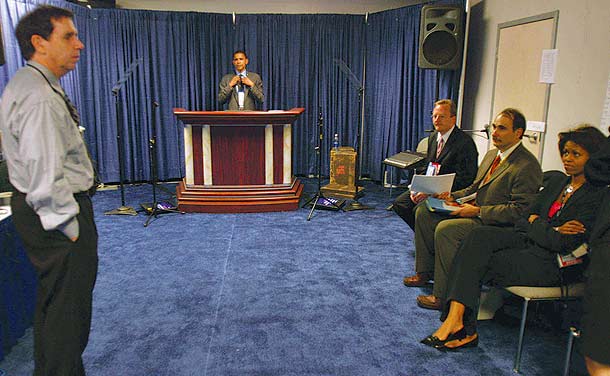
Adding to the tension in Boston was Obama’s rough start at rehearsals. Every convention speaker, even past presidents, is required to practice his speech at least once before delivering it. Obama had three rehearsals, one hour each, before Tuesday’s speech. Two rehearsal rooms were set up in the lower level of the FleetCenter, in the locker rooms for the Boston Bruins and the Celtics, made over with blue velvet curtains and a practice podium outfitted with a teleprompter. Obama, who prefers speaking extemporaneously, had no experience working with a teleprompter or addressing a group this loud and lively. Michael Sheehan, a Washington speech coach who advised Obama, says the prime-time convention speeches are “unexpectedly hard for several reasons: The noise is overwhelming, and on top of it, you’re speaking to three audiences at a time: the live audience; the big JumboTron in the convention hall; and to the TV cameras. It’s a juggling act.”
Obama struggled early on to master the mechanics of this new speaking environment. First, he had to train himself to read the words off the teleprompter screens without having it look or sound as if he were reading. He also had to adjust his speaking style. “There’s this impulse with these big, live speeches to orate as if you’re on a podium in the town square,” says Axelrod. “When you’re giving these speeches, you’re speaking not just to the crowd but primarily to a TV audience, and the microphone does all the work for you, so you don’t need to bellow.”
Next, Obama had to master a technique known in professional public-speaking circles as “surfing” or “riding” the applause. Sheehan explains how it works: “Because people at home don’t hear when there’s a big burst of applause-you hear it minimally in the background-speakers have to talk over the applause; otherwise there’s long gaps of silence. People are clapping but you can’t hear it at home-it’s like, sentence-pause-sentence-pause-sentence-pause. It’s just deadly.”
During one practice session, a Kerry speechwriter interrupted to say that Obama would need to rephrase or cut one of the lines from his speech because it was too similar to a line in Kerry’s acceptance remarks. The line in question was the climax to Obama’s famous passage on the red-states, blue-states divide. That passage, as Obama delivered it, reads: “The pundits like to slice and dice our country into red states and blue states-red states for Republicans, blue states for Democrats. But I’ve got news for them, too. We worship an awesome God in the blue states, and we don’t like federal agents poking around in our libraries in the red states. We coach Little League in the blue states and, yes, we’ve got some gay friends in the red states.” Axelrod says Obama had originally written the passage to end with something like, “We’re not red states and blue states; we’re all Americans, standing up together for the red, white, and blue.” But to satisfy Kerry’s speechwriters, Axelrod says, Obama grudgingly cut out the line. A transcript of Kerry’s competing text reads: “Maybe some just see us divided into those red states and blue states, but I see us as one America: red, white, and blue.”
After the rehearsal ended, Obama was furious. “That fucker is trying to steal a line from my speech,” he griped to Axelrod in the car on the way back to their hotel, according to another campaign aide who was there but asked to remain anonymous. Axelrod says he does not recollect exactly what Obama said to him. “He was unhappy about it, yeah,” he says, but adds that Obama soon cooled down. “Ultimately, his feeling was: They had given him this great opportunity; who was he to quibble over one line?”
Convention officials confirm that Obama was told to change his line, but they could not say for sure if Kerry-or, more likely, his speechwriters-had pilfered it. Still, several convention officials who spoke on condition of anonymity say pilfering happened elsewhere. Take the line “I’m John Kerry, and I’m reporting for duty,” the opening words of Kerry’s speech, which he delivered with a crisp military salute. That line, insiders say, was originally in a speech written by Max Cleland, the former senator from Georgia who had lost three limbs in Vietnam. After Kerry’s team read Cleland’s remark, they decided to appropriate it. “They stole that line,” says one official. “They said to Cleland: ‘Guess what: Kerry likes your closing line so much he wants to use it.'” The official added, “I don’t believe that was the case with Obama; I have to take them at their word that the line was already in Kerry’s speech.”
As unhappy as he was about losing the line from his speech, Obama had far bigger worries. At the final rehearsal on Monday afternoon, the day before his speech, he was still tripping over some of the text and not yet fully comfortable using the teleprompter. “We knew Barack could do a little more,” says Kevin Lampe, a Chicago-based Democratic consultant who helped with rehearsals. “He knew he could do a little more.”
Obama was buoyed, however, by the hordes of reporters and well-wishers who descended on him as he walked around the streets of Boston on Monday with his close friend Martin Nesbitt. “I said to Barack, ‘You know this is pretty unbelievable, man-you’re like a rock star,'” Nesbitt recalls. “He said, ‘Yeah, but it might be a little worse tomorrow.’ I said, ‘Really? Why do you say that?'” Nesbitt recalls that Obama then smiled and replied: “It’s a pretty good speech.”

On Tuesday, the day of his speech, Obama was up before 6 a.m. He gobbled down a vegetable omelet en route to the FleetCenter for back-to-back-to-back live interviews with the network morning shows. Next, he rushed off to speak at the Illinois delegation breakfast and then to a rally sponsored by the League of Conservation Voters. Afterwards, he returned to the arena for another hour of TV interviews. There was barely time for lunch, a turkey sandwich that he ate in the SUV while being interviewed by a group of reporters.
Gibbs recalls that by midafternoon, Obama’s voice was getting hoarse from overuse. In the middle of one taping, Gibbs had to search the FleetCenter for hot tea and lemons to help soothe Obama’s throat. “I can remember having this panic attack,” he says: “Oh, my God, what if he’s written this tremendous speech and everything’s great, except I’ve scheduled too many TV interviews and he loses his voice?”
Even when Obama used one of the portable toilets outside the FleetCenter, the media horde followed. “Can y’all just give me one moment to use the Port-O-Let?” he told the group, according to one newspaper account. After a final dry run of the speech, Obama returned to the hotel to get some rest. A couple of hours before he was scheduled to go on, Obama had a wardrobe problem. He had a handsome black suit, but his wife, Michelle, didn’t like his ties.
Gibbs was dressing in his hotel room, getting ready to put on a blue tie, when Axelrod knocked on his door. “Axelrod said, ‘That one’s good,’ and he took it,” says Gibbs. Michelle Obama approved of the new tie, but Gibbs says Obama grumbled until he got to the convention hall and one of the makeup stylists told him, “That’s a really nice tie.”
On the drive to the FleetCenter, Obama called his grandmother, Madelyn, in Hawaii and his two young daughters, Malia and Sasha, then six and three. Backstage, the Obamas watched the other convention speakers on the monitors in the greenroom. He was relaxed but pensive, “like an athlete getting ready for a big game,” as Axelrod puts it. Obama insisted that Michelle stay with him backstage until it was time for him to go onstage. “He gained some stability by having her there by his side,” Lampe says.
In The Audacity of Hope, Obama recalls the final moments right before his speech. Waiting behind the black curtain as Dick Durbin introduced him, Obama writes, his thoughts turned first to his family-his parents, his grandparents, and then to his friends and supporters back home in Illinois. “Lord, let me tell their stories right, I said to myself. Then I walked onto the stage.”
Shortly after 9 p.m., Barack Obama made his way to the podium-flashing his movie-star smile and waving to the thousands of cheering party faithful. A sea of blue-and-white signs emblazoned with “obama” sprang up across the hall. As the soulful sounds of the 1964 civil rights anthem “Keep On Pushing” by Curtis Mayfield & the Impressions filled the room, it was hard to miss Obama’s swagger, especially on the 90-by-17-foot video screen centered over the stage.
Senator Durbin greeted his future colleague at the dais. They slapped palms, shook hands, and exchanged professional hugs. Then Obama stood alone on the podium, mute for nearly 30 seconds, basking in his prime-time moment.
He opened the speech with a CliffsNotes version of his 1995 memoir Dreams from My Father, recounting his multicultural upbringing, a story that moves from Kenya to Kansas to Hawaii. By then, he had related it probably thousands of times before, and it came across as earnest but slightly lackluster. His hand gestures were stiff and methodical, like a news anchor’s; his delivery, a bit tentative. Valerie Jarrett recalls the nervousness in the room as she sat in a skybox, watching the speech with about two dozen of Obama’s other closest friends and supporters: “I was digging my nails into my hands when he started.”
Then something clicked inside Obama’s head. He found his pitch and cadence. He projected effortlessly. His gestures became more theatrical, yet still natural. As Rideout watched from the side of the stage, she noticed the striking change. “I saw this moment where, like, something happened to him physically,” she says. “His shoulders settled down, and this wave of support from the crowd looked like it literally washed over him. You could just see him gain this confidence and go with the moment. That’s when the speech took on a life of its own.” Dan Shomon also noticed the difference: “I think he just said, ‘I’m not hitting on all cylinders-I’m just going to go for it.’ Then he just took it up a notch, and I was like, ‘Wow.’ He just went on fire.” The cheers and ovations erupted. Before he was finished, he would have been interrupted by applause 33 times.
After talking about his background, Obama focused on the concerns of everyday Americans: the Maytag plant workers in downstate Galesburg, whose jobs were going overseas; the woman from East St. Louis who couldn’t afford college; the idealistic young marine from East Moline who went off to fight in Iraq. “If there’s a child on the South Side of Chicago who can’t read, that matters to me, even if it’s not my child,” he declared to huge applause. “If there is a senior citizen somewhere who can’t pay for their prescription drugs, and having to choose between medicine and the rent, that makes my life poorer, even if it’s not my grandparent. If there’s an Arab American family being rounded up without benefit of an attorney or due process, that threatens my civil liberties.”
The crowd was rapt; some even wept. “It was like he had 10,000 sets of eyes,” says Jarrett, “like he was looking into everyone’s eyes and talking one-on-one with everyone in the room.”
The momentum built when Obama proclaimed: “Tonight, there is not a liberal America and a conservative America; there is the United States of America. There is not a black America and a white America and Latino America and Asian America; there’s the United States of America.” Then the speech climaxed with the edited red-state, blue-state assertion. Even Obama was caught up in the moment. “I remember standing behind him and watching his feet move,” recalls Stephanie Cutter, Kerry’s former campaign press secretary. “It was like he was dancing at the podium. His feet were moving to the rhythm of the speech.”
When it was over, Obama strode away from the dais and embraced his beaming, if visibly relieved, wife. The Obamas left the stage together, serenaded by the strains of “Keep On Pushing.”

On a sunny but bitterly cold morning on the second Saturday in February of this year, Obama stood in front of the Old State Capitol in Springfield, where Abraham Lincoln rose to prominence, to officially launch his campaign for president. A crowd of more than 15,000 shivering supporters were on hand to hear Obama’s 21-minute address-a speech that Obama had finished and sent to Axelrod at 4 a.m. only two nights before. Wrapped in a black wool overcoat, his breath visible in the freezing air, Obama delivered a Lincolnesque speech that, though very good, did not garner the same accolades as his keynote address. “I think whenever you make one of those speeches, in certain ways you are always going to be measured against that speech,” explains Axelrod. “That’s just one of the burdens you have to live with. Not every symphony Beethoven wrote was the Ninth.”
So, what made Obama’s speech at the Democratic convention so good?
“I knew he was eloquent,” says Laurence Tribe, the renowned Harvard Law School professor who once hired Obama as his research assistant. “I knew he had passionate beliefs. But I had no idea that he was a magician, rhetorically.”
Obama did deliver a riveting speech at the convention. But there was no magic to it. Interviews with linguists and historians make it clear that Obama combined, simply and masterfully, the tried-and-true rhetorical techniques of effective speechmaking with an instinct for making a political message sing.
While his speech was original in terms of its content and phrasing, he dipped into the same rhetorical well as other great orators who preceded him. Thematically, he borrowed heavily from the likes of Martin Luther King Jr. and John F. Kennedy and, more recently, Ronald Reagan, using similar aspirational and optimistic language, flag-waving themes, and rich imagery and references to dreams, particularly the American dream. “Barack Obama talks about ‘the promise of America’ and America standing as ‘a beacon of opportunity,'” says Scott Deatherage, a professor of political communication at Northwestern University. “That’s reminiscent of Reagan, who talked about America as ‘a shining city on a hill.’ Both express a great reverence for the land of opportunity.”
Though his speech bore similarities to those given by great orators who preceded him, the experts I interviewed pointed out how Obama made it his own through his deft use of language. He relied on casual, comfortable words, not lofty rhetoric. He often used the first-person plural, which makes an audience feel like confidants: “We have more work to do . . .”; “We can make sure that every child in America has a decent shot at life . . .”; “We are one people, all of us pledging allegiance to the stars and stripes. . . .”
He also employed traditional rhetorical techniques, such as metaphor, imagery, anecdote, contrast, and “claptrap,” or language designed to catch applause. “On the language front, he uses all these techniques that you’d find in any great speech-some of the most powerful rhetorical techniques known to man,” says Max Atkinson, a leading public-speaking coach and author of Lend Me Your Ears (Oxford University Press, 2005).
One common device that Obama used was what linguistics experts refer to as “contrasting pairs,” constructions of “not A but B,” or “not A or B, but C.” Examples abound in the spoken-word pantheon. Take Shakespeare’s “To be, or not to be,” or John F. Kennedy’s “Ask not what your country can do for you; ask what you can do for your country.” Obama used this device at least five times in his speech, by Atkinson’s count. One example: “Tonight, we gather to affirm the greatness of our nation-not because of the height of our skyscrapers [not A], or the power of our military [or B], or the size of our economy [or C]; our pride is based on a very simple premise . . . ,” Obama concluded, going on to quote the “all men are created equal” passage of the Declaration of Independence (but D).
Another classic rhetorical tool that Obama drew on was the “rule of three”-packaging words or phrases in lists of three. It’s a device that dates back centuries-“Veni, vidi, vici,” as Julius Caesar said. Similarly, Obama began his convention speech, “On behalf of the great state of Illinois [1], crossroads of a nation [2], Land of Lincoln [3]. . . .”
Repetition has long been a favorite tool of the orator, and Obama used the device effectively: “It’s the hope of slaves sitting around a fire singing freedom songs,” he declared. “The hope of immigrants setting out for distant shores. The hope of a young naval lieutenant bravely patrolling the Mekong Delta. The hope of a millworker’s son who dares to defy the odds. The hope of a skinny kid with a funny name who believes that America has a place for him, too.”
Another time-honored rhetorical technique Obama used was the “puzzle/solution,” says Atkinson. Here the speaker presents a problem to his audience and then solves it. At the end of Obama’s speech, after he rattled off a litany of problems-the economic squeeze on the middle class, joblessness, homelessness, and urban violence-Obama offered up his solution: “America! Tonight, if you feel the same energy that I do, if you feel the same urgency that I do, if you feel the same passion that I do, if you feel the same hopefulness that I do . . . then I have no doubt that all across the country, from Florida to Oregon, from Washington to Maine, the people will rise up in November, and John Kerry will be sworn in as president, and John Edwards will be sworn in as vice president, and this country will reclaim its promise, and out of this long political darkness a brighter day will come.” (The astute reader will note that this passage also makes use of repetition, the rule of three, and metaphor.)
Says Atkinson: “I don’t have any simple reason why things like saying things in threes or contrasting things actually have the effect that they have-they just do.”
But what about the old maxim: It’s not what you say; it’s how you say it?
Here, too, Atkinson, Sheehan, and others agree, Obama’s performance at the convention, after his nervous start, stands out as nearly flawless. His pitch was husky and baritone, not squeaky or shrill. He spoke naturally, not as if he were reading from a teleprompter, and he avoided clumsy pauses and verbal tics such as “uh” and “ah.” And his pacing was measured and rhythmic, building to a rousing climax. “The speech is like a movement of a symphony,” says Sheehan. “He was smart enough to recognize that.”
Obama also surfed the applause masterfully. In several instances, Atkinson notes, Obama repeated the first few words of a sentence or raised his voice to make himself heard over the cheering, in effect rebuffing the applause. “If you carry on speaking after the audience starts applauding, it implies that you weren’t asking for applause,” says Atkinson. “You’re implicitly saying that getting across my message is more important than standing around savoring the plaudits. It creates a favorable impression that, somehow, the speaker is more passionate and committed than your average speaker.”
Although Obama didn’t develop his style of speaking from a church pulpit, at times during the convention speech he resembled a preacher, speeding up and slowing down his pace, raising and lowering his voice, and subtly changing his inflection. At one point, he even threw in a sermonlike rhetorical question: “Do we participate in a politics of cynicism, or do we participate in a politics of hope?” he asked the audience. They roared back: “Hope!”
Obama comes out of a mixed tradition, and he is known to adjust his speaking style when addressing black audiences and white audiences. But he doesn’t try to be somebody he’s not: a progeny of the civil rights movement and Baptist church traditions. “He would not come across as authentic if he tried to be Dr. King,” says Garry Wills, the Pulitzer Prize–winning author, who has studied the speeches and writings of Lincoln and Jefferson, among others. “He can’t talk the talk.”
If anything stands out as negative in Obama’s convention-night delivery, says Atkinson, it’s that his few stabs at humor fell flat. At one point, toward the beginning of his speech, he said: “The true genius of America” is “. . . a faith . . . that we can participate in the political process without fear of retribution; and that our votes will be counted.” He paused and then quipped, “At least most of the time”-a reference to the 2000 election debacle in Florida that cost Al Gore the presidency. The line got tepid applause. Atkinson says it would have worked much better had Obama not mixed seriousness with humor so quickly in succession.
Failed jokes aside, not everyone is enamored of Obama, the writer-orator, even when he’s at his best. The conservative commentator Ann Coulter, for one, recently wrote in her column for the weekly magazine Human Events: “Only white guilt could explain the insanely hyperbolic descriptions of Obama’s ‘eloquence.’ His speeches are a run-on string of embarrassing, sophomoric Hallmark bromides.”
Ted McClelland, who covered Obama’s failed 2000 congressional bid for the Chicago Reader, recalls that back then Obama “was not real comfortable or confident as a stump speaker.” McClelland found him wonkish and aloof. “He was stiff and monotonous, and he spoke like a poli-sci professor-a pedantic lecturer who used lots of deadly boring, neutron bomb language.” Even some lines that are now crowd favorites bombed back then, he says. He recalls hearing Obama one afternoon at a South Side church use the line about how people would mispronounce his name, calling him “Alabama” and “Yo’ mama.” Nobody laughed.
McClelland suspects that Obama’s style improved dramatically because of his humiliating loss to U.S. Rep. Bobby Rush (D-1st) in that 2000 campaign. After that race, McClelland says, Obama loosened up and found a genuine sense of purpose. “I think he finally has a message,” he says of the new-and-improved Obama. “He finally stood for something more than his own ambition. When he first ran [for Congress] I saw him more as a résumé in search of an office. And he has also learned to at least appear self-deprecating.”
Will Obama’s convention speech survive the scrutiny of time? “It will if [Obama] succeeds,” says Wills, referring to winning the presidency. “That will give it historical importance.” Deatherage says: “I would definitely say it’s one of the best convention speeches. I’m not ready to go so far as to add it to the greatest speeches in political history-that’s probably a bit of a stretch. But to say that this ranks up there with the best convention speeches in history is not a trivial thing.”
Obama knew immediately that the speech had struck a chord. And at the afterparty feting Obama at a wine bar in Boston’s Downtown Crossing district, a crush of well-wishers practically engulfed him. The next day, when Obama showed up at the FleetCenter, it was more of the same. “I remember walking behind him-it was almost like the wave at a football game,” says Gibbs, referring to all of the rubbernecking as Obama walked around the convention hall. “I think you have to understand,” says Axelrod: “when we began the [Senate] race-he and I-we couldn’t draw a crowd. There was nothing that could prepare you for what would follow that speech in Boston.”
The day after Obama returned home from the Boston convention, he embarked on a five-day, 1,600-mile barnstorming tour of Illinois. “This was the first time that we dealt with crowds that were not 100 or 200 but were 500 or 700,” recalls Gibbs. Heading to a rally for Obama in DeKalb-the heart of Dennis Hastert country, unfriendly territory to Democrats (Hastert was then U.S. House Speaker)-Gibbs remembers thinking, “OK, today is the day we go back to having 100 or 200 people.” Instead, more than 1,000 people showed up. “We drive up and the place goes nuts.”
For Durbin, who joined Obama on much of the tour, that DeKalb rally confirmed what he had already suspected: that Obama was not merely some one-hit wonder who gave a nice speech in front of a friendly audience. “I’m thinking, What’s going on here?” recalls Durbin (now Senate majority whip). “Something’s happened-this is no longer about Barack Obama running for the Senate; this is something bigger.”