

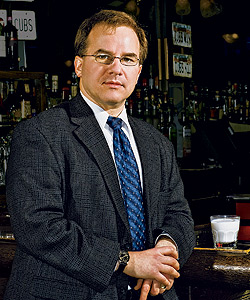
At a small Japanese restaurant in River north, Neil Steinberg, 47, settles into a back booth. Shooting his cuffs—his shirt is impeccably starched, his suit a ringer for one from Savile Row—he peers through his glasses and studies the menu. He knows Japanese food, thanks in part to visiting his older brother, Sam, who lived in Tokyo for several years, and he loves it. So he decides: For lunch, he will have the combination box of sushi. And to drink: He orders hot tea.
He understands that everyone will want to know what he is drinking. "I am, after all, the most famous drunk in Chicago now," he says.
For years, Steinberg has been known as a Chicago Sun-Times columnist, the writer of a splashy full page he has produced since 1996. He now writes four times a week. His column photo shows a slightly bemused man with an ironic glint in his eyes. In person, Steinberg is less bemused than intense, a fast talker consumed with whatever subject he is discussing. Emotions do not lie deep beneath his surface; rather, they roil through his conversation, spilling out in unexpected and at times unsettling ways. A listener sometimes just wants to jump out of the line of fire. In his column, Steinberg often writes about ordinary people (a girl and her bat mitzvah) and the thrills of the mundane (he got free sponges at the housewares trade show). And he sometimes adds a heavy dose of his own opinions on politics (in print he wondered how sick Cook County Board president John Stroger, a stroke victim, really was). Recently, on the anniversary of the war in Iraq, Steinberg apologized for his early support. But he also writes in the column about his own life: his smart, sassy wife, Edie; his two young sons, Ross and Kent; his ramshackle 1905 house in a "leafy suburban paradise."
His claim to being the city's most famous drunk stems from an incident in September 2005. It all happened so quickly, and yet it had been building to that moment for a long time. Late at night, Steinberg was arrested on a domestic-battery charge for striking his wife—for slapping her because she said she was afraid of him and she started to call 911. He was also charged with interfering with the reporting of a domestic battery—that happened when he ripped his kitchen phone off the wall and hurled it across the room. Steinberg was immediately placed on leave from his job. He announced through the Sun-Times that he had been drinking before the domestic-battery incident, and that under court order, he would be entering an alcohol-recovery program.
"Everyone focuses on the slap—and that was the only time I ever hit my wife," Steinberg says. "But the big issue was really the drinking. I had been drinking." In less than 24 hours before the incident leading to his arrest, Steinberg had consumed a third of a bottle of Cognac in the early-morning hours, knocked back two vodka tonics and a beer before a 10 a.m. editorial meeting, taken a "long and boozy lunch" with a college friend, had several drinks before boarding his evening Metra train, where he consumed two glasses of wine in the bar car, and then slammed back a drink at a local pizzeria when he picked up the family dinner. He topped the evening off with a snifter of Cognac. Drinking, he admits, is the greatest love of his life.
"Drinking is my essential nature," says Steinberg. "That kind of drinking [before the incident] didn't happen all the time. For one or two days a week, I could go to work and come home and not have a drink at all. And at the time, I'd say to myself, See, I'm fine."
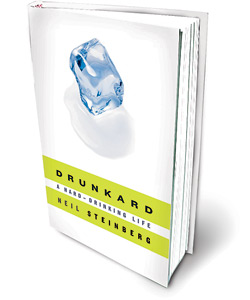
In his new book, Drunkard: A Hard-Drinking Life (due from E. P. Dutton on June 19th), Steinberg examines in unrelenting detail how he had been drinking—sometimes up to 40 ounces of hard liquor a day—for a long time. Somewhere along the line, it stopped being fun. The book starts the day before the domestic-battery incident and then takes the reader through Steinberg's 28-day rehab and his struggles to stay sober (under the threat of a divorce) in the first months afterward. His wife, Edie, is a pivotal yet aloof character in the account. She is a driving force in his quest for sobriety, yet she moves quietly around the edges of much of the book, reading her Al-Anon pamphlets and refusing to indulge her husband. Drunkard is, by turns, horrifying (Steinberg drinks the bottle of vanilla used for his kids' French toast), exasperating (he turns a speech in New York into a scene from The Lost Weekend), frightening (he leaves his young son Ross alone in the children's section of the Northbrook library so he can run out and buy a pint of bourbon), and funny (home from jail, he wishes he had spent half as much time thinking about his life as he had planning his kitchen renovation). The book is a compelling read, sad and wistful and breathtakingly forthright. Amazingly, it also has a lot of laughs.
"Well, all I have is a certain candor," Steinberg says, "and if I give that up, I'm lost." He may not be lost, but not that long ago he was on the brink of irretrievably losing some fundamental part of himself. By his own admission, he still struggles every day not to drink. And he struggles to find a new way of living—without losing his marriage, his work, and his sense of humor.
Steinberg's heroes have always been alcoholic writers. Robert Benchley, James Thurber, Ernest Hemingway, F. Scott Fitzgerald. "You have to get it done," Steinberg says. "And the words work. That's the kind of writer I am. I don't know if it's a blessing or a curse, but I'm a facile writer. I like to write. It's the only time my anxiety goes away."
"Anxiety" is the word Steinberg uses to describe his urge to drink or his feeling that he just doesn't fit in. In one way or another, there has always been some kind of anxiety. He grew up in a suburb of Cleveland, Ohio, where his father, Robert, was a physicist, and his mother, June, was a homemaker. "But all the other Jewish families lived on the other side of town, so I was always the only Jew in my classrooms. I'd have to stand up every year and do my Hanukkah speech. 'This is a dreidel, and this is a menorah.' I hated it." Before he went outside to play, he would arrange with his mother to call him back inside 20 minutes later so he could read. He liked words and their ability to bring order to things. They seemed friendlier than human beings. Even today, he says, "I don't know how to interact with people that well." Yet he was popular enough to be voted class president one year in high school. Attending Northwestern University, where he majored in journalism, he helped found a humor magazine and is still friendly today with several of those colleagues.
Over the decades, some family relations have, at times, become tremendously strained. In 1999, Steinberg tried to heal a lifelong rift with his father by sailing for a month and a half on a merchant-marine ship with him, sharing a small cabin from New York to Naples. He wrote about the voyage and their relationship in the book Don't Give Up the Ship. The trip did not go as Steinberg had hoped—the two failed to smooth over their many differences. In an article in this publication in May 2002, Steinberg's father was quoted as saying he had only "looked at the book."
"It was a flop because people want to read things like Tuesdays with Morrie," says Steinberg, "emotional treacle where everything works out in the end. And in my book, when we finally finished the trip, we were getting along worse than before." Steinberg has a sister, Debbie (as adults, they didn't speak for more than a decade), who lives in Plano, Texas, and a brother, Sam, who currently works in the Cook County treasurer's office. When Steinberg was released from jail, he temporarily moved into his brother's suburban basement.
He always believed that he would be a writer. The last job he had that didn't involve writing was when he worked in the kitchen at a Bob Evans restaurant in Berea, Ohio, when he was in high school. He was fired shortly after singing all the verses of "Ninety-nine Bottles of Beer on the Wall." After graduating from Northwestern, he briefly took a job in Los Angeles as a public-relations writer, then moved back to Chicago, where he freelanced and eventually took a job at the Barrington Courier-Review. Next he became an opinion-page editor at the Wheaton Daily Journal, but he was fired after writing a column that made fun of the publisher. He joined the Sun-Times in 1987.
By then he had been dating Edie Goldberg for about four years. They met when Steinberg wandered into an Evanston art gallery; she was working there part-time while attending Northeastern Illinois University. "I thought he was funny and interesting," she says, "so we went out to dinner." On their second date, though, Goldberg developed a migraine headache and went home early. "I think he felt I didn't like him, because I didn't hear from him for a year." When he finally got in touch, their relationship grew. Goldberg attended John Marshall Law School and worked as an attorney at Jenner & Block. But Steinberg resisted marriage until the end of a getaway weekend in Galena. "I was unloading this case of wine Edie had bought and I thought, Who is she going to drink this with?" he recalls. They married in 1990, and their first son, Ross, was born in 1995. (Their son Kent followed two years later.) Steinberg took an extended paternity leave, and Edie became a full-time mother.
In 1996, Nigel Wade, then the editor of the Sun-Times, persuaded Steinberg to come back to work by offering him a column that would run three days a week. Steinberg also secured a seat on the paper's editorial board, writing two to four unsigned editorials a week. (After his arrest, Steinberg was removed from the editorial board, but he was given a fourth weekly column.) At times, his column was humorous (the renovations to the Queen Anne house he bought in Northbrook), and sometimes it seemed deliberately provocative and even mean-spirited (the mocking of Native Americans for protesting certain images and team names). "He's rare in that the literary merit of what he writes is primary to him," says Robert Kurson, who worked at the Sun-Times with Steinberg for five years before moving to Chicago magazine and then going on to write books. "That is a hard thing to care about when you're working on a daily paper."
Steve Rhodes, a former Chicago senior editor and the founder of the blog The Beachwood Reporter, who has been a public critic of many of Steinberg's columns over the years, acknowledges that Steinberg is a talented writer. But, Rhodes adds, "I don't think the format of his column now—it's basically written like a blog—is suited to his strengths. And I think he has written some disastrously terrible columns about sports and politics over the years. But I've never had any personal animosity toward him. Neil has always shown a deep appreciation for newspapers and for newspaper culture."
Maybe that is part of the problem. From The Front Page to Network, journalists have always been cast—at least until these current politically correct days—as hardworking, hard-drinking characters. The University of Chicago sociologist Everett Hughes once wrote about "occupational mythology," the arrangements "by which men make their work tolerable, or even make it glorious to themselves and others." Traditionally in journalism, alcohol was part of the myth. "The journalist likes to think of himself as living close to the edge, whether he's covering real estate or Iraq," wrote Jack Shafer early this year in the "Press Box" column for the online magazine Slate. "If he drinks, he considers booze his muse. . . . Deny the journalist his self-image as a rule-bending individualist and you might as well replace him with a typist."
"I never had any problem getting my column done," says Steinberg. "Drinking never affected me." The only exception, he says, was the day of [Sun-Times veteran] Irv Kupcinet's funeral. "I remember going to Kup's funeral, and then a bunch of us went to Harry Caray's and got blasted. And then I wrote my column. When I picked up the paper the next day and read it, I had no memory whatsoever of having written it."

In the Sun-Times's new location in the Apparel Center, having been displaced from its old site by Trump Tower, Steinberg has a nifty office where he hangs his Burberry trench coat. The space is filled with natural light and books and photographs—Edie astride a horse, with her strawberry blond hair rolling down her back; his sons. Tucked back on the wall next to his desk, where only he can see it, is a sign he made: don't repeat rehab. While he has complained of being lonely and isolated at the paper, he is close friends with Michael Cooke, the vice president of editorial operations. The two of them play racquetball three times a week at the East Bank Club. (Out of 205 games, Cooke has won 109.)
"There is a depth to Neil, but also the common touch," Cooke says. "He can write about the state budget, and he can write about Madonna's navel, and you'll read every word. And he's such a character—one day there will be a musical about him."
But Steinberg admits that he tends to put people off. In Drunkard, Steinberg describes how some fellow writers asked him out to lunch when he returned to the paper after rehab. Their only caveat: They wanted to drink with their meal, even though he was on the wagon.

"I was friends with Mark Jacob for over a decade," says Steinberg. "But once I got arrested, he didn't want to talk to me any more."
"I wish Neil and his family all the best," says Jacob, a former Sunday Sun-Times editor and currently a foreign and national news editor for the Tribune. "That's all I have to say."
Over the years, Steinberg has had his share of critics, like Rhodes and Michael Miner, the press critic at the Chicago Reader—and he has dispensed his share of criticism. In the mid-nineties, under the byline Ed Gold, Steinberg wrote the sarcastic Reader column "Bob Watch," a skewering analysis of the former Tribune columnist Bob Greene. And he has traded public brickbats with the Tribune columnist Eric Zorn.
Other colleagues shy away from commenting for fear, as one says, "of getting on his bad side"—even if what they have to say is relatively benign. "Don't quote me, because it's impossible to tell how Neil will react to anything," says one journalist. "But I think he's a great writer, and he seems like a nice enough guy."
"At work, he's left some hard feelings in his wake," says another colleague, "and he can be prickly and insecure—but that takes nothing away from his writing. And he seems to be making an effort to be more normal now."
"The word around the paper is that this book could be the breakthrough book for Neil," says the journalist.
Steinberg certainly hopes so. Drunkard is his sixth book. "All the rest of them sank like stones," he says. That is not exactly true. He was invited on the Oprah Winfrey Show to promote Complete and Utter Failure: A Celebration of Also-Rans, Runners-Up, Never-Weres and Total Flops (Doubleday, 1994). Other books by him have garnered good reviews in The Washington Post and Playboy. But, in part, the subjects that have often attracted him—the history of men's hats; college pranks—were too esoteric to be mainstream hits. "I'm worried that this book will sink without a ripple," he says. "That would be the worst thing. But I don't want to turn my life into a big public spectacle."
Of course, if most people felt that way, they might not write a book exposing every gritty detail. But Steinberg hopes that people will read the book and get a better understanding of him. "This is what I do," he says. "I write. I started taking notes the day I got out of jail."
A judge ordered Steinberg to enter an outpatient program at the Chapman Center in the Highland Park Hospital. At night, he returned home to his family.
In some ways, Steinberg's notes were too good. When he turned in the manuscript, his editors cut 120 pages. "I fought, I screamed, I yelled, I withdrew the manuscript twice." In other words, it was business as usual for Steinberg. "It was very important to me to show the arduous and boring process of going through rehab. It's like 28 days of traffic school." Some of the rehab scenes are the funniest in the book, with Steinberg describing how he is always being told his blood pressure is sky high and how he shouldn't be scared but he could have a stroke or drop dead any minute with no warning. Also, the descriptions of creative relaxation exercises—bouncing balloons across the room or playing Pictionary—are vivid in their deadpan humor.
When Steinberg finally returns to his job, he quickly relapses. He falls into one binge after another; the descriptions of him scuttling around the northern suburbs, thinking up excuses to leave the house so he can buy pint bottles of alcohol (pint bottles so he can hide them in his coat pockets and sneak them into the house), are harrowing.
"Why would anyone want to stop?" he says. "Rehab showed me the reasons I needed to stop." He ticks them off now. "I didn't want to get divorced. I didn't want to lose my job. I didn't want to move into a Red Roof Inn so I could drink. I love my kids. And I love my wife, so I have to stay sober so I don't piss her off." When the book ends, Steinberg has been sober for a year, and he says he stayed that way for another six months. "Have I had relapses since then? Yes. I get into trouble not when I feel like I need a drink, but when I feel fine. That's what is dangerous for me. The anxiety comes and goes, but alcoholism is obsessional. It is on your mind all the time. That 'one day at a time' idea is a huge intellectual blessing."
He is referring to one of the famous slogans of Alcoholics Anonymous. And while Steinberg attended AA meetings during his rehab period and afterward, and writes about it in his book, he is not a big fan of the organization. "I never bonded with the fellowship and God parts of AA. I never go and make the coffee. I'm not big on the higher-power thing."
Still, life is going well for him—as well as he expects it can. "Edie's happy, and that's important to me. Even though I'm the city's most famous wife beater, I'm a pretty easygoing guy. I mean, I'd prefer she would go back to work so we would have more money to travel and to pay off our $50,000 kitchen remodeling job, but it's her decision." (Asked if she dreads the publication of Drunkard, Edie answers, "What happened doesn't define a life—mine or Neil's. You just keep going.")
"I think Edie gets the drinking thing now," says Steinberg. "She used to think it was something I was doing because I'm a jerk. Now she understands it's a compulsion. People say, 'Well, just don't drink.' But it's not that easy. I have learned the power of time. Wait an hour and the anxiety may pass.
"I'm open to being fine someday. I hope that happens. I hope they come up with a little pill or something. But if they don't—will I ever drink again? Probably. Given my history, the answer is probably yes. But not today."