

Student Profiles | Honor Roll: How the Elite Eight Make the Grade
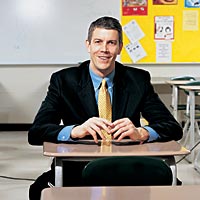 |
| "It is a myth to say that selective enrollment schools are funded more," says CPS chief Arne Duncan. |
Sharon Ford was "absolutely feeling the pressure" of trying to find a good public high school for her daughter, Kelly, a high-performing eighth grader at a magnet elementary school on Chicago's North Side. Not satisfied with their neighborhood school, the Ford family toured the top tier of the city's elite public schools: Northside College Preparatory High School, Walter Payton College Preparatory High School, Whitney Young Magnet High School, and up-and-comer Jones College Preparatory High School.
"The discouraging thing about this is that over and over we were told there are not enough slots for all the applicants," recalls Ford, who also has a son in fifth grade. "This means that hundreds, maybe even thousands, of qualified kids, many who have been in the Chicago public school system for nine years, are turned away simply because of lack of availability in the good schools.
"I see why people move out of the city," Ford says. "It's a very frustrating experience even with a good student coming from a good elementary school."
A decade ago, families like the Fords faced few good public high-school choices. But in the intervening years, the city has adopted a program-somewhat unusual among major U.S. cities-aimed at capturing the best students and keeping their families in town: the Chicago Public Schools (CPS) have created a handful of high-performance high schools that admit only select students, those who meet demanding standards. The tactic has worked, at least in some respects. These elite schools with their lofty admission standards now provide an A-plus education to more than 10,000 bright kids, who then go on to some of the best colleges in the country.
That's the good news. On the harsher side of the ledger, thousands of other good students get turned away. At Northside College Prep, for example, just under 5,600 students applied for the 225 seats in last fall's freshman class. (Students may apply to as many as four selective enrollment schools and must rank the schools in order of preference.) Overall last year, 10,755 students vied for the 2,565 places in the city's eight selective enrollment high schools, which means fewer than one in four got in. Beyond the disappointment for students who miss the cut, some skeptics of the program wonder whether it is appropriate to skim off the best students, thus depriving others in neighborhood schools of talented classmates who could lead, set examples, and productively rub shoulders with their less academically successful peers. Critics also question the choice of creating new schools for students who are already performing well, when so many Chicago students lag far behind.
"It's discouraging to see how much money was put into schools like Payton and Northside Prep when there are so many other high schools in the district that don't have science labs, or computers or swimming pools," says Julie Woestehoff, executive director of Parents United for Responsible Education (PURE), an advocacy group for parents in Chicago's public schools; Woestehoff's own kids graduated from Whitney Young.
There's no question, however, that the elite schools are making the grade. Average ACT scores for the graduating class of 2005 at seven of the schools was 23 out of a possible 36, compared with 17 for all CPS high schools. (Lindblom Math and Science Academy reopened last fall after a $40-million renovation with just a freshman class and was not included in the results.) Seventy-six percent of students who graduated in 2004 from selective enrollment high schools went on to college, compared with 43 percent of all CPS high-school graduates.
Last year, five of the six schools that graduated a senior class sent at least one graduate to an Ivy League school, and Northside College Prep sent at least one graduate to every Ivy. (A student at the sixth, Gwendolyn Brooks College Preparatory Academy, was accepted at Yale, but went to Stanford instead.)
"For the first time ever we're competing for the best students in the city," says CPS chief Arne Duncan. "To keep more families in the city, to keep them in CPS, is unprecedented. We were not even in the game before. Now we're at the table in a big way, and that raises the bar for everyone. Does it [the selective enrollment program] help keep middle-class families here? Absolutely. That's a piece of it. But there's a decent number of poor kids who desperately need good options, too."
On an ordinary February morning, things were anything but ordinary at Northside College Prep, housed in a $45-million glass-and-steel wonder on the Northwest Side. In freshman physics, small groups of students measured the velocity of a red toy car they had rigged to a track and hooked up to a computer. Down the hall in sophomore chemistry, teacher Barry Rodgers vacuum sealed a student up to her neck in a plastic trash bag to demonstrate the effects of changing atmospheric pressure. Juniors in British Literature were rehearsing scenes from Shakespeare's A Midsummer Night's Dream in the hallway. And in the world language wing, Spanish teacher Wanda Villodas was cleaning up from a Mexican fiesta. Her students had made pico de gallo, quesadillas, and guacamole. For homework, they would write the recipes in Spanish. Everyone knew the 100-minute period had ended when, instead of a bell, Motown tunes played through the sound system.
"Students who want to be told the right answer will be frustrated here until they discover the joy of learning for themselves," says Northside's Principal James Lalley.
Like Chicago's top private and suburban schools, the selective enrollment schools offer a high-powered curriculum of courses taught at the honors or advanced placement (AP) level. The demanding course loads are not surprising considering the caliber of the students admitted. To get in, they compete on a scale of 1,000 points. Seventy percent of the score is based on a student's academic performance in the seventh grade, what Sharon Ford calls the "pressure-cooker year." The breakdown includes: standardized achievement test scores in reading and math (300 points); grades in reading, math, science, and social studies (300 points); and attendance (100 points). In eighth grade, students take an entrance exam worth the final 300 points. At the elite schools, the average placement scores for the current freshman class ranged from 804 at Dr. Martin Luther King Jr. College Preparatory High School to a whopping 956 at Northside.
A decades-old federal desegregation mandate requires CPS to keep enrollment in balance with the race and ethnicity of the district's population. When the rank order of applicants does not produce an acceptable mix, schools select comparatively lower-scoring students from groups that are underrepresented. In practice, that means that some black and Hispanic students may get moved ahead of higher-scoring white students. "We want a balance between equity and excellence," says Jeff Gray, CPS program manager for the selective enrollment high schools program. "All of the kids are superstars."
Nonetheless, the schools mirror the city's housing patterns, at least to a degree. The South Side schools-King, Brooks, and Lindblom-are predominantly black, and, heading north, white students make up the largest group at Northside and Payton. But that's fine with Karen Lueschow, one of Lindblom's school counselors. "We want to keep the South Side students on the South Side," she says. "Why travel hours and hours when you can get the same opportunity right here?"
In a school district that is nearly half African American, CPS data (which does not include Lindblom) shows that in the current school year, 38 percent of selective enrollment students are black, a number down slightly from the previous year. Hispanics make up 38 percent of the district, but only 22 percent attend selective enrollment schools. Although CPS is just 8 percent white, 23 percent of selective enrollment students are white. And Asians, constituting just 3.2 percent of the district, account for 12 percent of selective enrollment students.
"While students don't have to absolutely reflect the demographics of the district, the percent of black students is starting to look better, while the percent of Hispanic students is starting to look a little skimpy," says Sue Sporte, senior research analyst at the Consortium on Chicago School Research at the University of Chicago. "I don't know exactly what the range should be, but the number of white students, while lower than I expected, probably is a little high. That Asian students are overrepresented compared to their population in the district mirrors the kind of distribution that is typically seen at highly selective schools nationwide, whether they are at the high-school or college level. This is not unique to Chicago."
The nearly two-year-old radio podcast produced by 40 Whitney Young students, called WY Stream, blends an eclectic mix of politics, culture, sports, music, and poetry. On a recent show, junior Jeremy Kiolbassa interviewed Michelle Obama, a 1981 Whitney Young graduate and wife of U.S. Senator Barack Obama. In another segment, a jazz trio of seniors played original music. More recently, Daniel Williams shared his favorite "senior moments" in his high-school career, while Kyshira Moffett discussed the fading appeal of the hippie skirt. The team will soon move into a state-of-the-art broadcast studio adjacent to the school's new computer lab.
"We're big enough to handle the different interests and tastes that students might want to share," says Assistant Principal Melvin Soto, who runs the technology lab and directs the broadcast.
Coffee House, a frequent after-school open mike session, offers another opportunity for creative expression. Acts typically range from poetry readings to electric guitar.
"It's a place for kids to be safe and enjoy each other's art," says Martha Murphy, a music teacher who directs the program. "We have some astonishing talent and they're very supportive of each other. Our students come from all over the city, so you've got to have a family."
But what is the impact of segregating a school district's brightest students? Some of the skepticism comes from surprising sources. "I don't want to be negative, because the quality of education is so terrific, but there's something lacking when all students are extremely bright," says Keith Foley, principal at Lane Tech (with more than 4,200 students, arguably the most economically and academically mixed of the selective enrollments). "It's an unrealistic view of what life is going to be like. It leaves a gap because you're not interacting with kids who are just average. Kids who are extremely bright should share it with others. In the classroom, it helps to raise the level of discussion. I've seen some kids who are really bright and are so focused on grades, they let life go by. They see the kids who have other skills and qualities beyond academics that they can learn from. It's definitely a two-way street."
Arthur Tarvardian, principal at Taft High School, a neighborhood school of 2,500 in Norwood Park, says that a selective system creates the impression that his and other local schools are second rate. "Years ago [Taft] had such an outstanding reputation," he says, adding that in recent years the school has "lost the trust of its neighbors" due to gang problems. "My objective is to bring them all back and make it a true neighborhood school. The kids who I believe belong to me were stolen by a thief in the night. We got the short end here."
Tarvardian also questions why a public school system would create separate schools for academically elite kids. Building, renovating, and supporting these schools, he says, "takes money out of my kids' pockets."
Arne Duncan denies that. "It is a myth to say that selective enrollment schools are funded more," he says. "The basic funding formula is identical."
Tavardian is unconvinced. "I really feel like [the neighborhood schools] are going to lose in the long run," he says. "This was done at the expense of the general high-school population."
While CPS has made a commitment to grow its selective enrollment system, other big cities seem content to live with what they have. New York, with by far the largest school district in the country, has seven exam-entrance schools. The best known, the Bronx High School of Science, was founded in 1938. Boston, although smaller than Chicago, has three. Los Angeles, the second-biggest district, has just one selective enrollment high school.
Sue Sporte, the University of Chicago education researcher, says studies have shown that concentrations of poverty or low motivation have a detrimental effect on schools. But it's less clear that there's an added benefit to congregating the smartest students together. "I don't know that people have looked hard enough at the flip side," she says.
Of course, a handful of top private high schools have long featured concentrations of bright kids. These days, according to CPS, approximately 14 percent to 18 percent of students attending selective enrollment high schools come from private or parochial elementary schools. Northside's Principal James Lalley estimates that approximately 30 percent of his students come from private schools. Previously, many of these families likely would have remained in private schools or fled to the suburbs.
Anne Frame, director of admissions for the private Latin School of Chicago, says that although more of their students are looking at the elite public schools, Latin lost only one eighth grader last year to the CPS program. "It's good for us to have stiff competition and it's exciting that there are more good schools to choose from," she says. "We need to be really clear about what the Latin experience is and what it means for our families. We need to make it easy for families to see what it's really like here."
The display of Chinese newspapers and magazines is the only indication that Walter Payton College Prep is pre-paring to become the Midwest leader in Chinese language and cultural education. Tucked into a corner on the first floor of the school is the future home of the Confucius Institute of Chicago, a partnership with the Chinese government similar to the well-established Alliance Française. Once the books from dozens of boxes are unpacked and shelved, the institute will support Payton's growing Chinese language curriculum and integrate the study of Chinese culture into such regular courses as literature and art. The institute eventually will offer community programming, such as tai chi classes, movies from China, and programs for parents who have adopted Chinese children.
"The business community in Chicago has said they need people who speak Chinese and understand Chinese culture," says Robert Davis, program coordinator. "Motorola, Boeing, United, McDonald's, and John Deere are all Illinois companies that have a major presence in China." While Chinese study is spreading across the country, fewer than one percent of students in the United States are studying the language, says Davis. "We're ahead of the game and we expect student interest to continue to grow."
Arne Duncan says that selective enrollments strengthen the district by keeping more families in public schools and adding new students to the school population. While he acknowledges that many kids pass up their neighborhood school to attend one with selective enrollment, he notes that "getting into a top high school can be a life-transforming opportunity for a high-performing low-income student who needs to remain in the public system."
Duncan believes the record of elite schools has created a sense of academic rigor that has spread throughout the district. His goal is to create more "schools of choice" in neighborhoods and to provide families with more strong options for high schools.
"We have opportunities in a lot of neighborhood schools to replicate what the selective enrollments are doing at a smaller level," he says. "In my monthly meetings with selective enrollment principals, I'm always asking, What can we learn and apply to neighborhood schools? How can we raise the bar for the entire system? The goal is to offer a great menu of high-quality offerings and let parents figure out which is the best choice for their kids, to let the demand drive the marketplace."
In an effort to beef up neighborhood schools, 15 high schools have added the international baccalaureate (IB) program, a rigorous, internationally recognized diploma program that some believe is tougher than a selective enrollment curriculum. The independent IB organization, headquartered in Switzerland, authorizes schools, trains teachers, and oversees student assessments to ensure consistency with international standards.
"For a long time, Lincoln Park High School had the only IB program [in Chicago]; now there are 15 schools with IB programs," says Lalley. "And for a long time there was only Whitney Young. These are very special, rigorous, challenging programs. Why should there be only one?"
Approximately 75 CPS high schools now offer nearly 500 AP classes, and the number of students taking AP classes jumped 61 percent in a five-year period beginning with the 2000-2001 school year. Four magnet high schools-Chicago High School for Agricultural Science, Clark Academic Prep High School, Curie Metropolitan High School, and Von Steuben Metropolitan Science Center-also serve up a rigorous curriculum, with a specific academic focus.
"I would love to give every student six to ten good high-school choices," says Duncan: "an IB program in their neighborhood school, a math and science academy, a military academy, vocational ed, a performing arts school."
All those ambitious plans cost money, and Illinois has a dismal record for funding education. In the 2002-2003 school year, Illinois was ranked 49th, ahead of only Nevada, in the percentage of public education dollars received from state sources, according to the U.S. Department of Education.
"Every school in Chicago, including the selective enrollment schools, is dramatically underfunded," says Duncan. "It's heartbreaking; it's my biggest battle. The way our state funds education [through property taxes], the children of the rich get more, the children of the poor get less. It's absolutely unequal, and resources have never been tighter."
In February, facing a $328-million deficit, Duncan announced $77 million in school cuts that were expected to slash spending in special education, magnet schools, and high-school programs. While cuts had not yet been finalized at press time, approximately 60 teaching positions used for special classes and extra programs were on the proposed chopping block at the eight selective enrollment high schools.
"We are pretty much at our limit for cutting administrative costs, so we now need to start looking at our core functions," says Jones Principal Donald Fraynd. "If I had to lay off two or three teachers, we would lose higher-level language classes or classes like calculus that are slightly underenrolled. But what's a selective enrollment school without calculus? The most frustrating part is that there is no sustainable solution. When are we not going to have this conversation?"
At Gwendolyn Brooks, Assistant Principal Robert Kobylski is concerned that renovation of the 40-acre South Side campus, which began in 1998 and has cost $34.5 million to date, will not be completed. Brooks still lacks an auditorium, a fine arts building, and a swimming pool, all part of the original construction plans. CPS estimates it will cost an additional $15 million to $20 million to complete the project. "These are all amenities that are found at our sister schools to the north," says Kobylski. "It's an ongoing frustration for us. We lose candidates to schools that do offer these programs. We are competitive in academics, but behind the times when it comes to our facility."
Despite the budget pinch, Jones College Prep, which was converted in 1998 from a two-year vocational school to a selective admissions high school at a cost of $25 million, is moving forward on its long-awaited expansion into the former Pacific Garden Mission building, in the South Loop. The $42-million project, which includes a library, fine arts wing, and gymnasium, is part of a tax increment financing (TIF) plan, which brings monies from the neighborhood's property taxes, not from the CPS operations or capital budget. The expansion is expected to be completed by the start of the 2010-2011 school year.
Last year, CPS announced plans to build the city's ninth selective enrollment school, this one on the West Side. The proposed $47-million facility will replace a vocational education institution, the Westinghouse Career Academy High School, with a new building that houses both vocational ed and selective enrollment programs. The school is slated to open in 2008.
"Facing a financial crisis, will these [selective enrollment] schools take an equitable share of the cuts that are coming or are they more or less protected from anything that might make them less attractive to the families who are already in?" asks Donald Moore, executive director of Designs for Change, an educational research and reform think tank based in Chicago. "If we were to put money in an excellent school, it should be a school like Little Village that has a lot of exciting programs but can serve a wide variety of kids."
The new Little Village Lawndale High School, which opened last fall at a record-breaking cost of $63 million, was the product of more than a decade of heated community activism and neighborhood fundraising. The city's Renaissance 2010 initiative, which aims to open 100 new small elementary and high schools by 2010, counts the Little Village school among its success stories even though it contributed no funding.
"There are physical inequalities and resource inequalities that plague the district. There are disparities that need to be addressed," says Sue Sporte. "But I think expanding AP offerings, adding more IB programs, and creating stronger neighborhood schools are attempts in the right direction. It speaks to a willingness not to just put all the resources in schools with high achievers."
While the process is anything but easy, Kelly Ford had good news waiting for her when she returned from a weekend church retreat earlier this year. She was accepted at all three of her selective enrollment choices and plans to attend either Whitney Young or Jones in the fall.
"We're thrilled with the way it worked out, and in retrospect, maybe we put too much pressure on ourselves and our kids, but I don't know that I'd do anything differently," says Sharon Ford. "Are we building it up to be more difficult than it really is? Since you don't know what the other factors are, I'd be nervous to let my guard down."
Photography by Anna Knott