

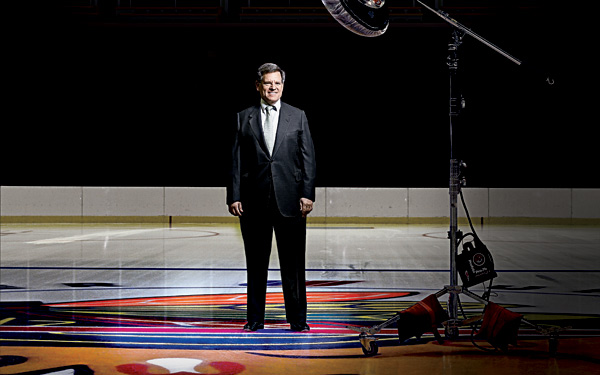
He knew it was coming, could feel it like the first cold prickle of dread-sweat. A night that was supposed to be about reverence and remembrance was about to become another instance of embarrassment—for him, his father, his family. He also knew that, despite his newfound status as the most powerful man in the building, there wasn't a damn thing he could do about it. Tonight was out of his hands. The only thing to do was get through it, endure it.
It was October 6, 2007, a Saturday night and the start of a new season for the Chicago Blackhawks. Eleven days earlier, his father, William Wirtz, had died. It was no secret that Bill Wirtz, one of the most influential professional sports team owners in Chicago history, was also one of the most reviled. From bars to blogs, radio talk shows to letters to the editor, the mere mention of "Dollar Bill"—as he was derisively called for his penny-pinching ways—prompted expressions of outrage and disgust. His team, the Blackhawks, once the most popular franchise in Chicago, had become a laughingstock, named "the worst franchise in sports" in 2004 by ESPN, with the second-lowest attendance in the entire National Hockey League. On the few occasions when he would make a public appearance—when he presented the former star and current head coach Denis Savard with his retired jersey, for example—he was booed mercilessly. His refusal to televise Hawks home games in the face of withering criticism had become maddening in its obstinacy. Still, at the insistence of his second-oldest son, Peter, Bill Wirtz was to be publicly honored on this night—with a pregame speech by the team's general manager, Dale Tallon, followed by a moment of silence. The sons and daughters, in-laws, and grandchildren of the late owner had gathered in the owner's box, high above the ice in the $175-million, 960,000-square-foot United Center, the arena that was Bill Wirtz's crowning achievement. A spotlight snapped on. The white-haired Tallon, dressed in a shiny gray suit, began his remarks.
Rocky Wirtz, the oldest son, the man who was now in charge, braced himself. He had tried to warn his family—Peter, in particular—about what would happen, what they had let themselves in for. But nothing could have prepared the family for what followed. Grumbles grew into jeers, jeers into hisses and catcalls. Then, at the first mention of Bill Wirtz's name, a rolling thunder of boos—loud, sustained, and angry—swept the stands like a moving curtain of dark rain.
Rocky took it. He had no choice.
But as he watched the stricken faces of his family—trying not to show the deep pain he was feeling at the display of disrespect and contempt—he was more convinced than ever of the rightness of what he was about to do. He was going to save the franchise his family had built and redeem the family name that had become so despised. And he was going to do it the only way he believed would work: by reversing the key business principles his father had held most sacred, by doing the very things his father, famously, vehemently and tenaciously, had declared should not be done.
This is not a sports story. It's a tale of fathers and sons, of loyalty and defiance, of private family drama played out against an intensely public backdrop. Whatever one may think of Bill Wirtz and how he ran the Chicago Blackhawks, his decisions grew out of dogged loyalty to his own father, Arthur, whose nickname, "the Baron of the Bottom Line," would prefigure the son's own derisive sobriquet.
When Arthur Wirtz died in 1983, fans hoped that the "new" Wirtz in charge would usher in a modern era—specifically, that he would allow Blackhawks fans the privilege enjoyed by fans of every other major sport, in every other major city: to watch their beloved team's home games on television. "Everyone was saying, 'Wait till this young energetic son, Bill, takes over this team,' " recalls Bob Verdi, the Chicago Tribune sports columnist who has followed the Wirtz family for more than three decades. " 'He'll put the team on the fast track—put games on TV and overturn many of his father's ways.' "
He didn't. He changed nothing. If anything, he seemed determined to outdo Arthur in stubbornness, stinginess, and irascibility—not easy, considering Arthur's reputation as harsh and uncompromising. In the process, Bill alienated a string of legendary players over contract disputes, fired one of the team's most popular broadcasters (Pat Foley), and (as the story, perhaps apocryphal, goes) dismissed one coach, Billy Reay, by sliding a pink slip under his hotel door on Christmas Eve.
Bill's loyalty to Arthur was both unyielding and defiant—some would say mulish. When asked, as he often was, whether it hurt to be the most hated man in town, his answer would have made the old man proud. "Club presidents aren't in the business of being loved by fans," he said. "I learned that from my father." So complete was Bill's devotion to Arthur that he refused to defy him even in death. "As one friend of the family explained it to me," Verdi says, "Bill probably felt if he did anything his father wouldn't have done—like put home games on TV—the old man would have come out of his grave and wailed on him."
When Bill died, there was little reason to believe that things would change. Under the family succession plan, Rocky became president of all Wirtz Corporation holdings, including the Blackhawks even though he had shown little interest previously in being actively involved with the team. It was Peter Wirtz, Rocky's younger brother by seven years, who had seemed the logical choice to become team president. After all, Peter had spent his career with the Blackhawks, including several years as vice president, and was far better acquainted with that piece of the family empire than Rocky was. And all indications were that Peter planned to uphold his father's longstanding policies. He would also run Bismarck Enterprises, a food service business he had created apart from Wirtz Corporation. Rocky would focus on the family's lucrative liquor distributorship—the $1.3-billion Judge & Dolph.
Rocky made it clear from the start, however, who was in charge. For starters, he took the title of chairman of the Blackhawks. Rocky also told Peter that he planned to "keep the president position open until we could evaluate things," he says, meaning Peter would not be running the team.
There was more. "I took [Peter] aside at Dad's wake and told him that certain things were going to have to change," Rocky says—namely the policy against televising home games. Attendance was down. Season ticket sales were abysmal. The team had not made the playoffs in years. There was no way things could continue the way they were going. "He told me he was fine with that," Rocky says. Assuming everything was settled, Rocky went to Washington, D.C., to accept a posthumous award for his father from a trade association of liquor wholesalers.
A few days later, however, on the way home from the airport, Rocky received a call from the family's corporate attorney. "[He] said, 'There's a letter from Peter on your desk, but Peter wants [me] to explain to you what it says before you read it,' " Rocky recalls. "[Peter and I] talked, and he just said he wanted to do something else. He said he wanted to go and work on Bismarck. He told me he wanted to write a release to the fans, and asked if I could publish that, and that he'd help me in any way in the transition."
Rocky says he was stunned. "It hit me like a sledgehammer," he says. "I would certainly honor his wishes, but I was bowled over."
To this day, Rocky says he isn't sure what happened. "I sent an attorney to talk to him, to say, 'Why don't you sleep on it for six months?' " Rocky recalls. "He said no." Rocky says the two brothers were never close and have barely spoken since Peter's decision to step aside, even though Peter's offices are just one floor above his on North Lake Shore Drive and both men have offices in the United Center. Gail Wirtz Costello, their sister, says she believes Peter simply wasn't up to making the changes Rocky was suggesting, certainly not so soon after their father's death. "He took Dad's death extremely hard," she says. "Dad was his best friend. I think he was so close to him that he probably didn't feel he could do what was needed. Rocky was ready." Asked if Peter felt spurned by the decision not to name him president, Rocky shrugs. "I don't know," he says.
Whatever Peter's reasons, his abrupt decision left Rocky in charge of a team about whose inner workings he knew little. He did know there were problems. At best the team had become irrelevant; at worst, a joke. Rocky was aware, as Bill had admitted to the Toronto Star in 2007, that the team had lost some $191 million over ten years—$31 million in 2006-07 alone. But nothing prepared Rocky for the truth. Just days after Bill's death, he says, "the financial vice president came to me and said, 'The Hawks can't make a payroll. We're already $6 million in the hole.' We were not just losing money; we were hemorrhaging money." Rocky knew he could borrow the money from the other Wirtz businesses. Nonetheless, he says, "I was scared."
He was also incredulous. As unpopular as many of his father's decisions had been, he had earned a reputation as an excellent businessman. Indeed, the rest of the family's holdings were solidly prosperous. But the more Rocky learned about the Blackhawks, the more dysfunctional this corner of his family's empire seemed. There seemed to be no marketing plan beyond the HawkQuarters store on Michigan Avenue. Season ticket sales desperately needed to be increased, but the sales force struggled to sell a product no one wanted. A team that had once outdrawn both the Cubs and the White Sox now attracted barely 12,000 fans a game to a 20,500-seat arena.
"I couldn't understand it," Rocky says. "If I could ask [my father] one question, I'd ask him, Why? He was a superb businessman, and other stuff wasn't this way."
What he did know, he says, is that he needed to act quickly. "It couldn't wait. We had to be decisive. We had to be quick. And we had to do things that were dramatic. I hadn't had a chance to mourn Dad's death yet, but I wasn't going to let that hold me back in business. People who were in the organization, who aren't now, might take this the wrong way, but we were on the brink of not bringing this company back … It was showtime."
Of all the changes Rocky has wrought in the past year—the greenlighting of Blackhawks home games on television, the luring of the team president, John McDonough, away from the Cubs, the reaching out to the old legends, Bobby Hull, Stan Mikita, Tony Esposito—one of the most symbolic is one of the least well known.
For 25 years, the office of Rocky's late grandfather, Arthur, sat unoccupied, Bill having chosen upon his father's death to stay in far more modest digs down the hallway at 680 North Lake Shore Drive, the estimable address that has been home to the Wirtz Corporation for more than four decades.
With its polished parquet floors and oak and glass display cases, its floor-to-ceiling windows with their 19th-floor view, the office evokes an old-fashioned, captains-of-industry masculinity, fitting for a man of Arthur Wirtz's imperious temperament. The place, Rocky says, had been left untouched after his grandfather's death, a frozen-in-time tribute to the founder of the empire. "Everything is exactly as it was—his pen-and-pencil set, the telephone on the desk, the display cases," Rocky tells me.
Each day when Rocky passed the office, he wondered why it wasn't used. "As I got older, about ten years after Grandpa had passed away, I talked to Dad about [his] moving in here," Rocky says, sitting on a long black leather couch in the office one late-summer morning. Rocky paused, then shot me a sidelong glance. "He was not receptive to it." When I asked why, Rocky shook his head. "I don't know, but it wasn't one of those things you pushed with my dad. That's one of those you leave alone."
Shortly after his father died, Rocky showed no such reluctance. He moved into the old patriarch's office without hesitation. "I just thought it was symbolic," he says. "I wanted everyone in the office to know that we're progressing as a business. That we're moving along. We're not fearful." Rocky adds, "I think he'd be honored, that he'd say, 'By all means, I want you to sit there,' because that means the business is still aggressive."
On a recent afternoon, Rocky gave me a tour of the headquarters. He is a square-built man with a wide-open, expressive face; like his father and grandfather, he dresses expensively but soberly in finely tailored suits. He bears a fleeting resemblance to his father in Bill's younger days, with pale eyes, a high forehead, and a thick head of hair neatly parted left to right. But he looks nothing like the caricaturist's dream that Bill—with his enormous head, fierce expression, and bulbous nose—became in later life. Along with familiar facial features, Rocky inherited the burdens of carrying his father's famous name. Being a Wirtz often hasn't been easy. Among other things, Rocky, 56, endured having his divorce in 2003 from his first wife, Kathleen, dragged into the public spotlight. (He is now remarried and lives with his wife, Marilyn, on the North Shore.)
In the couple of days that we spent together, Rocky seemed eager to avoid any suggestion of the kind of bullying swagger associated with his father. After a tour of one of the family's Judge & Dolph warehouses, he insisted we eat lunch at Ringside Sports Bar, a cheeseburger and potato-skin joint in Elk Grove Village. Earlier that morning, when he allowed me to sit in on a board meeting, he insisted that I sit at the head of the table while he sat in the middle. He cracked jokes and often shot me a conspiratorial glance when discussing something he found foolish or questionable, even something his father did, as if to say, "I know—I can't believe it either."
On the other hand, during the tour of Arthur's office, he delighted in the majesty of his grandfather's intimidation. "Grandpa was a six-four, 300-pound man, and he'd sit behind that desk with absolutely nothing on it but the telephone. He had a buzzer underneath for his secretary, Gertude Knowles, the same secretary he had for 50 years. He'd have the air conditioner on so high that when people smoked, they could watch their cigarette burn down in the ashtray. The vent blew down on his arm, and doctors couldn't figure out why his blood pressure was different in one arm than in the other, until they realized the air conditioning was coming down on one side.
"What happened was, it made you feel uncomfortable. It was a whole ritual. First, he'd make you wait awhile outside. When you finally got into the office, he'd start making phone calls. By the time he finally talked to you, you were so ready to get out of there that he had you."
Rocky recalls the time his grandfather summoned him to the inner sanctum one day, apparently to express his displeasure over a less-than-stellar financial statement from a family holding under Rocky's purview. "He called me in around two," Rocky recalls. "He had all the financial statements in a pile on his desk with the worst on the top, but he didn't say anything about them. Instead, he said, 'Mind if I make a few phone calls?' Well, he made 50 or 60 calls. Occasionally he would get up to go to the bathroom. He'd always come back—until the last time. I waited 40 minutes or so, then went to Gertrude, and she said he'd gone home. That was his way of telling me he wasn't happy."
Other than adding a framed family portrait of himself with his three children, Rocky has left the office largely intact. The display cabinets still hold a special bottle of whiskey emblazoned with the Blackhawks logo and bearing the legend "For Chief Blackhawk and his associates." Trophies from the family's harness horses gleam next to Arthur's original nameplate. "These tan chairs were his," Rocky says. "The desk, of course." Rocky has also added some memorabilia to the office, including the original bid book for Chicago Stadium, the "Madhouse on Madison" where the Blackhawks first played. He has added another book, one that would almost certainly have had no place on his father's bookshelf—The Elusive Fan: Reinventing Sports in a Crowded Marketplace.
Rocky finished the tour by showing me the boardroom where his grandfather and father got down to their most serious business. Filled with English antiques, the room is dominated by an enormous round oak table. "Arthur designed it himself," Rocky told me, shooting me one of those sidelong glances. "It was inspired after King Arthur and the Knights of the Round Table. Guess who was King Arthur."
Whereas Arthur ruled by royal decree, Rocky disarms with an Everyman's affability and openness. One of the first things he did after taking charge of the Blackhawks, for example, was to launch a goodwill tour among the three largest Chicago-area newspapers—the Tribune, the Sun-Times, and the Daily Herald—which had been the target of regular harangues by Bill over coverage he perceived as hostile. Such a conciliatory gesture would have been unthinkable under his father, he admits. "I figured, Let's take a little different approach," Rocky says. "I introduced myself, said, 'Hey, here's my card if you need me.' Just wanting to say, 'It's a new day; we're not carrying grudges; we're moving ahead.' " Guy Chipparoni, a Chicago public-relations executive, chuckles at the reaction of one columnist after Rocky's first press conference: "She said, 'Where did you find this guy?' "
Underlying the question is a mystery that continues to baffle family observers far more accustomed to the combative, some say belligerent, style of Bill and Arthur Wirtz: How does someone who grew up in a family demanding unquestioning loyalty, and whose role models defined themselves by a stubborn refusal to change, grow up to be the peacemaker in a city willing to boo his father's eulogy?
The irony of Rocky's strikingly different approach to his father's vision is heightened by the numerous similarities he and Bill shared, starting with the fact that both were born on the same day, October 5th. Both spent time working on the family's 400-acre Ivanhoe Farm, in Fremont Township near Mundelein. Though he goes by "Rocky," the son actually shares his father's given name (Rocky's full name is William Rockwell Wirtz; Rockwell was his grandmother's surname. "Rocky" comes from Rocky Marciano, with whom Bill claimed he once got into a bar fight.) Both boxed when they were young. And like his father, Rocky learned at the feet of the family patriarch, Arthur Wirtz, the son of a Chicago cop who built the Wirtz name into a business empire and made the family name synonymous with hard-fisted business practices.
Arthur began building the Wirtz fortune during the Great Depression, buying up real estate at fire sale prices. Eventually the family holdings included insurance and liquor distributorships in Illinois and Nevada, banks in Chicago and Miami, and real-estate interests across the country.
In the 1930s, Arthur's hunger for property led him to join forces with James Norris, a Canadian-born grain speculator whose family had established a grain brokerage in Chicago. Together, Wirtz and Norris acquired interests in arenas and convention centers across the country, including Madison Square Garden and the Chicago Stadium. Among his many achievements, Arthur was considered the "father of the ice shows," having partnered with the three-time Olympic gold medalist Sonja Henie to create the "Hollywood Ice Revue," a widely popular show that made millions for both her and Wirtz.
At the height of his arena holdings, from 1949 to 1955, Arthur put on 47 of the 51 championship prizefights in the United States. The Wall Street Journal once called Arthur "one of the sharpest, best entrenched and most influential men on the sports scene." In 1954, when Rocky was a toddler, Arthur bought the Chicago Blackhawks, which he ran until 1966, when Bill took over as team president.
Like Arthur, Bill was a man of complexity. To those who knew him well, he was generous and thoughtful, a raconteur with a biting sense of humor. To those with whom he did business, he was a domineering bully.
On one hand, he was an attentive and generous dad. He could also be stern to the point of being martial. "He went to all of my games," Rocky says, recalling Bill's gentler side. "I played basketball and football. He would take me to all of the hockey games. When I was little, we'd stay up all hours of the night—he and Jimmy Norris would hold court at the Pump Room. I'd fall asleep in the booth while they solved the world's problems."
By contrast, "when I was ten, I was misbehaving on my birthday," Rocky recalls. "We were going to go to the Chicago Stadium for the party and he said, 'If you do that again, I'm leaving you behind for your own birthday party.' Naturally I tested him. Sure enough, the family station wagon went right down to Chicago Stadium with all my friends, and I got left home. I deserved it, but it was indicative that whenever he made up his mind you weren't going to change it."
For all the family's riches, Bill was as loath to pamper his children as he was to coddle employees. "There were no limos, no drivers. When I was 16, I drove the yellow family station wagon with wood on the side. If you didn't think that looked good, then you walked."
Rocky, the eldest of Bill's five children (Gail, Peter, Karey, and Alyson are the other four), spent his first two years of college at Boston University, before returning home to finish at Northwestern University, then enter into the family business. Working for his father was both rewarding and intimidating. Freethinking was tolerated if not exactly encouraged. "You could give him a dissenting opinion, but you did so knowing that sometimes you'd pay the price," Rocky says.
Rocky laughed when I asked what that price was. "He wouldn't talk to you," he says. "You just didn't want to get him to the point where he'd have to say yes or no about anything, because once he did that, then he wouldn't change. You told him what you thought, how you'd do it, but you always knew who would take the ball over the goal line and that was him, and that was fine. I had my role to play and was happy to play it."
For a time, the approach seemed to work. After Bill became team president in 1966, the Blackhawks went on a run that included 13 division titles and a Presidents' Trophy, presented to the team that finishes with the best overall record in the league. Nine times, Wirtz was elected chairman of the NHL Board of Governors. He was inducted into the Hockey Hall of Fame in 1976. "Bill Wirtz was a giant presence in a giant city, his beloved Chicago, and an even greater presence in the National Hockey League," NHL commissioner Gary Bettman said in a statement after Bill's death.
As miserly as he could be in paying players, he could be magnanimous to those in dire need. "Like his old man, he was famous for helping out, picking up checks, if one of the staff members had a family crisis and couldn't afford the health care of a child or something like that," Verdi says. When the former Blackhawks defenseman Keith Magnuson was killed in a car accident nearly five years ago, Bill paid for all the expenses surrounding his death. When the NHL staged a lockout in 1994, he continued to pay his employees and even threw a Christmas party. In 1993, Bill also established Chicago Blackhawk Charities, an organization that has donated millions of dollars to causes such as the Boys & Girls Clubs and the Amateur Hockey Association of Illinois. "He had his ways and he wasn't going to change them," Verdi says. "But to say Bill Wirtz was evil is very unfair."
By the time Rocky inherited the team, however, the Blackhawks were in freefall. They had made the playoffs only once in the preceding ten years—no mean feat in a sport in which half of the teams qualify for the playoffs each year. Having last won a Stanley Cup under Arthur in 1961, the team was also suffering through the longest championship drought in the NHL. To fans, Bill's transgressions are well known: allowing Bobby Hull, perhaps the most popular player in franchise history, to leave for the fledgling World Hockey Association in a bitter—and many say deeply petty—dispute over money; the loss of high-caliber players like Jeremy Roenick, Tony Amonte, Ed Belfour, and Chris Chelios; the firing of the longtime play-by-play man Pat Foley; the stubborn loyalty to his right-hand man Bob Pulford, whose judgment as coach and then general manager was called into question almost as often as Bill's. (Pulford was also blamed for Mikita's refusal to return to the team. "I never felt welcome," Mikita told me.) And of course, Bill's reasoning behind not televising home games: that doing so would be disloyal to season ticket holders.
Fans' discontent grew personal. "Some of the stuff was really cutting," Rocky says. The Web bristled with anti-Bill Wirtz blogs, including wirtzsucks.com and killbillwirtz.blogspot.com. In 2004, ESPN named the Blackhawks the worst franchise in pro sports. The network had named Wirtz one of the top ten greediest team owners. The Blackhawks—whose tickets were once "like jewels," as Verdi puts it—suddenly had the second-lowest home attendance in the NHL. Many saw an ad campaign by Chicago's other hockey team, the minor-league Chicago Wolves, as a veiled slap at the Blackhawks. "We Play Hockey the Old-Fashioned Way," the Wolves' slogan said. "We Actually Win."
Far from assuming a defensive crouch, Bill seemed to adopt almost a bring-it-on defiance to the scorn. A sly, subtle smile played on his lips when he was booed. When Verdi tagged him with the "Dollar Bill" nickname, he embraced it. "I joke about it," Bill told Mark Suppelsa in a 2005 interview. "I sign my letters 'Dollar Bill.' . . . You have to be a masochist to be a team president today. You have to love to take punishment. But I'll tell you one thing, I have fun every day."
There was nothing fun, however, about that night at the United Center last October, as Dale Tallon struggled through his remarks amid showers of boos. "I told Dale that he should get hazardous duty pay," Rocky says. "What was hardest was how everyone reacted to it, my sisters and my brother. They were really taken aback. You just take it and let's get on with it."
The changes were swift, sweeping, and dramatic. One of the first, and Rocky says most crucial, moves he made was hiring McDonough, who had made a name for himself selling the once woeful Cubs to fans. "John was a year younger than I, and at the time I didn't know if he'd be comfortable to leave [the Cubs], or if he had fire in his belly. That's one of the first things I asked him, because I knew we had a lot of stuff to do."
The two met at Champps, a restaurant in Schaumburg. "I didn't really know Rocky," McDonough says. "I'd only met Peter once. Over the noise, we talked about lives and people and families and hockey for four and a half hours. About two hours in is when Rocky said, 'I think you're the right person to bring the Blackhawks back.'
"There was a full week of tears and gnashing of teeth as to whether I was going to take this job," McDonough recalls. "I needed to know that if I did this, nobody was sacred. I had a job to do, and it wasn't going to be for the faint of heart. When you haven't made the playoffs for seven or eight years, your games are not televised, you're not in good stead with your former great players and some of your recent great players left acrimoniously, you fire the most popular broadcaster in franchise history—somewhat inexplicably—it's a lot of ground to make up. Changes were going to have to be made, and it couldn't be personal."
What followed was a step-by-step dismantling of Bill Wirtz's most stubbornly protected policies. Besides moving into his grandfather's office, Rocky also opened negotiations with Comcast SportsNet Chicago (of which the Blackhawks are a part owner) to begin televising home games. He informed Pulford—an untouchable in the Blackhawks front office under Bill—that he would no longer have an active role with the team and that he was being moved out of the United Center.
With McDonough in place, the pace of change accelerated. Rocky and McDonough approached the Blackhawks legends Bobby Hull, Stan Mikita, and Tony Esposito—each of whom had felt alienated under Bill Wirtz—about returning to the fold. Of the three, McDonough knew that Hull would pose the biggest challenge. "I realized when I called that Bobby was probably a little reluctant to even take a call from the Blackhawks," McDonough says. "But I implored him to come to Chicago so he and I could have a conversation. It really improved my listening skills, because for about 90 minutes I just let him talk. It was painful and toxic, but probably therapeutic and cathartic at the same time.
"He said things that hurt, that were painful, and that he needed to finally say. When he was through I said to him, 'All right; do you feel that there is a chance for reconciliation? We want to bring you back to the Blackhawks.' He said, 'I need to think about it.'" Mikita says he was also leery—until he talked with Rocky. "I knew where [his invitation to return] was coming from. I knew it was coming from the heart." All three men eventually agreed to return and were honored in separate ceremonies at the United Center last spring.
Pat Foley, the popular broadcaster, was rehired; meanwhile, McDonough scored a marketing coup, winning the rights to an outdoor game at Wrigley Field, to be played on New Year's Day against the Detroit Red Wings. A similar game in Buffalo, New York, this past January 1st drew a league-record 71,217 fans and generated enormous national interest, making competition fierce for a sequel. The Blackhawks won out over numerous teams, including the New York Rangers, which had offered to make the game the valedictory event at the soon-to-be-demolished Yankee Stadium.
Most important, in Rocky's view, was establishing the club's priorities, which meant clearly stating its desire to win a Stanley Cup. "I think maybe the fans didn't hear enough about what our goal was," he says. Indeed, one of the knocks on Bill was that, while he clearly loved the team, his loyalty belonged to the bottom line. "Beneath all of this marketing strategy and new enlightenment, there is an underlying story line," says Verdi. "And that is Rocky's desire to win at all costs—a passion that his dad didn't share."
The reaction from fans, former players, and observers has been one of shocked delight. "There were a few years where you just kind of hid from people," says the former Hawks winger Cliff Koroll, who played in the 1970s before joining the team for seven years as an assistant coach. "You didn't want to talk about hockey, and we used to own this town. Now it doesn't matter where I go; the buzz is back in the air. It's fabulous." Coach Denis Savard agrees. "When an organization like this is drawing eight, ten thousand people at most, something had to be done," Savard says. "And there's no doubt Rocky's done a great job."
At this year's Blackhawks convention in July, fans greeted Rocky like a rock star. At the end of last season, chants of "Rocky, Rocky!" replaced boos at the United Center. In the year since Rocky has taken over, season ticket sales have more than quadrupled, from 3,400 to more than 14,000. Verdi says he has never seen anything like it in his 30 years covering the family. "We always knew it was a sleeping giant, but my Lord . . ."
Amid the ringing praise, however, a note of dissent echoes: Was it all too fast? "From a fan's perspective it's great—he's doing everything right," says Mark Weinberg, a Chicago attorney whose many legal dustups with Bill Wirtz culminated in his book Career Misconduct: The Story of Bill Wirtz's Greed, Corruption and the Betrayal of Blackhawks' Fans. "On a deeper psychological level, I think one has to ask, 'What's going on here?' With the things Rocky has done, and the speed with which he's done them, there's almost an 'In your face, Dad' quality. The guy wasn't even cold in the ground before they decided they were going to make all these decisions and undo everything the old man stood for."
The speed and scope of the changes raised Verdi's eyebrow, too. "As soon as Bill died and Rocky took over and started making these changes, I thought, 'Wow, I wonder what the old man would think about this,' " he says. "I wondered, Is this respectful—not only to do it, but to do it so soon?" Then, too, he believes Rocky had little choice. "The franchise was in such a state of disrepair, what greater service could Rocky perform for the family name than to roll up his sleeves and fix what he thought needed fixing?"
An unlikely defender of Rocky agrees. "I don't think it's disrespectful at all," says Pulford, the odd man out in the new regime. "I think Bill believed in a certain way and Rocky has a different approach. . . . Bill was an extremely good friend as well as my employer, but the moves that Rocky has made have been right on as far as I'm concerned."
Including moving Pulford out of the front office?
"I've been in hockey since 1955," Pulford says. "I was probably obsolete. It's time to move on."
For his part, Rocky insists the changes were merely an urgent response to a dire situation. "My father was a superb businessman and he did what he believed was right for the team. But what he really was adamant about was moving the business ahead," the son says. "So how we get there is going to be different, but he'd be quite happy with the way things are going." Of course, he adds, "if he was living, I couldn't have done it."
From behind the iconic desk his grandfather used to build an empire, Rocky Wirtz fields calls on a recent late summer afternoon. The office these days is warm and comfortable rather than subarctic. Stacks of paper clutter the famous desk—something Rocky realizes Arthur would never have tolerated. But it's a different day, different style.
If there is any doubt, one need merely look at the next generation of Wirtzes, namely Rocky's son, Danny, the potential heir to the Blackhawks throne. While the business backgrounds of Arthur, Bill, and even Rocky were all formed in the crucible of buttoned-up tradition, Danny came to the family trade through the Web-world byways of Generation X. He has a resumé that includes stints in music promotion and Internet marketing. The summer after graduating from college, he traveled the country with the band Ministry as an assistant tour manager—a time, he laughingly recalls, "when I had different color hair and wasn't exactly the clean-cut kid my father remembered, but even then he was tremendously supportive." Today, Danny is an executive with Judge & Dolph, and, like his old man, and his grandfather before him, a passionate fan of the Blackhawks. He was present that night at the United Center, when the fans booed Bill's eulogy, but prefers, as does the rest of the family, to remember the funeral services at which thousands lined the block to pay their respects. Bearing the Wirtz name hasn't always been easy, he admits. "We've been through a lot," he says. "But we're riding a pretty good wave. I'm just so proud that [my father] was able to make these decisions and that he's getting such recognition for it. He's having a great time with it, which is the best part."
On the day I met Rocky in his office, I asked him what it was like to be perceived so differently from his famous forebears, to be cheered when he walks into the United Center, to see the smiles of the staff and hear the accolades pouring in, to hear the Wirtz name, for the first time in decades, praised in connection with the team that has defined the family and his father's legacy.
In the day's morning light, slanting through the window of the office, his office, he thought for a moment, then said, with that sideways, conspiratorial glance, "It beats getting booed."