

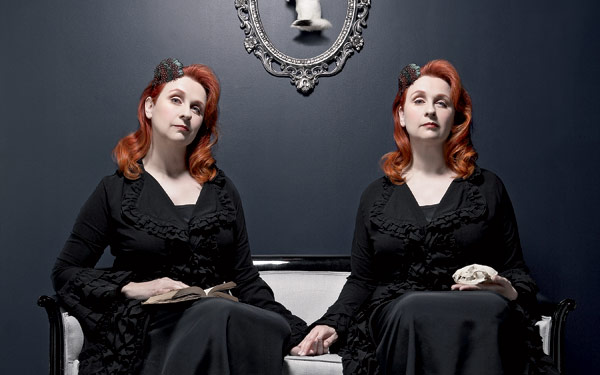
Double take: In her new novel, Niffenegger (opposite) tells the tale of Lake Forest twins who settle in their late aunt’s London apartment. Or as she puts it, “Young ingénues come over from America and get into trouble.”
She craves strangeness. The weird, the bizarre, the inexplicable—she is repeatedly drawn to all of it. “It’s the boredom factor,” says Audrey Niffenegger, 46. “If I ever got a tattoo, it would say Easily Bored. On the surface, people seem ordinary. But if you chose anyone and got to know him or her very, very well, there would be something about that person that was extraordinarily peculiar.” And she finds that fascinating.
She has also found it rewarding. Niffenegger has built her fearless and extremely successful career, both as a writer and an artist, around private worlds filled with dark and mysterious experiences. Sometimes these worlds are ominous, such as her prints that show conjoined-twin skeletons or an elaborate funeral for a starling; other times, the worlds are heartbreaking, such as the love story of The Time Traveler’s Wife, Niffenegger’s blockbuster debut novel. Published in 2003 and recently made into a movie, The Time Traveler’s Wife tells the story of a man with a genetic disorder that causes him to travel through time unpredictably and the woman who waits for him to reappear. Difficult to classify—some called it science fiction, others romance—the novel was a hit with the public, who saw it as a metaphor for the difficulties and bad luck that even the best of relationships can suffer. To date, it has sold an estimated six million copies worldwide in 33 languages, according to Niffenegger’s literary agent, Joe Regal.
With her tall figure and long titian hair, Niffenegger casts a striking presence in a Lincoln Square café. A faculty member at Columbia College’s Center for Book and Paper Arts, she is relaxing during the summer months before the September 29th release of her long-awaited second novel, Her Fearful Symmetry. The phrase “fearful symmetry” is taken from a William Blake poem (although it also turns up as the title of a Star Trek novel and the name of an X Files episode).
Until the official publication of the book, Niffenegger is relaxing, considering herself to be in a state of grace. “I have no idea how critics will react to it,” she says. “I can just enjoy the moment.” Already, though, comments on advance copies of the novel have hit the Internet. Editor and Publisher deemed it “a disappointment,” while the majority of readers at goodreads.com liked the novel, calling it “engaging” and “lovely.”
Niffenegger’s moment of relaxation has taken its time coming. She defied the custom for best-selling first novelists, which is to create only the outline of the second book and cash in with a large advance based on the success of a smashing debut. Instead, she took six years to complete and then sell a finished manuscript. In March, after a fiercely contested auction, Her Fearful Symmetry was bought by Scribner, a unit of Simon & Schuster, for a reported $5 million.
“People seem to think it was a strange thing to do,” she says. “But to me it was the best way to insure that I had the freedom to do what I wanted to do.” What she did was write a supernatural story about 20-year-old Lake Forest twins who inherit an apartment near the famous Highgate Cemetery in London. Moving there, the twins become entangled in the lives of the building’s other residents. And then there is the ghost of their aunt, who left them the flat. “It’s essentially the Henry James plot: young ingénues come over from America and get into trouble,” she says. “The concept was to write a 19th-century novel for the 21st century.” As her models, Niffenegger chose James’s The Portrait of a Lady and The Turn of the Screw, along with The Woman in White, by William Wilkie Collins, considered to be one of the first mystery novels. “Repeatedly what you get in 19th-century novels are these very sheltered females, and the novel is the story of their education, for better or worse. And I wanted to deal with all the tropes of the 19th-century novel: doubling, mistaken identity, mistaken parentage, and spirits. I got to write it exactly as I wanted, and that was very satisfying.” Beyond that, she says, she—just like many of her characters—has no control.
* * *
Photography: Erika Dufour; Stylist: Amy Lauhoff O’Brien Hair and Makeup: Sharon Casey Parker First Assistant: Flynn
 |
Niffenegger was born in South Haven, Michigan, the oldest of three daughters, but the family soon moved to Evanston, Illinois. Her father worked as a civil engineer and her mother as a paralegal, but some of Niffenegger’s earliest memories involve her mother creating something—quilts, art—with fabric. As a toddler, Niffenegger became fascinated by books and how they looked. She began to create her own publications—much to her parents’ chagrin—by pulling their books off the shelves and scribbling on the pages. Over the years, she progressed to writing poems and then illustrating them, folding pages and binding them together. “I can’t say that I loved drawing before writing,” she says. “They were always so intricately bound together for me, and I just had this determination that the words and the pictures belonged in a book.”
“Audrey has this great love of books that extends to them as objects as well as words,” says Zach Dodson, founder of the independent publishing house Featherproof Books. “She thinks about the ways that form and content intersect. That’s an indication of a true and deep obsession.”
When she was 11, she made a 70-page book in which she described and illustrated her fantasy tour with the Beatles. At 14, a bad ear infection kept her home from school for weeks, and, to keep her entertained, her mother brought in a stack of art books from the library. In one of them, Niffenegger discovered Aubrey Beardsley, the 19th-century English illustrator. “I became devoted to him,” she says, “his amazing, decadent drawings and his dark, scandalous side.” After graduating from Evanston Township High School, she enrolled at the School of the Art Institute in Chicago. She had plans to become a book illustrator like Beardsley, but reality set in. “I realized that the world of illustration was shrinking. And I also realized that I wasn’t very good at doing what I was told, so I could never be art-directed.”
But she was still “so hell-bent on this bookmaking thing,” she says, that she started to make her own books. While she concentrated in printmaking, her passion at the Art Institute became elaborate bookmaking projects, involving everything from illustrations to binding.
“Audrey became the only artist we ever picked up as an undergraduate,” says Bob Hiebert, codirector of Printworks Gallery, which specializes in fine arts on paper. At school, she had done an installation that was an illustrated book, The Adventuress, about a woman who becomes a moth. “The type was hand set on handmade paper, the pages hand bound—and then she had deconstructed it,” says Hiebert. “We could see that even then she was a consummate printmaker.”
Niffenegger had eight shows at Printworks before The Time Traveler’s Wife was published; a recent summer exhibition showcased her work The Night Bookmobile, original mixed media drawings for a serial comic that ran for 32 weeks in the London newspaper The Guardian. One of Hiebert’s favorite works by Niffenegger is The Three Incestuous Sisters, a 2005 limited edition of ten beautifully bound books that shows, according to Hiebert, “a dark, closed world” of thoughts, fears, and supernatural powers.
After graduating from the Art Institute, Niffenegger worked as a printmaker and taught classes at the Evanston Art Center. Discovering that she loved to teach, she went to Northwestern for an MFA degree in printmaking. Then she began working as an adjunct teacher in Columbia College’s art department. In 1997, she had an idea for an illustrated novel that would deal with a man who worked at the Newberry Library and hurtled through time with no control; eventually the idea expanded to become a love story about people who rarely connected and yet felt they had known each other for all of their lives. The good parts of the romance were inspired by Niffenegger’s parents’ marriage, and she had her own experiences in failed love affairs to draw on, too. “She talked about this idea for awhile, and then one day she said that she simply couldn’t capture the time-travel element in art,” recalls Hiebert. “She said she had decided she had to write it out.”
The Time Traveler’s Wife was published in September 2003 by the small independent house of MacAdam/Cage in San Francisco. It had paid $100,000 for the novel, and the house mounted an aggressive publicity campaign. But the book truly took off when Scott Turow endorsed it on the Today show. The first print run of 15,000 immediately sold out. Soon the novel became a publishing sensation; Amazon.com named it one of the best books of 2003. Brad Pitt’s production company, Plan B Entertainment, purchased the film rights. Directed by Robert Schwentke and starring Rachel McAdams and Eric Bana, the New Line Cinema movie did well on its opening weekend in mid-August, ranking third in the United States (and first in the United Kingdom) in box office receipts and taking in $19.2 million worldwide. (Niffenegger was not involved with the movie nor has she seen it.) Now Niffenegger’s characters may be headed to the small screen: ABC has announced plans to produce a pilot based on the book that could lead to a weekly TV series.
“Today there isn’t a day that goes by that we don’t field an inquiry about works by Audrey,” says Printworks’ Hiebert. “People from all over the world ask us about her now.”
* * *
Photography: Erika Dufour; Stylist: Amy Lauhoff O’Brien Hair and Makeup: Sharon Casey Parker First Assistant: Flynn
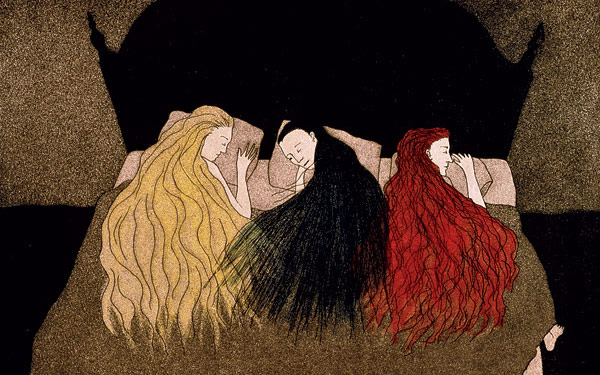
Not only did Niffenegger (opposite) score big as a writer with The Time Traveler’s Wife; she’s also an accomplished artist and printmaker. Above is an illustration from her graphic novel The Three Incestuous Sisters.
The success of The Time Traveler’s Wife enabled Niffenegger to do several things: She paid off her credit cards (she used to lose sleep over how she would ever do it); she began to travel more (she had not been west of the Mississippi); and she secured tenure at Columbia College (she had already been on the tenure track, but, as she notes, it didn’t hurt to land on The New York Times bestseller list). Now she teaches one class a year, a seminar on writing for visual artists, and the rest of the time she devotes to her own art and writing projects. She doesn’t own a television because she considers it a waste of time—an irony, she realizes, since she credits the Today show for making her first novel successful. But if she wants to see something, such as the British sci-fi series Doctor Who, she watches the DVDs on her computer.
Niffenegger also bought a large house on Chicago’s Northwest Side, in “a wonderful neighborhood with committees and block parties,” where she lives with her two cats. She once thought of marriage as “a good idea,” but now her goal is a permanent boyfriend. “I used to think of dating as a form of travel,” she says, “but then I would just be going to stranger and stranger places. I got tired of it.” (Currently there is no steady beau.) She has turned the third floor of her house into a studio, and the rest of the place is filled with her vast collection of books, including old medical texts, as well as her assortment of taxidermy.
The taxidermy collection started years ago with a stuffed toad Niffenegger found at a garage sale. “It was so pathetic; its hands are broken off, so there are just wires. It’s really ghastly looking,” she says with delight. “And once you start with something, people give you more.” Now she has a pair of white doves under a glass dome, a gift from her British publisher; a squirrel; and what she calls “the usual taxidermy clichés, like a mongoose with a cobra wrapped around it.” She disdains stuffed heads, choosing instead complete and more unusual animals. The prize of her collection is a badger from the famed Deyrolle taxidermy shop in Paris. She has even painted the downstairs of her house in the same colors as the rooms of Deyrolle: Her living room is sky blue, her dining room dark green, and her study pale green. “My goal for the house was to make it look like I was living in the Field Museum,” she says.
Taxidermy is just part of her larger fixation on death. “My original thought for Her Fearful Symmetry involved a man who would never leave his apartment. And the apartment, in Uptown, overlooked a cemetery. But then I thought, if I’m going to have a cemetery in the story, what am I going to do with it? And what is the best possible cemetery? Highgate Cemetery in London is the crème de la crème of cemeteries.” (She had first toured Highgate during a 1996 trip to England.)
Highgate is famous for its permanent residents: Karl Marx, George Eliot, and Radclyffe Hall, among others. The artist Dante Gabriel Rossetti buried his wife there and then seven years later had her coffin exhumed so he could retrieve poems he had buried with her. In 1981, after falling into disrepair, the historic cemetery was taken over by a group called Friends of Highgate Cemetery. Public admission to the older west side is now restricted to guided tours given by the group, as they work to restore the grounds to their former glory.
Image courtesy of Audrey Niffenegger
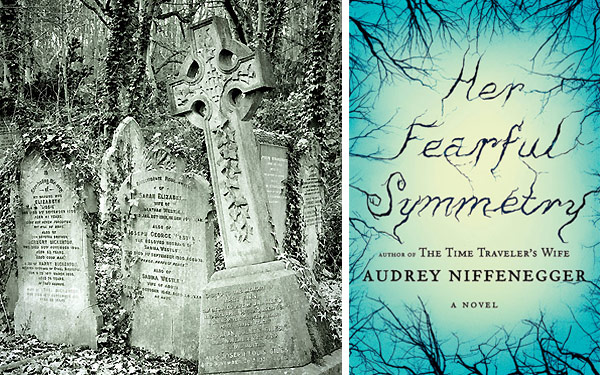
Niffenegger set Her Fearful Symmetry near London’s Highgate Cemetery (below) after agreeing with a group that maintains the grounds to limit profanity in the book and not depict any graveyard sex scenes.
As Niffenegger began work on her second novel, she called Jean Pateman, the 88-year-old founding member of Friends of Highgate Cemetery, and said that she wanted to set her next novel there. “‘Oh, my dear, I do not think that would be a very good idea,’” says Niffenegger, imitating Pateman. “That was her response. She was wary because there are always vampire hunters and ghost hunters trying to get into the cemetery.” It also didn’t help that Tracy Chevalier, author of Girl with a Pearl Earring, had set a sex scene in her second novel, Falling Angels, in Highgate.
Niffenegger wooed Pateman, flying to London and spending time with the Friends of Highgate group. After repeated meetings, Pateman agreed to cooperate, with two conditions. “There would be minimum swearing in my book, because by now she had read The Time Traveler’s Wife and thought there was far too much foul language. And there were to be no sex scenes in the cemetery. I said I could agree to those rules, and after that she was fantastic.” Niffenegger ended up dedicating Her Fearful Symmetry to Pateman. She also became a tour guide for the cemetery whenever she was in London, which was becoming increasingly frequent.
Niffenegger has fallen in love with London—she finds it even better than the London of books she had read—and now tries to visit at least four times a year. Her Anglophile tendencies flavor her conversation (“It was very amusing” is a frequent comment) and spill into the spelling in the new novel (“honour” “arguement” and “analyse,” for example). She has fantasies of buying a London flat and spending large parts of every year there, but even with her success, London real estate is expensive. She’s had other fantasies—owning a store that was open only at night and sold only black items, for example. She has given up that idea, but she still entertains the notion of opening a bookstore—a place that would sell artist’s books, comic books, graphic novels, and odd books. She hasn’t decided. “I mean, I’m not Madonna, so I’m not going to do something crazy, and I’m not J. K. Rowling, so I’m not going to buy a castle. I’m a person who takes a long time to think about things, and basically I’m a person who really likes her life.”
Yet she has a strong, even dominating, fixation with death.
“In America, people think it’s odd,” she says. “But in certain cultures—think about Holland in the 17th century or England at the end of the 19th century—there were these periods when people would just get into this whole memento mori state of mind. And I think it’s a great way to live. If you are reminded daily that you are a finite thing, you won’t sit around complaining that there’s nothing on TV.”
But overall, doesn’t everyone want to avoid thinking about death?
“It’s the job of the artist to remind people,” Niffenegger says. “Some people would say, ‘No, the artist should be helping us forget.’ And for that, you have Monet and that kind of thing. But I believe that if you are a really good artist, you have the ability to run behind the curtain and not just accept the show that’s onstage. And the big thing behind the curtain is we’re all going to die.”
It is what she returns to again and again, in her novels and in her art; they intersect in some crucible of loss and longing. And so she keeps returning to the weird, the mysterious, the inexplicable. “Yes,” she says. “And, so, what else can I do? Onward.”
Photograph: Jon Arnold/JAI/Corbis