

Over the years, this magazine has produced many rankings of the best places to live in the Chicago area. We’d consult with experts and cite stats, sure, but those lists were largely subjective.
This time around, we put a twist on the exercise: For the first time, we evaluated suburbs based purely on the numbers. And not just the best suburbs — we ranked all 205 in the six-county area with populations of more than 5,000, from top to bottom. We tapped the analytics firm DataJoe to help us collect and weight various statistical measures and crunch the figures. (Our methodology can be found below.)
This quantitative look turned up some surprises: For starters, north suburban Libertyville, which hadn’t been on any of our recent previous rankings, landed at No. 2. And not all of the area’s tony towns ended up near the top. Oak Brook, for instance, came in at No. 157.
Of course, this numbers-based approach has its limitations. It doesn’t account for things like, say, a suburb having a charming downtown or an interesting stock of homes. (Which helps explain how a town like Oak Park — often cited as an excellent place to live, in part for those reasons — ranked a relatively mediocre No. 57.) But for better or worse, our decision to rely on metrics removed much of that subjectivity — and produced an undeniably interesting list.
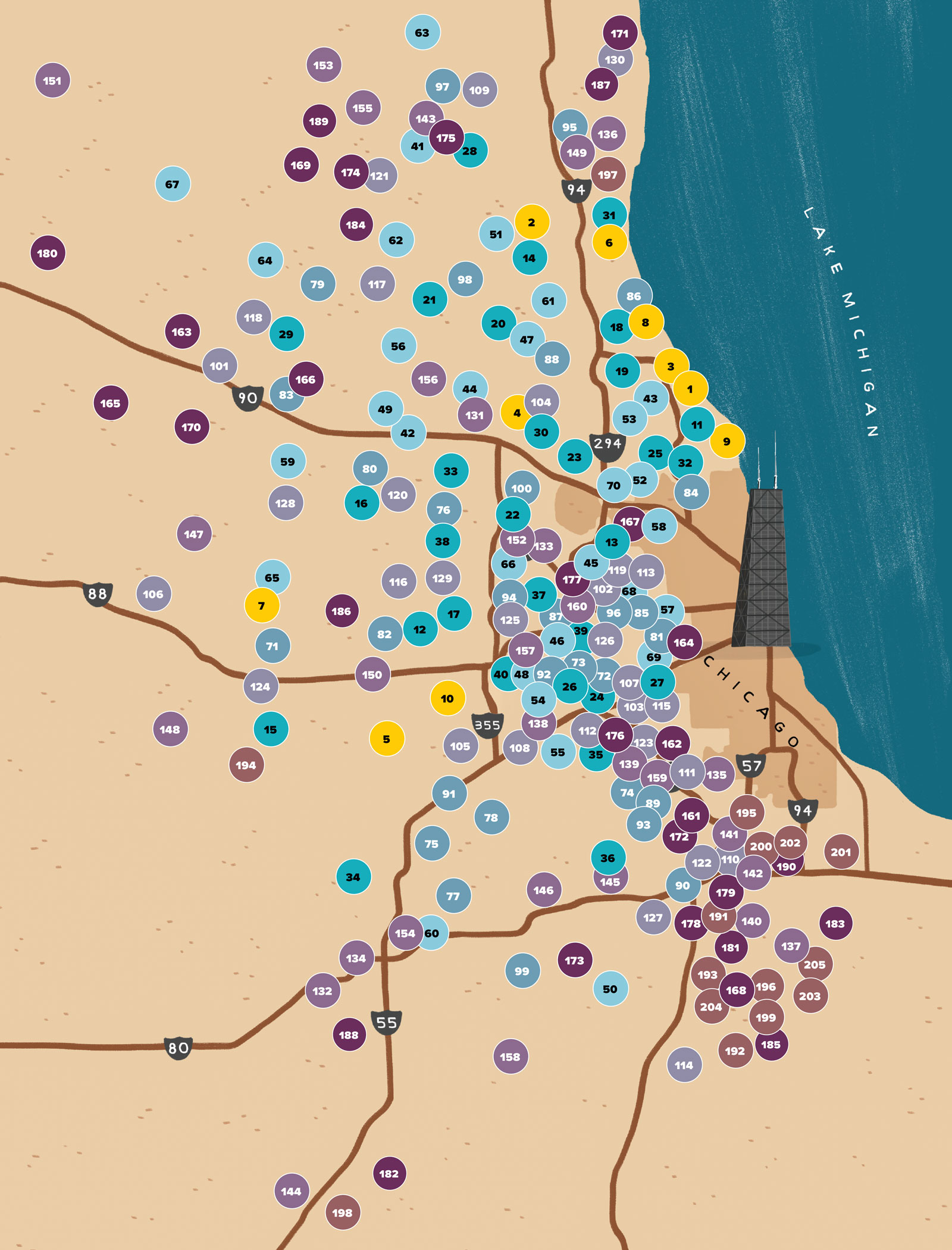
Scroll down to see the full ranking, which is sortable by category, and a color-coded map of where every ranked town falls in the metro area.
Note: Median home sale prices, provided by Midwest Real Estate Data, are for single-family houses in 2025.
Winnetka
Where you get what you pay (a lot) for
8.99
12,700
$1.98 million
The easiest way to gauge this North Shore town’s appeal? Look at how many people stick around. With just 45 active listings in the spring, it’s clear that once you’re here, there’s little reason to leave. The few who do opt to sell often wind up making headlines: A lakefront mansion sold last year for a Chicago-area record $31.25 million, only to be outdone by a nearby one that bested that mark by $3.25 million a few months later.
Those may be outliers, but there’s a reason prices in Winnetka have surged by 80 percent over the past five years. Namely, a pretty idyllic lifestyle. Nearly 83 percent of households here are families, who enjoy access to New Trier, which topped our 2024 rankings of suburban Cook County public high schools. What’s more, Winnetka’s traditionally quiet downtown is humming a bit louder these days. The Greek restaurant Avli is expanding with a vinyl bar and lounge, while Ballyhoo Hospitality, which operates the French bistro Pomeroy in town, is gearing up to open a Mediterranean spot next year. The Winnetka Music Festival, now in its 10th year, presents an impressive mix of acts (including the 2026 headliner, indie-rock darling Father John Misty) that wouldn’t feel out of place at Ravinia.
In a town this posh, even if you own a sprawling home, there is always going to be a neighbor who can make you feel small. Private equity billionaire Justin Ishbia, the future owner of the White Sox, is currently building a $77 million lakefront compound — the most expensive home in state history. — David McMillin
Libertyville
An overlooked gem
8.35
20,600
$690,000
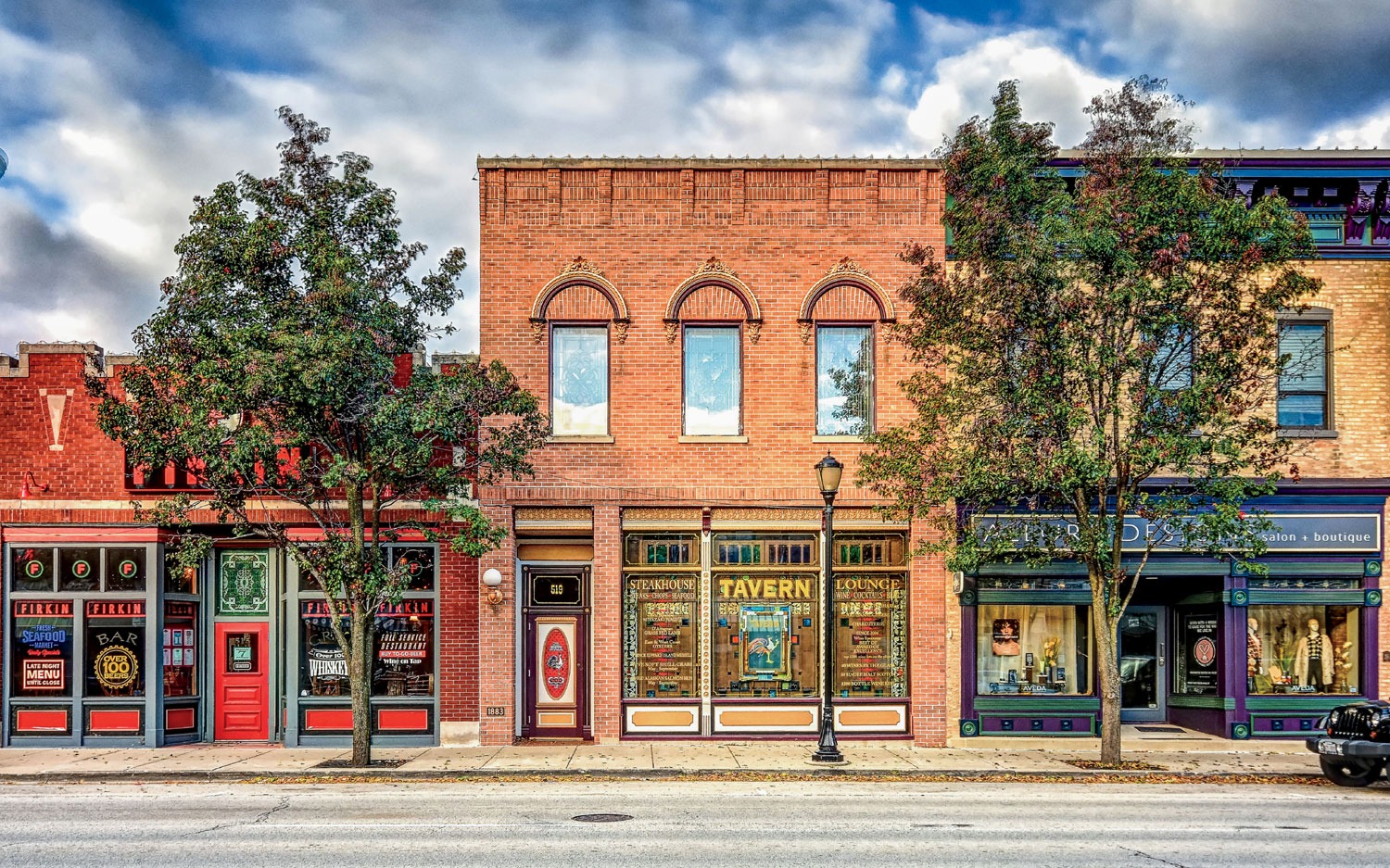
Libertyville knows exactly how charming it can be, with its quaint brick storefronts, patios glowing under string lights, and the feeling that a meet-cute could happen at any moment. (In fact, a few low-budget rom-com movies have been shot here.) Nowhere is that more true than in the town’s walkable stretch of Milwaukee Avenue, where you can go from pre-Prohibition cocktails to oysters on the half shell within a block.
But even residential parts of Libertyville are anything but cookie-cutter; instead of wall-to-wall subdivisions, you’ll find neighborhoods tucked into woods. One reason: A land protection program established by the township in the 1980s has preserved more than 1,500 acres of open space. And while Libertyville doesn’t get name-dropped the way some North Shore towns do, you’ll pay a lot less to get a lot more here. A recent example: a 2,200-square-foot house with four bedrooms, two and a half baths, a finished basement, and easy access to both downtown and the Metra for $650,000. You aren’t finding that combination in Highland Park or Lake Forest. Libertyville may not be the loudest name on the list. But it’s one of the smarter picks. — Kelly Aiglon
Glencoe
A small-town feel in the heart of the North Shore
8.35
8,800
$1.70 million
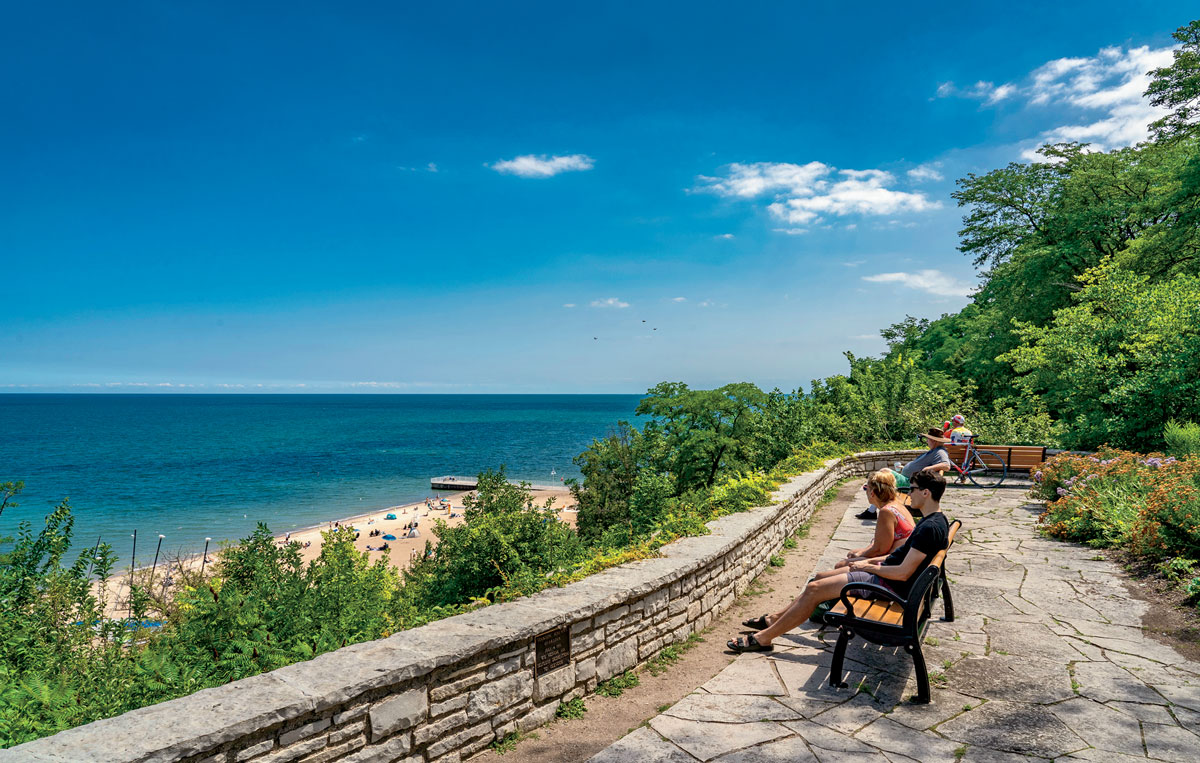
No one leaves their doors unlocked in 2026, but if you’re going to do it anywhere, it would be Glencoe. The suburb offers the kind of small-town tranquility many buyers covet, and not just when it comes to public safety: Roughly one-third of the village is open space, and 95 percent of residents are within a 10-minute walk of a park. Nearly nine in 10 households here are families, who come to Glencoe in part for its strong schools (high school students attend nearby New Trier).
The housing stock offers a sense of the North Shore’s rich history: Almost 70 percent of the homes were built before 1970, and the village has the third-largest concentration of Frank Lloyd Wright–designed structures in the world — not quite Oak Park, but impressive in its own right. The downside: Good luck buying a house under $1 million, particularly close to the lake. But you can occasionally find six-figure listings west of the Metra tracks. The vibe here is sleepy — the municipality recently approved its first-ever sports bar at the Glencoe Golf Club — but then again, that’s the point. — D.M.
Arlington Heights
A seemingly ordinary town that’s anything but
8.29
77,700
$567,000
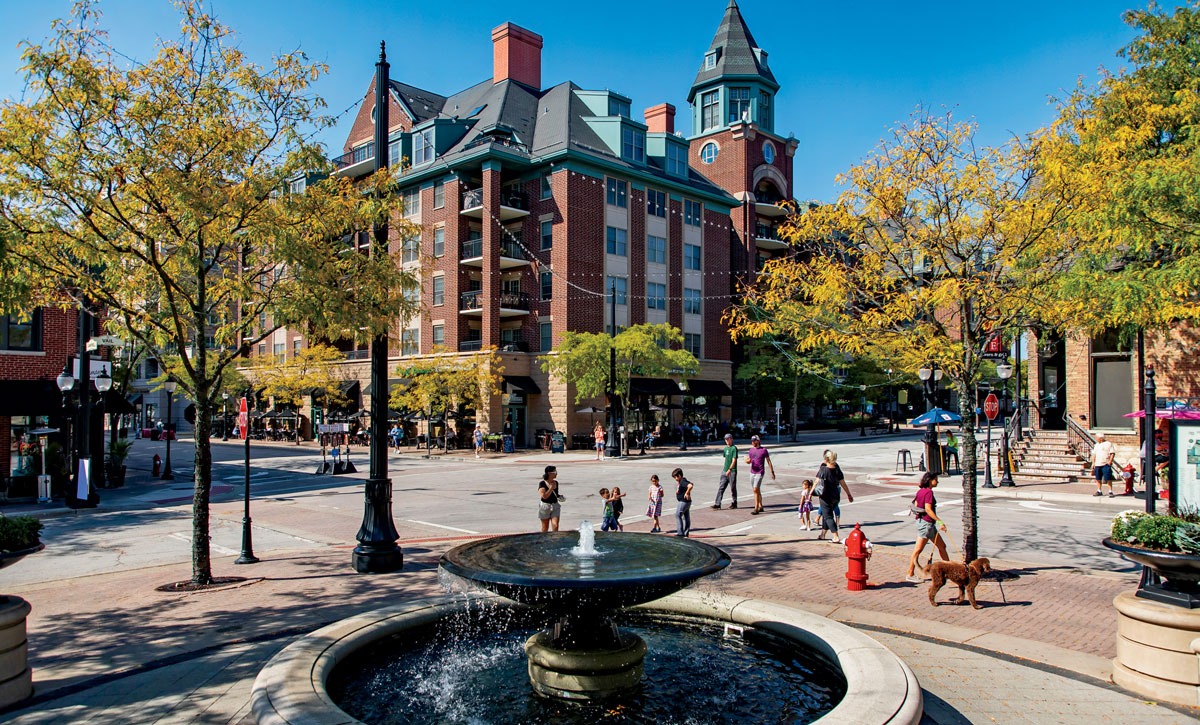
Arlington Heights is what happens when a commuter suburb realizes it doesn’t have to be only that. The Metra’s Union Pacific Northwest Line runs straight through downtown, where dinner, drinks, and a show at Metropolis Performing Arts Centre can easily be part of the game plan. Coming soon (maybe): the Bears. If the team builds a new stadium here instead of in northwest Indiana, it will reshape this village overnight, from the good (a big boost to local businesses) to the not-so-good (property tax uncertainty).
In the meantime, this northwest suburb checks all the coveted boxes: great park access (90 percent of residents are within a 10-minute walk to one) and top schools (John Hersey High ranked No. 3 in suburban Cook County on our 2024 list). The housing stock is a healthy balance of ranches, condos, and townhomes. It’s good to be a homeowner here, with prices appreciating considerably since 2020. (The median sale price was just $380,000 that year.) And with a 326-acre site still in flux, it’s a suburb with big changes in store. — K.A.
Naperville
A growing city that still feels suburban
8.27
149,500
$700,000
Naperville used to be just another Chicago suburb. Now it’s the third-largest city in Illinois, thanks to a population growth over the past two decades that has far outpaced the region as a whole. That influx of new residents is surprisingly diverse — more than a quarter of the people here primarily speak a language other than English — fueling a multicultural dining scene that includes the Filipino eatery Bistro Manila and the Korean-Japanese fusion spot Sho Wagyu.
With a modest 1.4 percent median home sale price increase last year, Naperville’s housing market is finally signaling some positive news for those looking to buy here. Don’t let that flattening curve fool you, though: The same factors that led to the city’s boom — outstanding public schools, loads of outdoor space, and plenty of local jobs if you don’t want to commute to Chicago — still beckon. Even as Naperville grows, its leaders have shown they’re willing to pump the brakes at times: The City Council recently rejected plans for a 145,000-square-foot data center along the I-88 corridor, citing worries over noise and pollution. — D.M.
Lake Forest
Peace and quiet and historic charm
8.24
19,400
$1.38 million
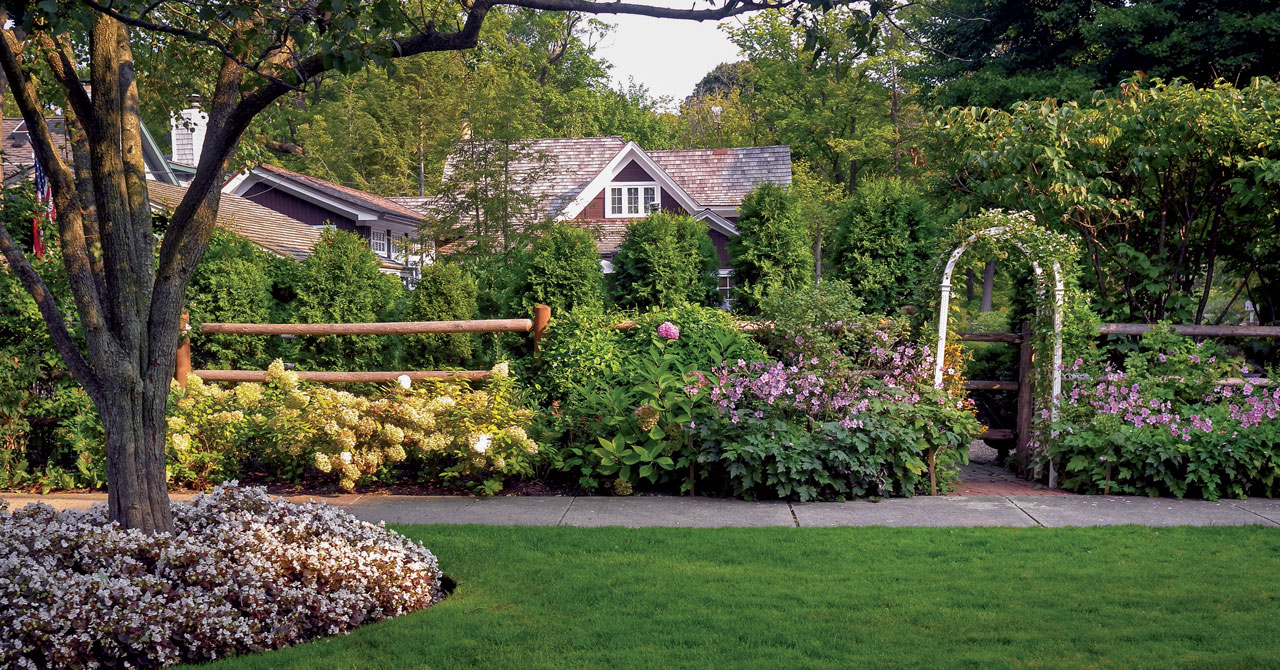
With large minimum lot sizes, deep setbacks, and height limits that keep even new builds from crowding the street, this North Shore town runs on restraint. (Hence the high home prices.) Market Square is still a tight, low-rise cluster instead of a built-out downtown, and the lakefront has no commercial strip, just a quiet boardwalk, staircases, and low-key access points. So the large price tags buy you not just square footage but also land and privacy. A renovated five-bedroom ranch recently listed for $1.9 million, for example, offers 6,000 square feet of living space on a one-acre lot.
For families who can afford the steep home prices, Lake Forest High School is a major draw. With a 98 percent graduation rate and the vast majority of students continuing on to college, it topped our rankings of Lake County public high schools in 2024, while Sheridan and Everett Elementary Schools placed first and fifth, respectively, in our 2025 list of the county's best elementary and junior high schools. And while there are tradeoffs to living here — Lake Forest is an hour’s commute from Chicago by Metra — the quaint downtown offers plenty of upscale entertainment: Le Colonial for lunch, Gerhard’s for something sweet, and the Deer Path Inn for afternoon tea served as if you’re in London instead of Lake County. — K.A.
Geneva
Where suburban cool meets affordability
8.17
21,400
$569,500
Geneva may be 45 miles from the Loop, but the western suburb boasts a downtown that feels a little like Wicker Park. Most of the action is along Third Street, near the Metra’s Union Pacific West Line stop, with a surprising number of watering holes for a family-friendly suburb: craft cocktails at Alchemist (insider tip: stick to just one Baptized by Fire, a potent mix of bourbon, rye, and mole bitters), housemade hard seltzers at Penrose Brewing Company, and tequila old-fashioneds at Revolución.
While housing prices have surged by more than 50 percent over the past five years, living here is still a relative bargain. If you’re looking for something on the smaller end, Geneva Crossing, a new 40-townhome development, includes some three- and four-bedroom properties under the half-million-dollar mark. New single-family builds closer to downtown are available in the $1.3 million range, but you don’t need to spend that much to get a lot of space: A 3,000-square-foot, five-bedroom house built in 2002 was listed this spring for $625,000. Another perk for the cost conscious: The City Council recently approved a property tax decrease. (Yes, it is possible for a municipality in Illinois to do that.) — D.M.
Highland Park
A buzzy town getting buzzier
8.15
30,200
$855,600
This North Shore town is having a moment. Celebrated restaurants have opened outposts here, including Evanston’s Barn Steakhouse and the Lincoln Park favorite DeNucci’s. And Ravinia is undergoing a multiyear overhaul that promises pavilion upgrades, refreshed performance spaces, and a full campus rethink. It’s little surprise that the housing market here has boomed, with the median home sale price increasing nearly 60 percent from 2020.
You’ll find a wide spectrum of homes: Tudors surrounded by trees, Prairie-style homes that sit low and wide, colonials on deeper parcels, and newer builds that fit well with their surroundings. Prices reflect the range, with entry points in the $600,000s for smaller homes or townhouses, a broad middle in the $700,000 to $900,000 range, and anything near the lake pushing well past $1 million. What’s changing now is how the town is adding inventory. The former Lincoln School property will be the site of a new development of single-family homes. Who moves in next will join a list of residents that’s long skewed eclectic: Billy Corgan lives here, and Michael Jordan once did too. — K.A.
Evanston
A city that puts the urban in suburban
8.11
78,100
$823,800
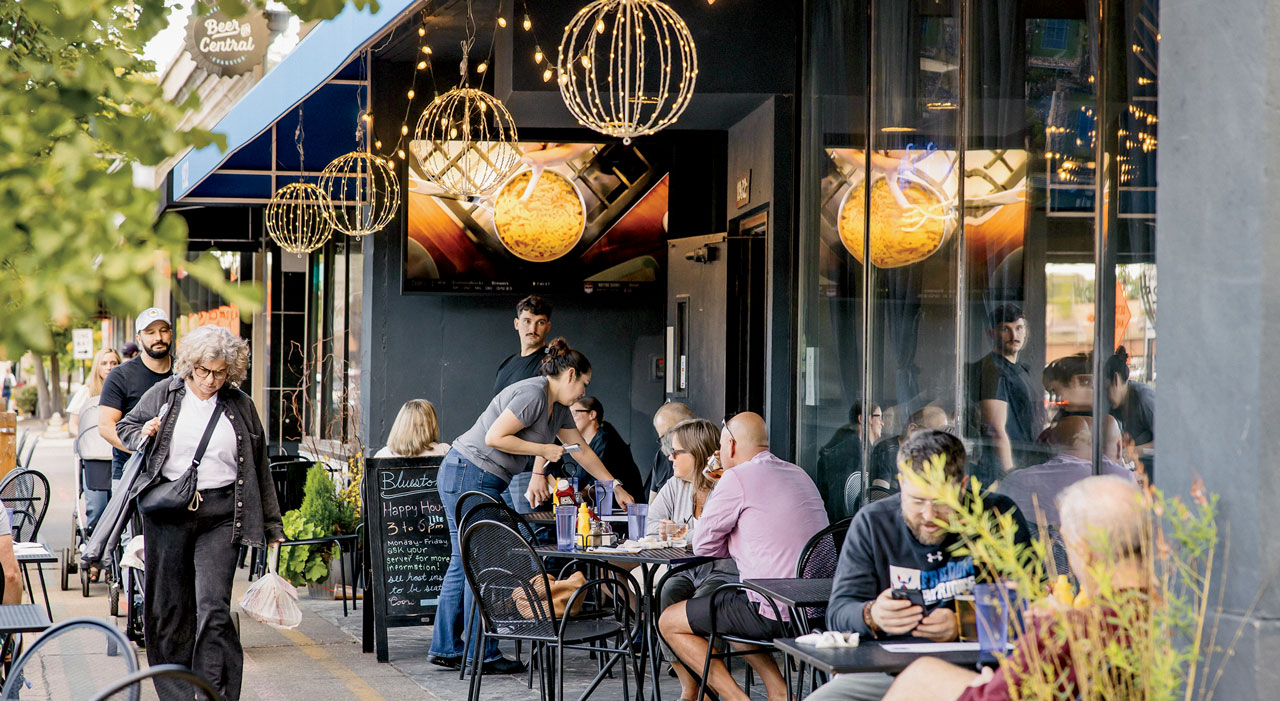
Living in the suburbs without feeling like you live in the suburbs has long been a major draw of moving to Evanston, which is just over Chicago’s northern border. No other suburb offers such a strong blend of urban features — walkability, transit access, diversity, a healthy supply of condos — and suburban charm. Recent evidence: The city is attracting major culinary stars, including a forthcoming spot from the James Beard Award–winning duo Beverly Kim and Johnny Clark. Northwestern’s renovated Ryan Field — set to host not just football games but concerts and possibly women’s professional soccer — will open this fall. (Not everyone is happy about that: The potential for more noise and traffic created an uproar among some neighbors.)
There’s a try-it-before-you-buy-it mentality here: More than 40 percent of occupied homes are rentals. That’s thanks in part to the university, but Evanston also attracts young professionals with its urban-like amenities. (Coming soon: a 29-story rental tower on Davis Street that will be the city’s tallest building.) For buyers, Evanston is among the most affordable towns on the North Shore, mostly because of its condos. But you can find move-in-ready single-family homes for under $800,000, largely on the town’s west side. If you want to live lakeside, budget accordingly: Some of those pre-1900 mansions fall in the $2 million to $3 million range. — D.M.
Lisle
Stepping out of Naperville’s shadow
8.06
24,200
$606,900
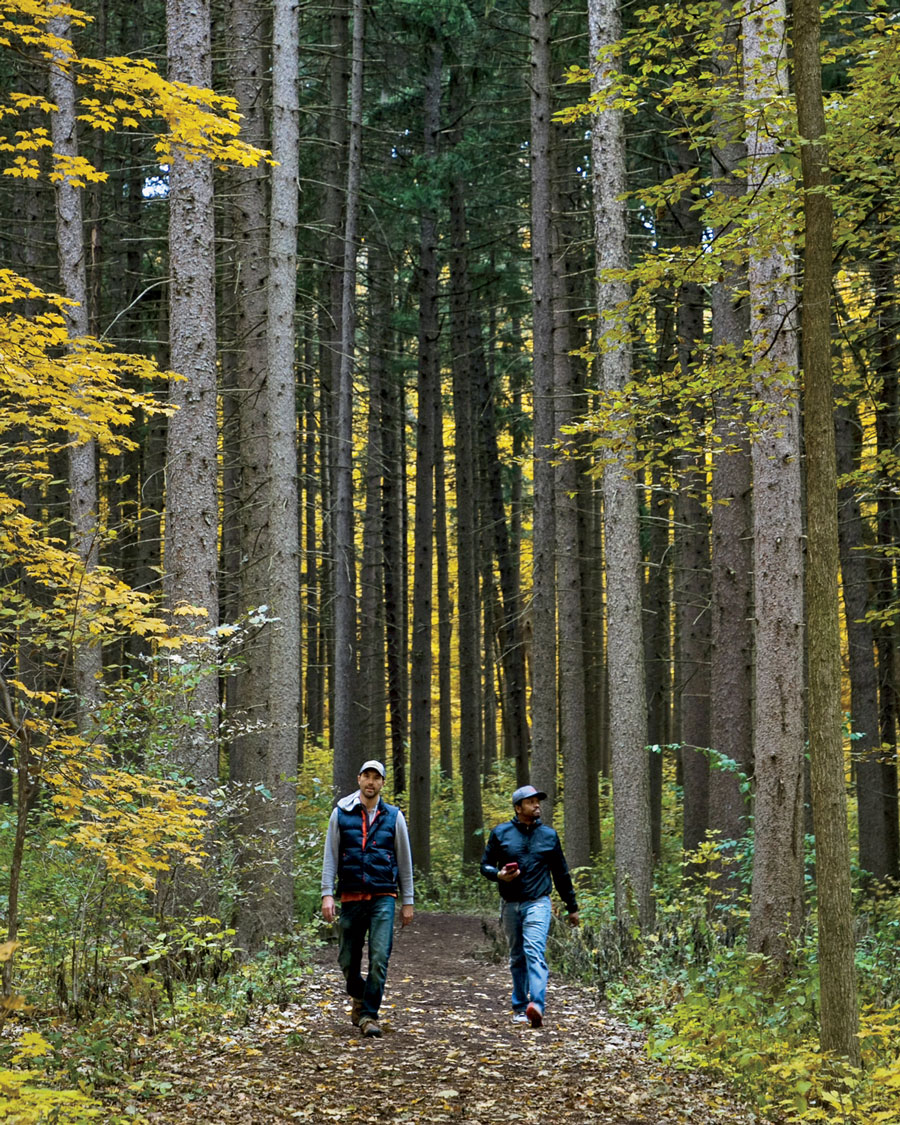
Long thought of as “the town next to Naperville,” Lisle has started to come into its own. And that respect is overdue. The DuPage County suburb has many faces: a railroad farm town, a college campus, a research-grade arboretum, and an office park corridor. The biggest thing shaping it these days is the Morton Arboretum, which draws more than a million visitors a year, features 16 miles of trails, and gives Lisle a tree-first identity that the village leans into, branding itself the Arboretum Village.
You’ll find an active, engaged community protective of the town’s feel. Plans for a proposed 256,000-square-foot data center on Ogden Avenue collapsed after pushback from residents. At the same time, the village is reshaping its core. A downtown streetscape project is set to begin this year, reworking Main Street with better pedestrian access and more usable public space. And nearby, the Arbor Station development will bring 60-plus townhomes. In this well-educated, solidly affluent community, the homes are a bit more affordable and the schools rate just a little higher than those in Naperville. (Cue Napervillian gasps.) — K.A.
How We Ranked the Suburbs
Chicago magazine partnered with the analytics firm DataJoe to evaluate all 205 suburbs with more than 5,000 people in Chicago’s six-county metro area (Cook, DuPage, Kane, Lake, McHenry, and Will). Each community was scored using key indicators across eight weighted categories.
The Categories
Community (18.2 percent): Rewards racial diversity (evenness of representation across racial groups), linguistic diversity, high rate of residents with bachelor's degrees, low poverty rate, and low unemployment rate.
Housing (13.6 percent): Rewards high appreciation (as measured by one- and five-year increases in median single-family home sales prices), high homeownership rate, and low vacancy rate.
Education (9.1 percent): Based on elementary school ratings from the Illinois State Board of Education.
Safety (9.1 percent): Rewards low crime rates (as measured by violent offense per capita and total offense per capita figures from the FBI). Communities too small to have their own reported crime statistics were excluded from this category, and their scores in other categories were given more weight.
Mobility (13.6 percent): Rewards high walkability and bikeability scores from the website Walk Score and access to public rail and bus lines.
Entertainment (13.6 percent): Rewards high total number of restaurants, high per capita rates of restaurants and liquor licenses, and high mean Google ratings of restaurants.
Green space and parks (13.6 percent): Rewards high rate of residents living within a 10-minute walk of a park, high total number of parks, and high per capita rates of parks and park acreage.
Proximity to the Loop (9.1 percent): Rewards shorter distance to downtown Chicago.