


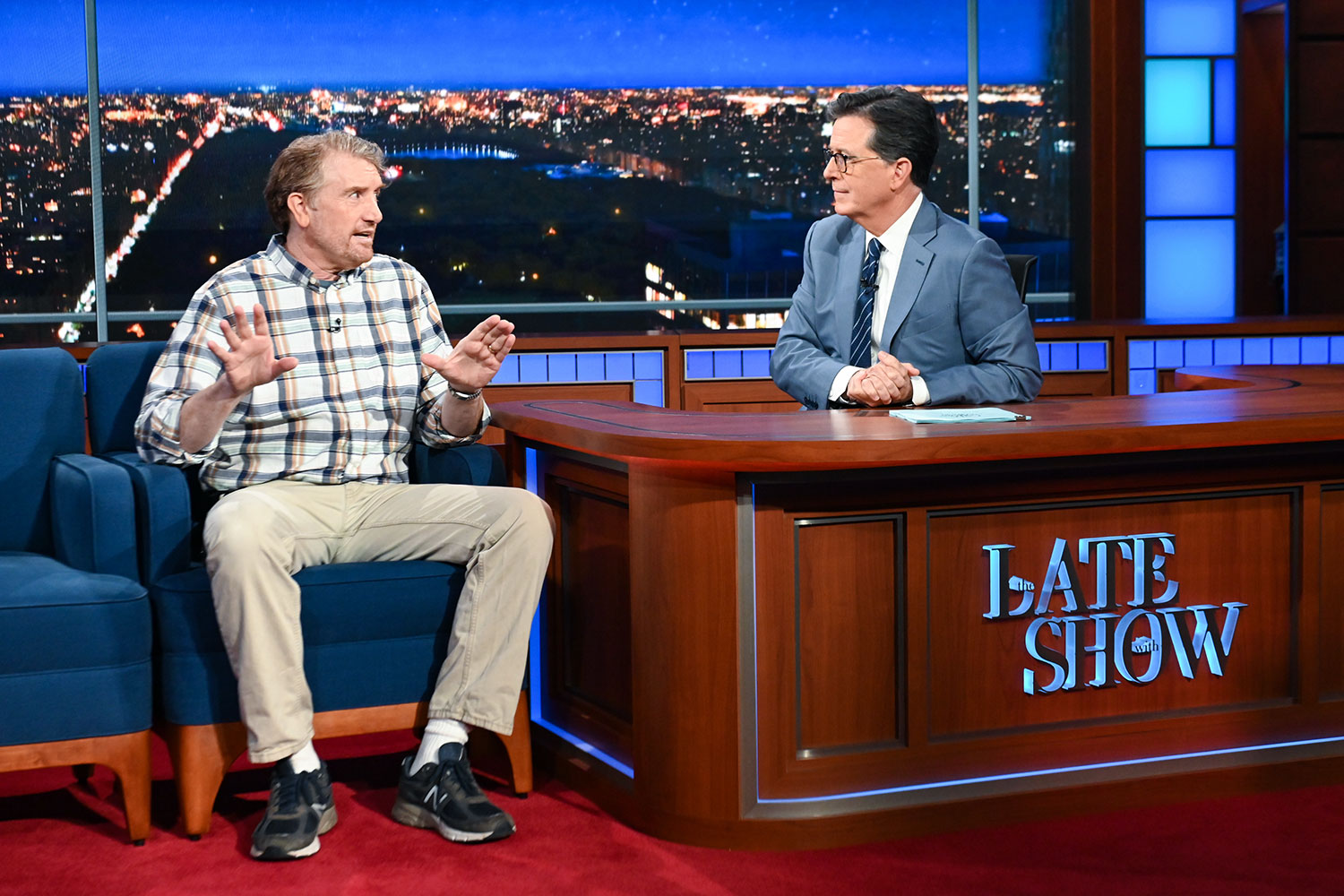
When The Late Show with Stephen Colbert airs its last show May 21 after a consistently ratings-topping and multiple-Emmy-winning 11-year-ish run on CBS, more than 200 people will be out of work or moving on to new jobs. That includes Colbert’s staff of 20-plus writers, among them Chicago-area native and former Second City and iO Theater performer Brian Stack, who has been at The Late Show since it re-launched with Colbert at the helm in 2015.
The program’s cancellation last July was a “shock,” Stack says, but “the mood has been very positive overall despite everyone’s sadness about it coming to an end.” Combined with his previous 18 years writing for Conan O’Brien’s various small-screen ventures at NBC and TBS, Stack has racked up nearly three decades of employment in the late night trenches — no small feat in a famously competitive and increasingly unstable industry.
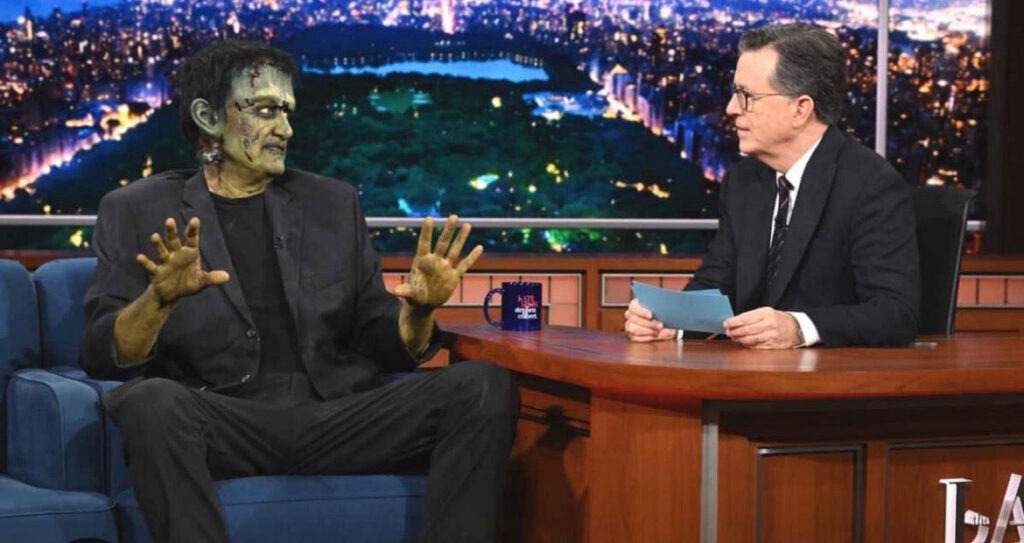
As a still-nebulous professional future lies ahead for him, the eminently genial 61-year-old son of Palatine talked with Chicago recently by Zoom from his home in Sleepy Hollow, New York. The discussion ranged from his creating memorable characters for national audiences (in addition to being an occasional on-camera presence at The Late Show as Dr. Frankenstein’s monster and The Ghost of Abraham Lincoln, among others, he also voices God, who can be heard thundering down at times from on high) to how refreshing it is to write about drunk raccoons instead of Donald Trump.
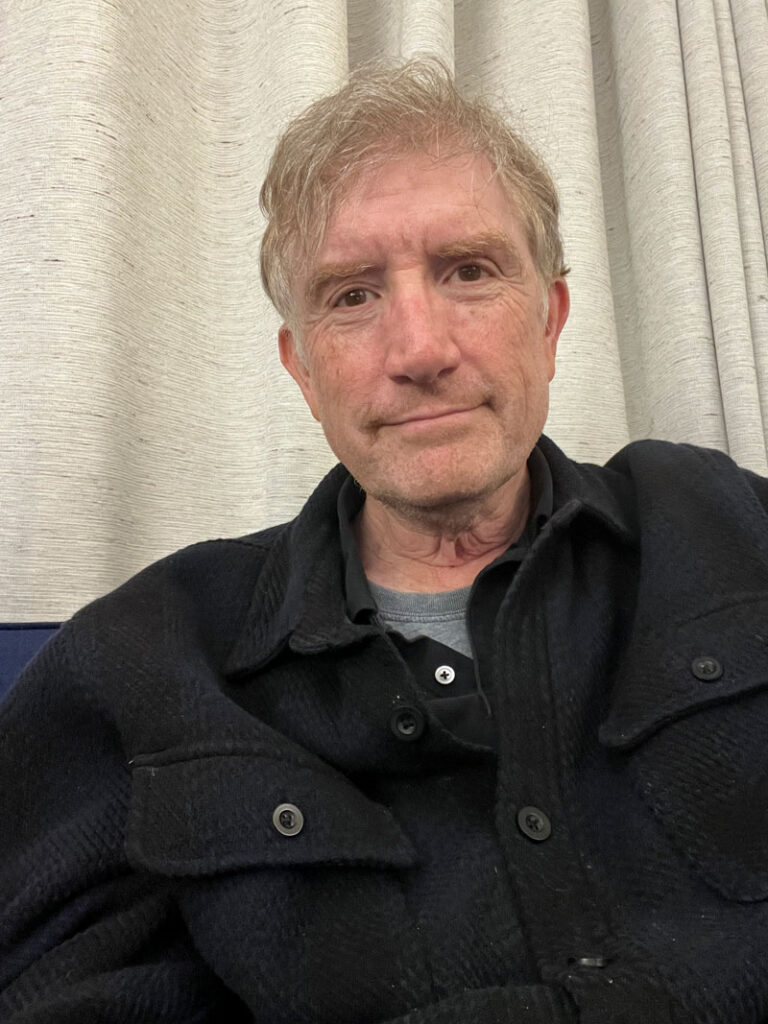
What are you most proud of in terms of your contributions to The Late Show?
While I’m proud of certain jokes and bits I’ve tossed in over the years, I think the most fulfilling thing for me has been when I’m asked to perform in character or do voice-overs that help bring other writers’ ideas to life. I’ve also always loved riffing around with other writers and bouncing ideas back and forth in an improvisational way. A lot of us came from an improv background, including Stephen, and we all love coming up with ideas collectively that we might never have come up with on our own. I’m proud that we did our best for the last 11 years to find humor in the events of the day, even when those events were far from humorous.
What’s been the main challenge of writing so much Trump material night after night at The Late Show?
He was just everywhere all the time for the last 10 years. That was something that none of us saw coming when the show started. I think the main challenge for all the writers, Stephen included, has been to try and lighten the emotional load so many people carry around with them with Trump in the news 24-seven, year after year. Trust me, we’ve always welcomed the chance to write about literally anything else, especially fun, silly stuff.
Political material is a big part of what shot The Late Show to No. 1, but it’s also been a source of criticism — that the show became too political. Conan was an outlier in that way, talk show-wise. Almost comedy in a vacuum.
[On Conan’s shows], if we dealt with politics, it was usually in a very silly, cartoony way. I don’t mean cartoony in a pejorative sense. I just mean that if Robert Smigel was doing his Clinton character, he played him more like a crazy good ol’ boy. And Stephen loves talking about things other than politics and Trump. He loves doing things like the “Meanwhile” [segments] and talking about a drunk raccoon running through a liquor store or something. We all just jump on those things like they’re footballs in the endzone. When we can find something fun to write about, we love it so much. It’s such a release.
Is a writer’s day at The Late Show much different than it was at Conan’s shows?
It is, actually. With Conan, we would start a little later in the morning, maybe around 10:30 or 11, but we would be there often until after midnight. I would be on the 1 a.m. train home to the suburbs. Because it was my first job, it felt completely normal. I didn’t have anything to compare it with. At The Late Show, we tend to get in earlier to get a jump on the day’s headlines and leave earlier. And we tend to work in pairs on monologue stories and things like that. Because Stephen’s show is much more monologue-centric and there are big chunks of material about each story, we all work on the monologues as well as the other bits. I had never been a monologue writer until I worked at Stephen’s show.
Who’s the better boss, Stephen or Conan? More important, who’s funnier?
[Laughs] One of the funny differences between Stephen and Conan is that a lot of times if you see Stephen in the hallway or something, he’ll talk to you as Stephen about something that’s really going on. With Conan, in all my 18 years there, I rarely had more than one or two genuine conversations with him. He was doing some bit in the hallway. Or he would come in with his guitar or a silly cap on his head and start doing a bit for us. He was always so playfully abusive, and he only does it to people he likes or loves. He would call me the Alabaster Ape, which is so funny, because he’s as pale as I am. He would say, “Stack, you alabaster ape!” He yelled that at me once from a car in Studio City. Or there’d be four of us sitting on a couch and he would say, “Oh, look, it’s a Mount Rushmore of incompetence.” He only did that with affection, but it takes some adjustment. If you don’t know Conan, sometimes people think it’s somehow coming from a real place, and it’s not. I remember when I was leaving and asking for his blessing to go to Stephen’s show, he was so nice about it and generous and understanding. I was thinking, “Why does this feel so weird? Oh, this might be the first sincere conversation I’ve had with him in 18 years.”
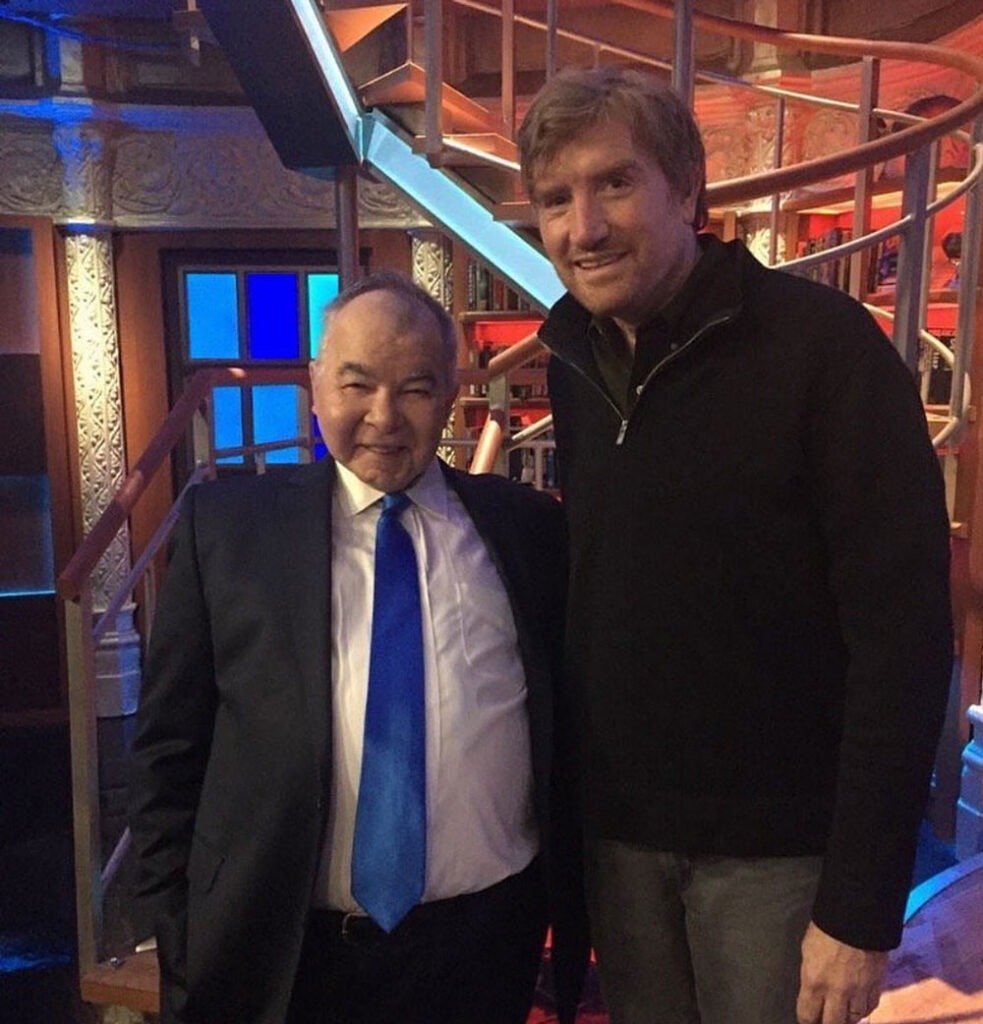
When you went to work with Colbert, did you miss the abuse?
Stephen can be hilarious, too, when he’s kidding around with us, but it’s different. [He and Conan] both come from big families, so I think they’re used to giving crap. Another thing I love about both of them is that they love it when other people give them crap. I don’t want to overgeneralize, but in comedians, there’s often a lot of self-doubt. When people give it back and nail you, it feels like you’re in a warm bath.
Who were your comedy influences growing up?
Letterman hit me really hard in college. At a younger age, it was things like SCTV, early SNL, Steve Martin, Richard Pryor, Peter Sellers, Monty Python. I also, through my parents and my grandparents, discovered all the old wonderful screwball comedies with William Powell and Carole Lombard. There was always a lot of laughter and appreciation of laughter in our house, but the idea of going into comedy as a career was unfathomable when I was younger. I’ve always admired stand-up very much, but I’ve never been inclined to stand on stage with a microphone. The second I discovered improv, I fell instantly in love with it. The thing I loved most about it early on was the sense of being in an ensemble of people that are like-minded and just having a lot of fun onstage together. It took me a long time to try it. I used to go see [Annoyance Theater founder] Mick Napier’s group at Indiana University and think to myself, “That looks so fun. I wish I had the guts to try it.” When Mick told me about ImprovOlympic [now iO Theater], I finally worked up the nerve in the summer of ’86. Then when I got to the University of Wisconsin in Madison for grad school, there was this little theater, the Ark Theatre, where I worked up the nerve to audition. That was where I performed for the first time in front of other human beings. Chris Farley was in my first group there. He was nothing like me — complete polar opposite in terms of his energy and his strengths — but we connected.
When you saw people like Chris getting cast on Saturday Night Live and other national comedy jobs, how did that impact you?
The idea of ever making a dime in comedy was unthinkable to me when I started out in improv. I thought the reward was just doing it. It never occurred to me that I would ever be able to do it professionally. Once some of my friends started getting jobs as writers or performers, I started to dare to dream a little bit. My ultimate goal was to get hired by Second City. I really didn’t think beyond that. That was the top of the mountain for me when I was starting out in Chicago. I started touring in late ’92 for a couple years, then did three shows in the e.t.c. Theater [on Wells Street].
The opportunity to write for Conan O’Brien came up in 1997 while you were at Second City. How did that come to be?
Tommy Blacha, another [Late Night With Conan O’Brien] writer, had broken his leg really badly. Back then, before Zoom, he couldn’t come in for a couple months. They thought, “Why don’t we bring in another writer to fill in?” Some of the other writers I knew from Chicago, like Andy Richter, Brian McCann, and Greg Cohen, all said, “Let’s have Brian send in some ideas.” I didn’t expect to get the job, but luckily, they liked the packet I threw together enough to bring me out for 13 weeks. The first character sketch I wrote was about Andy’s little sister who had a crush on Conan. Amy Poehler was so brilliant in it — that took a basic idea and kicked it up to a very memorable sketch. I’ll always be grateful to her. I think one of the reasons they kept me on was because that sketch went over so well. Thirteen weeks turned into 18 years.
Conan was silly for silly’s sake. As a result, you did a lot more characters there. Artie Kendall the Ghost Crooner killed me every time.
That just popped into my head one day. Rockefeller Center [where Late Night was shot] had been around since 1930, and these old singers like Bing Crosby were there. I thought, “A lot of the views from back then wouldn’t be acceptable today. What if there was a guy whose views weren’t even acceptable in his own time?” I always tried to make it clear that Artie Kendall was a monster who had been murdered because he was awful. I loved doing all the old silly characters at Conan, but I’m grateful for some of the newer challenges that I had at Stephen’s show and learning from people who are so brilliant at political satire. That was never my strong suit, so it was interesting and fun to try to develop that voice more. But it was an adjustment, especially when Trump came along, because that caught us all so off guard by how much we had to think about one particular guy.
Conan began hosting The Tonight Show in 2009, but it lasted only about seven months. Looking back at your time there, what was the value of that experience?
As happy as I was for Conan that he got the opportunity to do the show that he’d always wanted to do, I always felt like we were all better suited to something that was on a little bit later or had a little bit less of a high profile. Conan once said that The Tonight Show is like a big, beautiful ship that’s a little hard to maneuver. It moves very slowly, and it’s very large and bulky. When we got to the TBS show [in 2010], it was more like being on a little cigarette boat that can flip around and do whatever you want. I think that’s where we always felt more comfortable. I don’t remember anyone imposing any restrictions on us [at The Tonight Show], but there was something about it as an institution that made us a little self-conscious about some of the stuff we were trying. So while I wish Conan had gotten the shot at The Tonight Show that we all know he deserved and the time to develop it the way the other hosts did, I always loved the freedom to mess around like we’re up in an attic and no one’s paying attention.
Do you have something lined up for after The Late Show ends?
I’m not sure what’s next. I love the possibility of trying some other things, like getting back into voiceover work, which I used to do a lot of. I’ve done a lot of it at [The Late Show], too. That’s something I’ve always loved as much as anything, just being in a booth doing silly voices and characters. I’ve also thought it might be fun to work with college students and try to make [show business] seem a little more accessible, or at least try to answer some questions they have about the industry. I remember having so many questions at that age. Showbiz felt like it was all on another planet. So I’m genuinely curious about what opportunities might be on the horizon. I’ve taken some weird left turns in the past that I didn’t really see coming from a long distance. The fact that I got to work steadily in late night TV for 29 years is pretty bonkers when I think about it.