


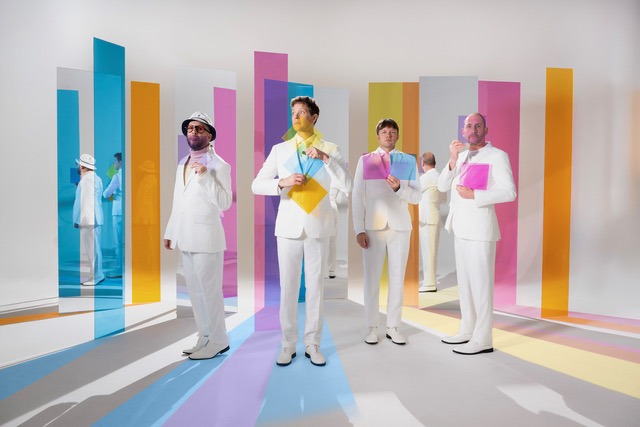
The polymaths of OK Go are so good at making art, some people forget what a great band they are. But beyond the filmmaking, choreography, engineering, and more, they remain a Chicago-born power pop and rock band that puts on one helluva live show. Judge for yourself when the quartet — lead singer Damian Kulash, bassist Tim Nordwind, drummer Dan Konopka, and guitarist Andy Ross — play June 13 at Gallagher Way next to Wrigley Field.
Of course, their fame as musicians is deeply entwined with their renowned music videos, which are jam-packed with a mix of human ingenuity and technical wizardry. The most recent example is “Love,” a single from their fifth studio album, 2025’s And the Adjacent Possible. Shot in the band’s signature single-take style, the disco ball spectacle uses 29 robots and 60-plus mirrors to continually create dazzling new kaleidoscopes. As is often the case, the artists rarely hide the mechanics of what they’re doing; viewers get a good sense of how it all comes together, though there’s clearly a ton of complex choreography also happening off camera.
Before we dive in, Damian, I have a little side story I’d love to share. I have a very old friend who moved a decade ago to Florence, so I don’t get to see him very much, but he was just here visiting. I discovered he hadn’t heard about OK Go, so I had the pleasure of showing him some of your videos. You know that experience of getting to share a great work of art with someone, and when you witness their reactions, it’s almost as good as when you saw it for the first time? I just had that.
This gets to a fascinating, nerdy point that I’ve been thinking a lot about recently: Virality is not just numerically and mechanically and technologically different now; it’s actually substantively different, because people aren’t doing the sharing. Even if the algorithm is just and pure, as we are meant to believe, that’s not the same as you spending an extra long time with something and choosing to send it to someone. Whether it’s your friend or your mom or your kids or whatever, showing people a thing you love is communicating that you’re thinking of them, and it’s communicating something about you: I want to be the person in your life who brought you this. I remember the first person who ever played me Shudder to Think, the first person who ever played me the Pixies. Every band I’ve ever loved, I associate with a person and that person gets a huge boost from me.
Looking at your current album: The song “A Stone Only Rolls Downhill” feels like a perfect balm for our time, with the refrain, “I wish I could say it would be all right / It’ll all be all right.” Of course, you expressed similar themes years ago in “This Too Shall Pass” — but “Stone” came into the public’s ears in 2025, so I have to wonder what space you were in when you wrote it. From the moment I heard it, it sure felt to me like a response to encroaching fascism in America.
You’re definitely not wrong. Let me first say that I think we’re often understood to be a band with lots of positive messages and very happy songs. Statistically, that might not very be quite accurate — although many of our songs with uplifting messages are the ones that get videos. I’m a cynical optimist. I need to move through the world thinking it’s going to be okay, even though my rational brain largely tells me it is not. What I want is music that helps me through that, so I write that music.
The one big difference between “A Stone Only Rolls Downhill” and “This Too Shall Pass” is that I have kids now. That song is written directly to my children. I think the clearest line in that song is: “Someday soon you’ll look out from your hilltop perch,” — our house is on the top of a hill — “your heart worn out from trying to make sense of the arc, which only bends one way.” That’s directly referencing the Martin Luther King quote, “the arc of the moral universe is long, but it bends towards justice.”
I grew up in an era where that was a truism. The world was shitty in all sorts of ways, but it was slowly and gradually getting better. Now, that seems to be more of an exceptional moment in time rather than a truth about the way the world works. How do you tell your kids: “This is getting worse, and the stone is only rolling downhill, and I’m not going to lie to you about that,” and also, “Your optimism, your resourcefulness, and your intelligence are exactly the only thing that can fix these problems. And we love you and the world is going to be all right.” These two things have to live in you at the same time, and that’s sort of what the song is about.
This might be a chicken-and-egg question, but given how much your videos are beloved, I wonder how you negotiate the relationship between music and visuals. I imagine the songs come first and inform your approach to making these whimsical short films. But do you ever develop the ideas together, or tailor the music to fit a video concept?
We have never developed them in tandem. It’s hard enough to write a good song. We have, on occasion, had a video idea sitting around for a long time that attaches to a song later. “Upside Down and Inside Out” is a good example of that. As soon as I learned that NASA’s “vomit comet” had gone private and normal citizens could get into it, I was trying to figure out a way we could do that as a video. But the cost of it was so daunting, there was no way the band could ever afford it ourselves. We get pitched a lot of ideas by marketing partners, and for ten-ish years, I pitched that back: “We could do it in zero gravity! Pepsi is a liquid, and liquids look best when they’re not in gravity!” When an Eastern European and Russian airline approached us and said, “What would you do with an airplane?”, it was like, “Ohh, yesss.” At that point, we look at the catalog of songs we have and go, “Does one of these work with that?”
What do you make a point to do whenever you guys return to Chicago?
I try to see shows at the Empty Bottle when I can, because it’s so special to me. I always get my guitars fixed up at Third Coast Guitars when I can because I love them so much. And I like to go to the Museum of Surgical Science because I think it’s hilarious that it exists, and so beautiful. I believe Dan is actually going to sing at the Cubs game, which I’m pretty excited about. You know, Tim went to the Theater School at DePaul and then worked at the box office at the Goodman, so I know he often visits his thespian friends.
You’ve come a long way from the days of screen-printing posters at the Art Institute and plastering them on streets. What do you miss, and what don’t you miss, about the city?
I don’t miss the shortness of the spring and fall, and I don’t miss the temperatures in the winter. I miss the sense of community. The rock scene in Chicago in the late ’90s and early aughts was so communal and generous. Everybody I knew was in a band, and all we did was go out to each other’s shows. In New York and L.A., it was immediately commercial, but in Chicago, there was something so unassuming and lovely about the fact that it was a bunch of people who wanted to play music for each other, and that was it. Chicago always feels to me like the biggest small town in America. People smile at you and wave when you pass them on the street. It’s a small wave with a metropolitan caution, but it’s not what you see in New York or L.A.. There’s an attitude to Chicagoans where they don’t feel like they own the world, and I appreciate that.