


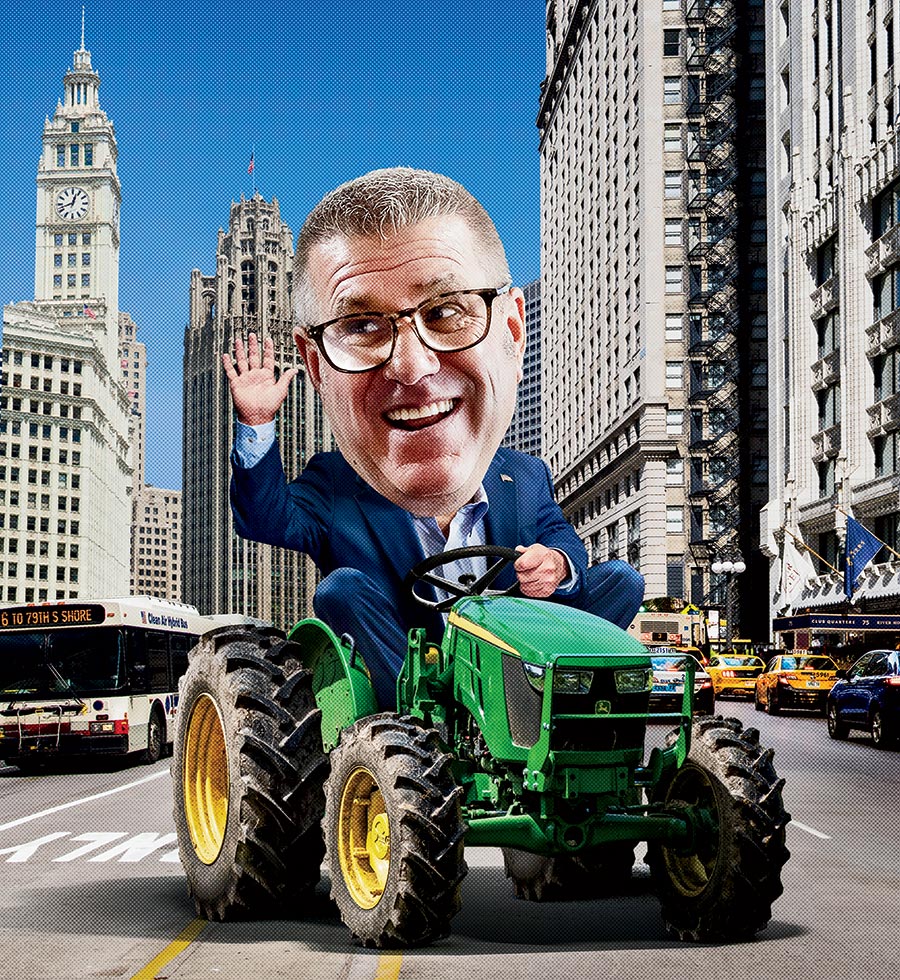
There aren’t many places where Darren Bailey is less popular than in Chicago. In 2022, the first time the Republican ran for governor against Democratic incumbent JB Pritzker, he called the city a “hellhole” during a speech at the Illinois State Fair. (This was even before Donald Trump famously used that characterization.) Chicago returned his contempt, giving Bailey a measly 16 percent of its votes.
So it might come as a surprise to learn that Bailey, who has a corn and soybean farm in rural Clay County, some four hours south of Chicago, is living among us during his second run for governor. He did so in the last election, too, but for a much shorter stint. This time, right after winning the March 17 Republican primary, he and his wife, Cindy, moved into an apartment in the South Loop, where they plan to reside at least through the November 3 election. What’s this downstater doing here? The way Bailey tells it, he’s trying to bridge the gap between two regions of the state that want little to do with each other.
“One thing I learned from four years ago: Illinois has a lot to learn about itself,” he says. We are at Wildberry Pancakes and Cafe, across the street from Millennium Park. Bailey greeted a few diners on the way to our booth, but as we’re drinking coffee, no one, if they even recognize him, is bold enough to interrupt our conversation. “People in southern Illinois don’t always trust people in Chicago, and people in Chicago for the most part don’t know what exists in the southern part of the state,” says Bailey in a southern Illinois twang rarely heard in these parts. “I hope I can bring an overall understanding of what the rest of Illinois has to offer.”
During the 2022 campaign, Bailey leaned into his political image as a conservative downstater and Trump supporter, but that backfired in the general election, when Pritzker soundly beat him 55 percent to 42 percent. “I don’t know that I was working with the groups that I needed to work with,” Bailey says. “I don’t know that I was in the places that I needed to be. So we’re trying to be a little more strategic about that.”
This time, he is positioning himself as more moderate. He has promised not to ban abortion in Illinois. And he’s distanced himself from Trump, criticizing the president’s attack on the pope and rejecting the MAGA label. Bailey’s moving here is “a symbolic way to show he is reaching out to the political center,” says political analyst Laura Washington. “It won’t get many votes in Chicago, but he wants to seem more reasonable and compassionate to moderates, especially in the metro area. That might earn him a little bit better showing than in his last run. Still, Bailey beating a two-term governor with presidential aspirations in this blue state is a massive mountain to climb.” The most recent poll, back in November, showed Bailey trailing Pritzker by 20 percentage points.
A downstate politician moving to Chicago for an election isn’t new. After all, this is where the votes are. Senator Alan Dixon, from Belleville, used to reside in the Chicago area for his campaigns in the 1980s and 1990s. But he was a Democrat. Jim Nowlan, a political commentator and former state legislator, says he recently recommended that Republican Don Tracy decamp from Springfield to the Chicago suburbs for his U.S. Senate race against Juliana Stratton. (Tracy has not taken the advice.) So Nowlan respects Bailey’s move: “Politically, it’ll be valuable, because he’ll learn some things — that diversity’s not bad. But I don’t think he’s going to get more than a healthy 42 percent of the vote.”
Chicagoans haven’t forgotten Bailey’s remark about their town. At a Cubs game, he says, “people would come up to me and jokingly say, ‘You still think our city is a hellhole?’ ”
Bailey figures he can pick up votes by tapping into a concern that Chicagoans share with downstaters, one he hopes could translate into disenchantment with Pritzker. “People are expressing their frustration at the high taxation and the high cost of living here,” he says. “They’re pretty angry about it. I haven’t talked to very many people who haven’t considered moving out of the state for a more affordable lifestyle.”
What’s city life been like for the Baileys? “We feel like we’re past the tourist stage and belong here,” he says. “We have no problem taking off walking. My wife loves coffee spots — Deko and Intelligentsia. I encourage people to visit Chicago. I’ll give ’em recommendations for restaurants.”
Bailey is a big man with a big appetite, so dining out is one of the first things he wants to talk about. Back home, he says, there’s just “mom-and-pop diners.” Here, on their free evenings, the Baileys often pick out a new spot to try. Rosebud Steakhouse. Eggy’s Diner. Uncle Remus. Harold’s Chicken. Sweetwater Tavern & Grille. Bailey gushes, “14 Parish in Hyde Park — that was fun.”
Religion is a big part of Bailey’s brand. So naturally, he’s been campaigning in churches, trying to cross political and racial lines. He toured the Robert R. McCormick Leadership & Economic Opportunity Center, slated to open this summer on the Park Manor campus of New Beginnings Church. And at True Light Church Baptist, in Grand Crossing, Bailey offered to apply his farming skills to the church’s community garden. “I asked who’s in charge of watering the plants, who’s in charge of keeping bugs off the plants,” he says. “And I told them, ‘I’m going to come back here in a month and a half and take a look at these plants and make sure they’re still thriving.’ ” (While Bailey is away, his sons, Cole and Mason, are looking after the family farm.)
Of course, while here, Bailey has had to do a mea culpa tour, walking back his “hellhole” comment. In May, he appeared before the City Council. “I owe you something: I owe you an apology,” he told its members. “I said some things about Chicago that were wrong. What I meant was that the political class is failing us, and I should have been more clear.”
Still, Chicagoans won’t easily forget that remark. Bailey says that when he went to a Cubs game, “people would come up to me and jokingly say, ‘You still think our city is a hellhole?’ ”
For the record, he says he no longer does. But plenty of downstaters still do. “People across the state, when they know that we’re here, the first thing they tell us is ‘Be safe,’ ” Bailey says. “They’re concerned that we’re here. And we’re like, ‘No, it’s fine. You just got to be careful where you go and what time you’re there and be smart about things.’ ”
Spoken like a true Chicagoan.