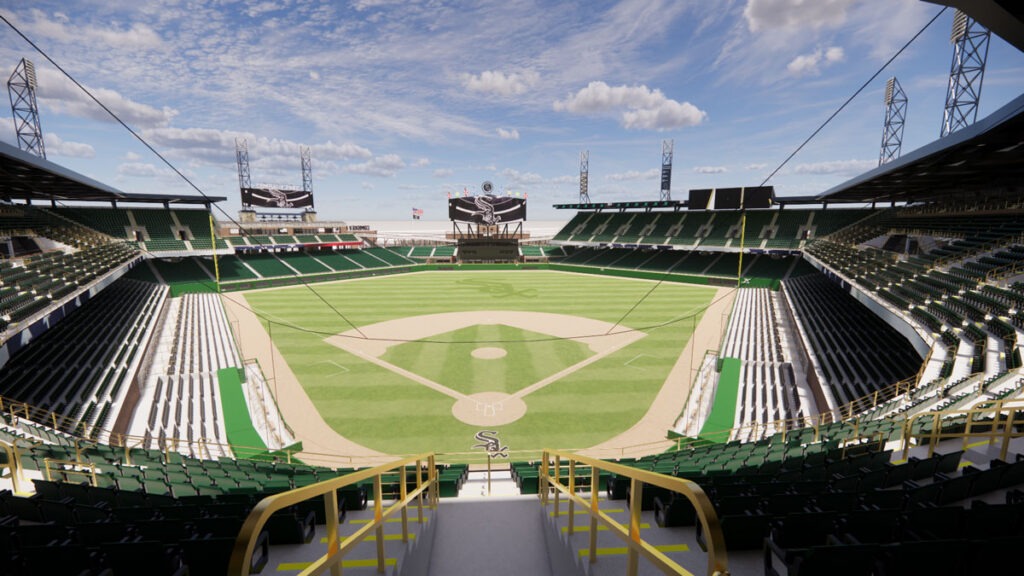


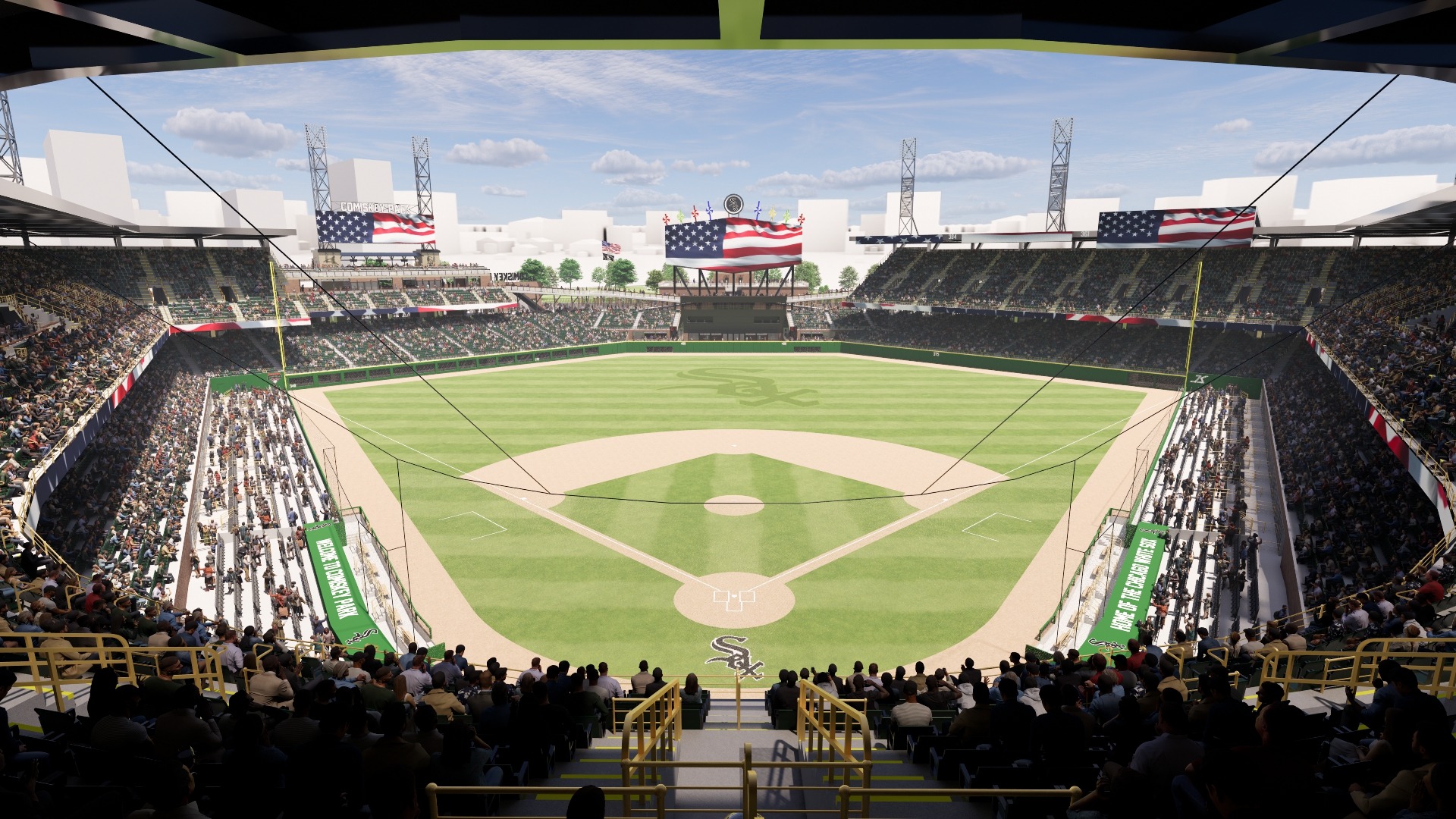
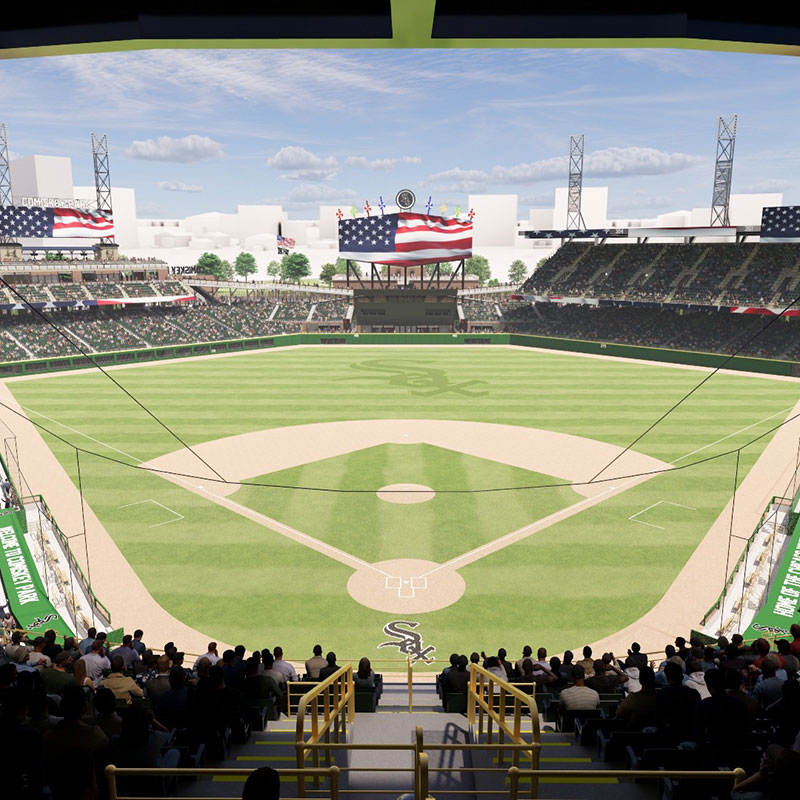
We have lost something in our experience as fans at the ballpark.
Yes, we are thankful to be beyond the multipurpose, donut-shaped era of stadium design. Each of the 22 stadiums built since Camden Yards — which opened in 1992 and ushered in the retro era — feature different dimensions, unobstructed views, and pleasant vistas beyond the outfield seats. They have wide concourses and great amenities.
But there is one great flaw that is present in almost every ballpark of the retro era: They’ve pushed us farther away from the game.
At Progressive Field in Cleveland, for instance, there are three levels of suites between the upper and lower decks. There is also zero cantilevering — when a structure hangs over something beneath it — of the upper deck over the lower bowl. In other words, by building the park up and out, designers kept fans away from the sights and sounds of baseball.
In Chicago, consider how much Rate Field dwarfs Old Comiskey, which was one of the first concrete-and-steel ballparks, part of the so-called “jewel-box” era. Fans were closer to home plate in the last row of the upper deck at Old Comiskey (150 feet) than in the first row of the upper level at Rate Field.
While Rate Field, which opened in 1991, is considered to be the last stadium built before the retro era, its multiple decks — and little cantilevering — fit the same modern model. Wrote Chicago Tribune architecture critic Blair Kamin when Rate Field first opened in 1991: “(Baseball) is a performing art that lacks the explosiveness of a Michael Jordan slam dunk, so its drama needs to be magnified to captivate the fan.”
The distance change was so jarring to Chicago sports fans in the early 90s that a Chicago Sun-Times editorial cartoonist depicted two fans surrounded by empty seats in the upper deck with a Goodyear blimp floating below them.
White Sox fans, and others in modern ballparks across the country, are pushed up and away, over and over again in the cheap and median seats. But what if there was a different vision for an optimal version of a ballpark? Well, a couple of other ballpark nerds and I did just that. We built a better ballpark.
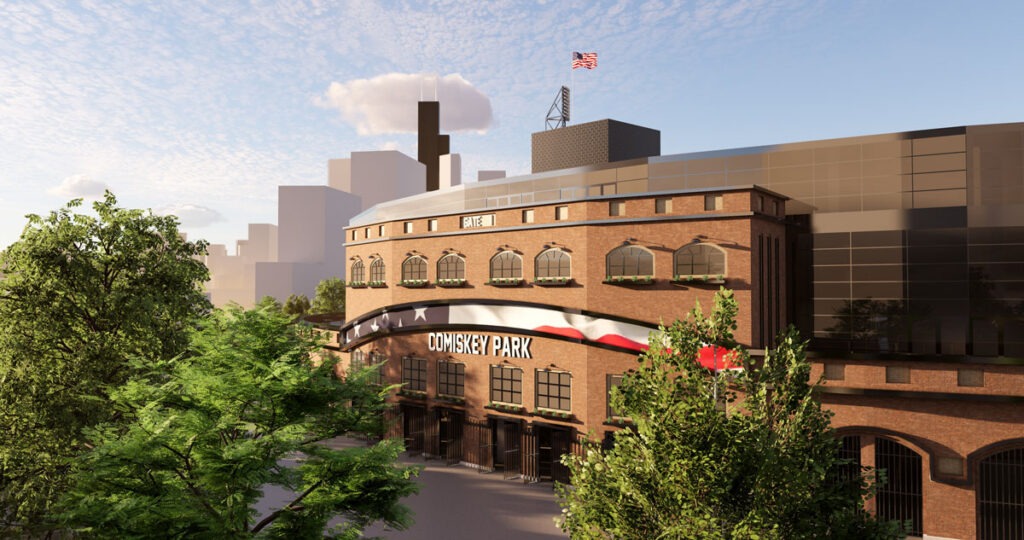
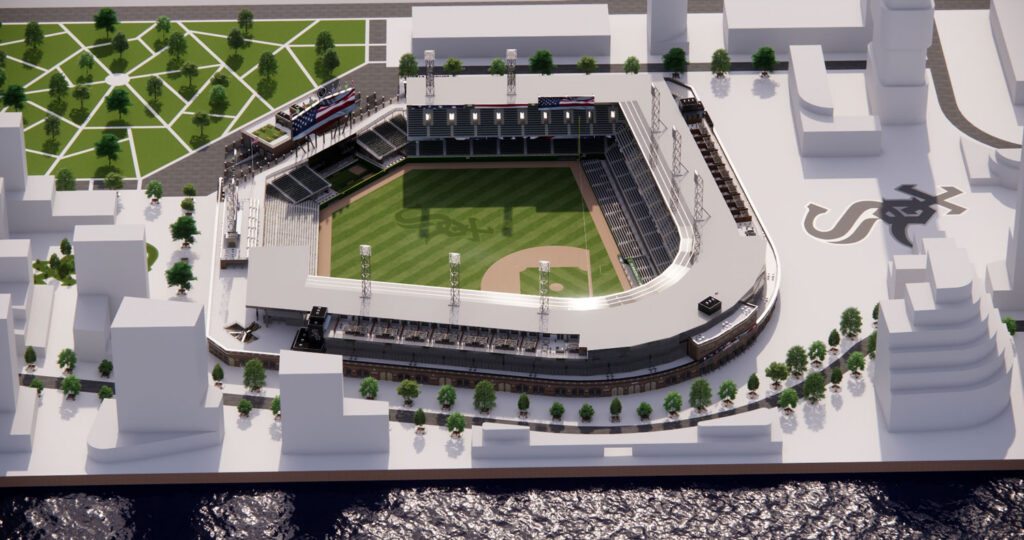
Specifically, we built a virtual stadium, a vision for a new home for the White Sox, who are currently looking to construct a new ballpark to replace Rate Field, perhaps in the South Loop.
The idea was to adopt the best aspects of old Comiskey, reviving parts of the jewel-box era experience, while modernizing the ballpark.
Last year, I started kicking around an idea with Mark Anderson, a fellow ballpark enthusiast who runs the popular X account @MLBCathedrals, where he shares old photos of stadiums and discusses ballpark design, and Jack Stamm, a self-taught ballpark design wizard who employs software to create stadium designs and shares his creations on social media (@architecturejks). While Anderson and I shared our ideas, Stamm made them a virtual reality.
“If we were able to bring back one ballpark that had seating kind of like what we are proposing, it would change everything,” Anderson says. “I think fans would love it. As soon as you recognize that sitting in the first 10 rows of the upper deck is better than anywhere else in the stadium, people will adjust to that and want to sit there. Everybody that would go up there: the media, the fans. They would say ‘Wow, this is amazing. You are right on the field.’ You could hear the players again.”
We’re going to place you at the same distance as fans were at Comiskey Park in the upper deck, and much closer in the lower level. We’re going to do that without structural support beams obstructing vision in either deck. We’re going to deliver a true vintage experience — how the game was meant to be heard and observed — but we are also not ignoring how fan behavior is changing: There will be social spaces, and plenty of dining and drinking options.
We incorporated the arches of Zachary Taylor Davis’ original Comiskey Park that served both form — an aesthetic flourish nodding to the idea of a ballpark as a cathedral — and function, allowing air to filter the stadium on warm summer days. But between the arches and seats we include a 360-degree open concourse.
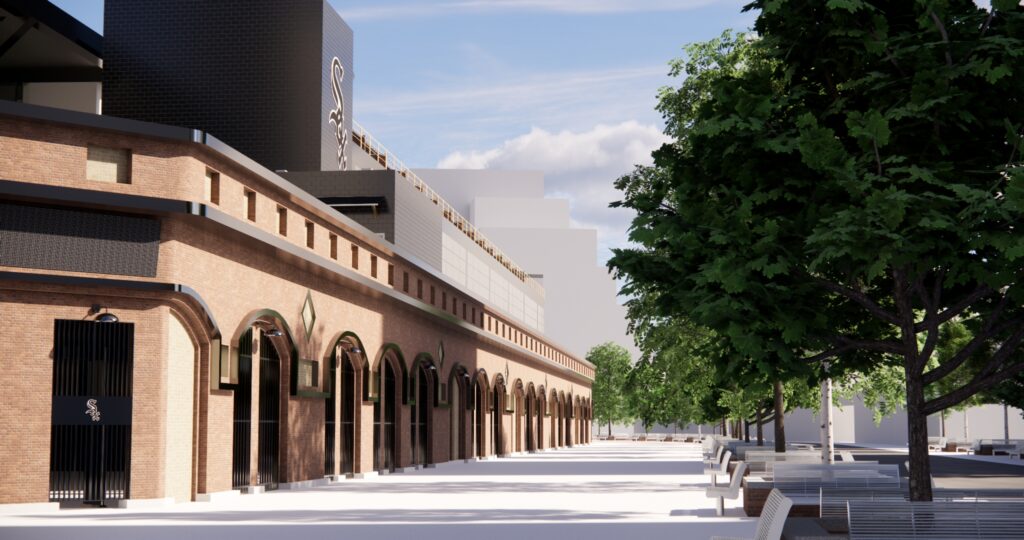
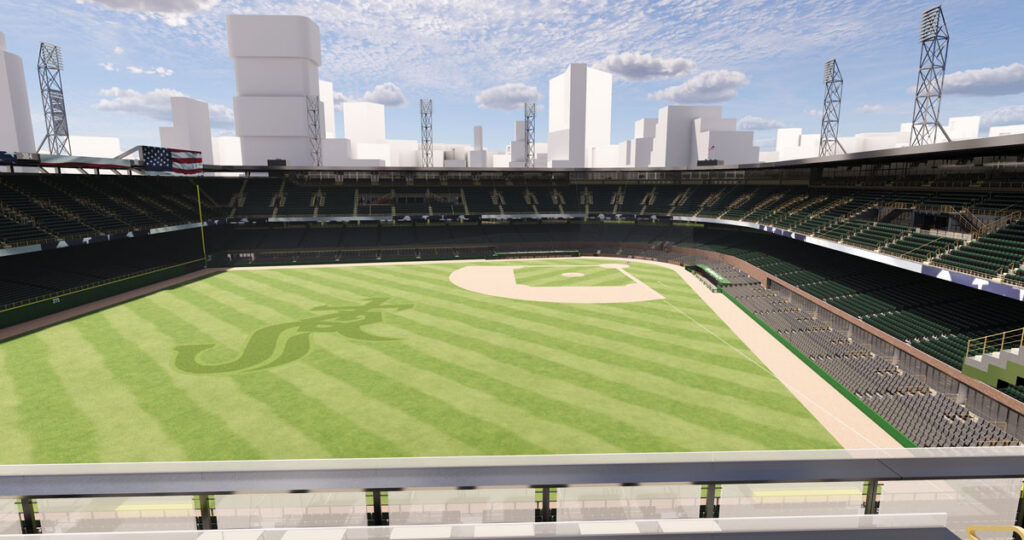
We kept the outfield wall dimensions the same as at the time of its demolition: 347 feet down the lines, 382 to the power alleys, 409 feet to center. But we shrank the foul territory. We also kept the same Kelly-green seats and gold railings that were features of the park in its 1981 renovation.
Unlike the original Comiskey, there is no upper deck in left field. We wanted to accentuate one of the park’s best features: The proposed site location offers the Chicago skyline as a dramatic backdrop.
We aren’t from Chicago, but our choice of Chicago was purposeful. We wanted to create this vision of a ballpark for a team sorely in need of it. The White Sox famously missed the retro revolution with the regrettable choice to build Rate Field. Camden Yards was the next stadium to open. But with an agreement in place to transition to new ownership, and a desire to build a new stadium, there is an immense opportunity to get it right with a new kind of ballpark on the South Side.
Welcome to Comiskey III.
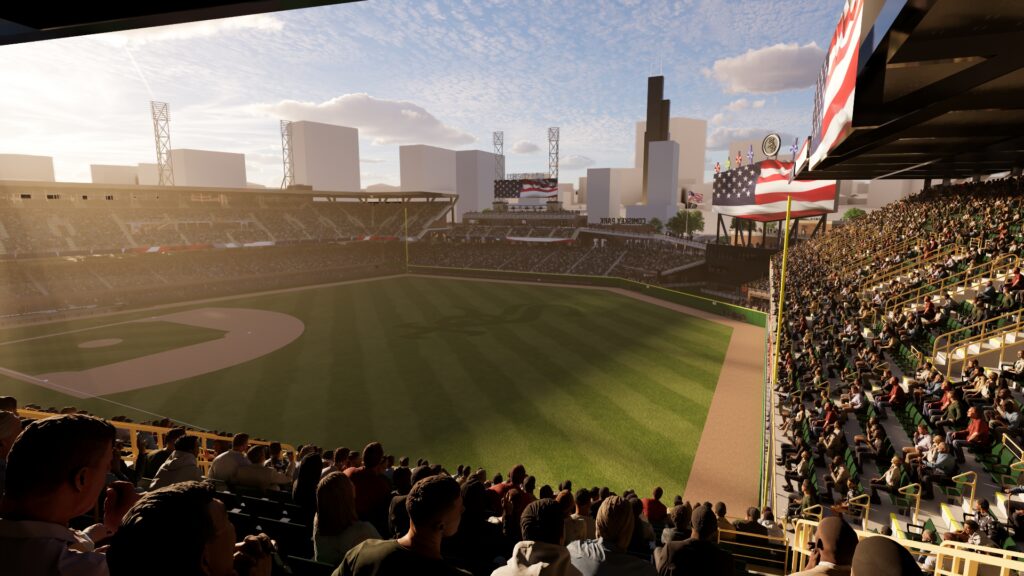
PNC Park in Pittsburgh is the most intimate of the retro-era stadiums, the one exception to the design flaws of its peers. Its lead design architect David Greusel told me that much of its magic is tied to working within a tight parcel of land.
“I have found over the years that size constraint is actually an advantage more than a disadvantage,” Greusel says. “It forces you to make decisions that introduce a lot of creativity. For example, Oracle Park in San Francisco is on a very small site, but I think works to its advantage in terms of things like short right-field dimensions and balls being hit into McCovey Cove. We had similar constraints (at PNC). For example, pushing the Isabella Street rotunda into a part of the ballpark where people who are walking up that ramp can see the game in progress. That turned out to be a huge advantage. It now becomes a unique perch to watch the game from, a popular place for people to just stand and take it all in.”
It’s no coincidence the least interesting period of stadium design, the cookie-cutter era, was not limited by constraints. These monstrosities were built in unconstrained areas, and surrounded by seas of asphalt parking lots. Consider facilities like Three Rivers Stadium, which predated PNC Park as the home of the Pirates.
“They leveled a whole bunch of the North Shore to build it and then they just plunked the circular building down in a giant parking lot,” Greusel says. “It was like the worst kind of suburban planning and in an urban context.”
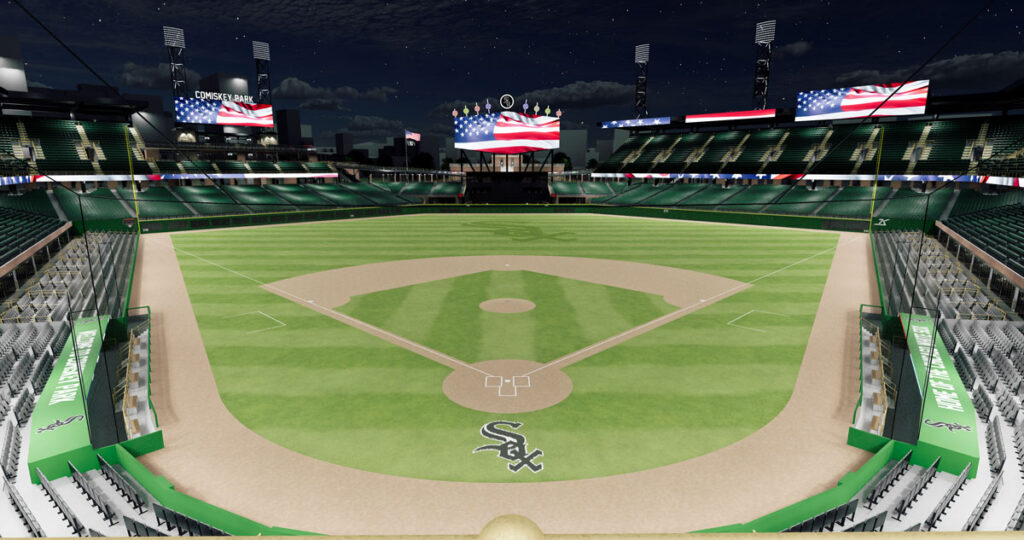
So as we designed a new Comiskey, we wanted restrictions — not just because it’s more realistic that way, but because it would help us build a better park.
When it came to our Comiskey III project, Anderson was adamant that we maintain the exact upper deck dimensions from the original Comiskey. When there was some debate about moving the first row to 110 feet from the plate, Anderson texted us that “the upper deck should be exactly 100 feet so we can say the upper deck is exactly the same distance as the original.”
Below the upper deck there would be no vertical support columns, another design constraint, and the lower level would be much closer to the plate than at the original Comiskey. The distance from the plate to the first row behind it is just 45 feet, matching the Rangers’ Globe Life Field in Arlington, Texas, for the closest such distance in the major leagues.
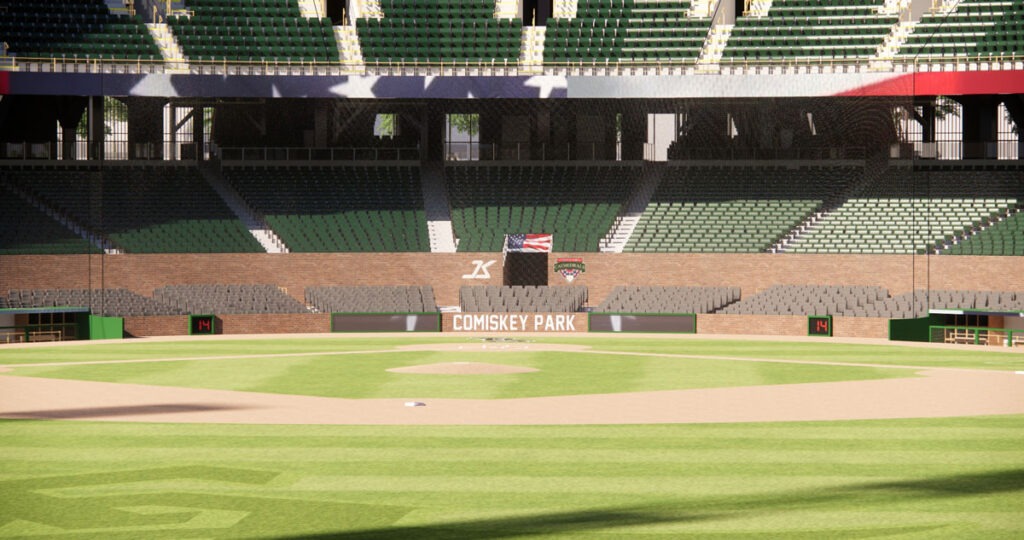
To make this realistic — meaning, commercially viable for an owner — we added other constraints: We had to match the number of suites in recent MLB stadium constructions and also house multiple social areas tailored to the changing behavior of fans. When Comiskey Park opened in 1910, fans largely spent the duration of the game in their seats, straw hats and all. Not as many do so today.
We also wanted to build within a constrained parcel of land just like the jewel-box era parks of the early 20th century, and some of the best designs of the retro era. So we chose The 78, a location where the White Sox have considered building their new venue. It’s a site of 62 undeveloped acres — soon to be home to Major League Soccer’s Chicago Fire — within the city’s South Loop. The location is constrained by the Chicago River to the west, Roosevelt Road to the north, and Clark Street to the east. A sprawling stadium cannot be built here. (In March, it was reported that Shore Capital, the private equity firm of Sox owner-in-waiting Justin Ishbia, is set to purchase a 47-acre Amtrak rail yard across the river from The 78.)
Anderson often proselytizes to his large social media following on the benefits of constraints. Asked by X users why Fenway Park has the Green Monster or why Wrigley Field looks the way it does, he points to their environment, surrounded by tight city blocks of a neighborhood.
The power of constraints is clearly seen in modern ballpark design, too. There’s the aforementioned San Francisco Bay at Oracle Park and the B&O Warehouse beyond right field at Oriole Park at Camden Yards in Baltimore.
“That would have never happened if you had an unlimited expanse of space,” Anderson says of the iconic venues.
While the retro-era parks were often confined by city blocks, there was no limitation on how high they were built or on how many suite layers could be added. It doesn’t help that one firm, Populus (formerly HOK), designed most of the retro-era stadiums. “You have one company doing design,” Anderson says. “I think they got stuck in a bubble.”
Two years after the new White Sox stadium opened, architecture critic Blair Kamin wrote a critique for the Chicago Tribune, focusing on the venue’s much-loathed upper deck: “Ever since the Greeks designed outdoor amphitheaters for the tragedies of Euripides, mankind has struggled to resolve the problem of accommodating large groups of people in small amounts of space to witness the performing arts. The brouhaha over Comiskey is simply the latest variation on this eternal theme.”
In many ways, the upper deck is the focus of our project. And it is through the upper deck that earlier stadiums did a better job of democratizing the fan experience.
According to architect and ballpark design hobbyist Brian Powers, designers of the early concrete-and-steel ballparks sought to emulate theatre seating, where the balcony is brought forward, providing a good vantage point. In our design, the upper deck — so often an afterthought in modern ballpark design — becomes more like a balcony. There are no layers of suites between the lower and upper decks, no club seats that push the upper deck into the clouds.
And, yes, we hear those of you who have been tucked way under an overhanging upper deck at Wrigley Field or Tiger Stadium in Detroit. Wrote Mark in our text thread: “Every time I bring up the superiority of the upper deck at Tiger Stadium and Comiskey, (people) always say the lower bowl sucked.”
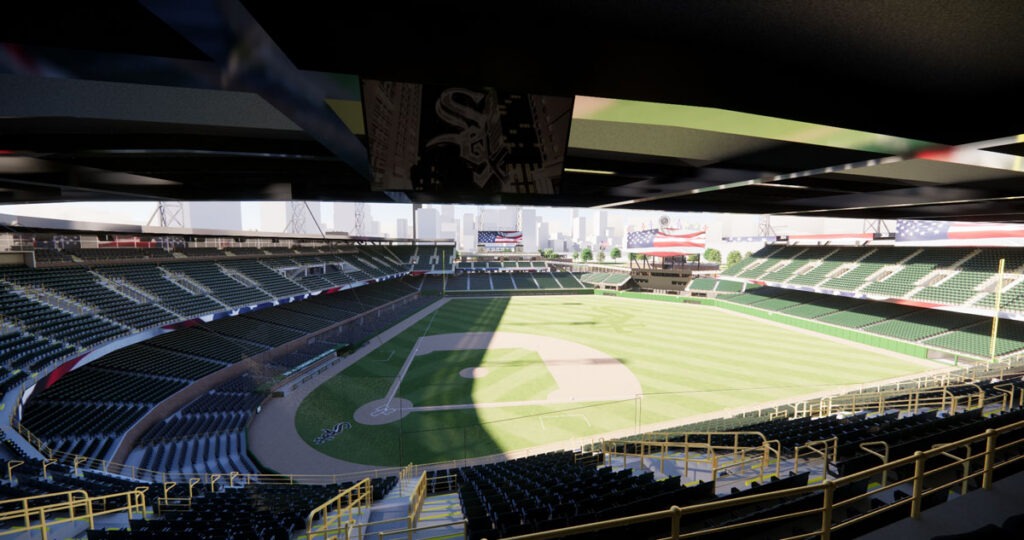
Our design anticipates that problem. For starters, there are no seats obstructed by vertical support columns. Sure, some fly balls wouldn’t be totally visible in the seats furthest back in the lower deck, but even the last row of the lower deck allows for visibility of all line drives and fly balls with lower launch angles.
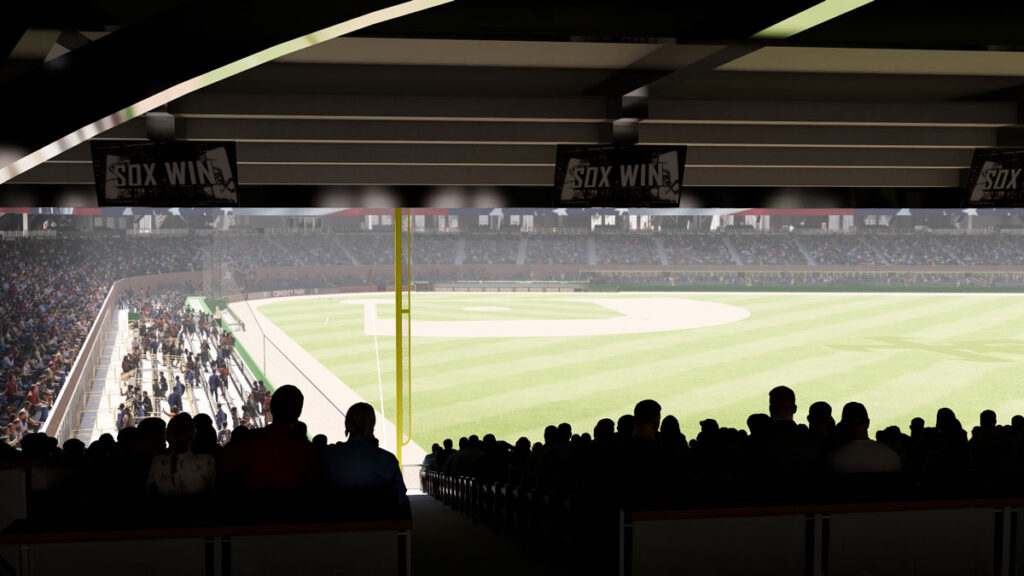
How is this possible? Without suites attached to the underside of the upper deck — as were added at Wrigley in 1989 — there is less obstruction. Moreover, because of the arches, the upper deck is five feet more elevated than that of Tiger Stadium.
While 19 of our 29 lower-deck rows are covered by the upper deck, there are superior horizontal sight lines compared to the jewel-box era parks, in addition to the lack of vertical pillars.
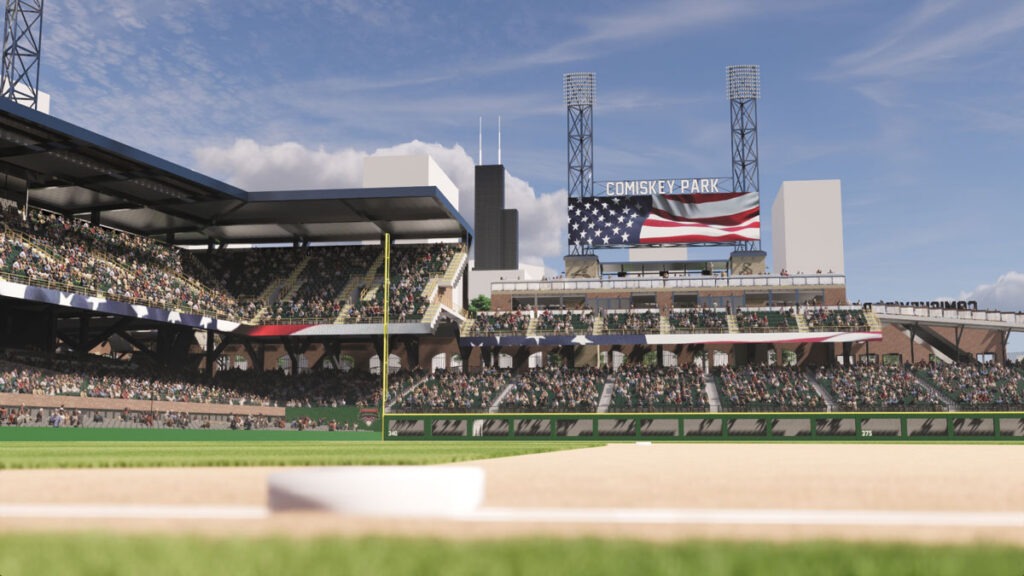
Is it physically possible to cantilever to such a degree without vertical support blocking views? The short answer is yes.
Greusel’s upper-deck cantilever at PNC Park is among the most aggressive of the retro era. It includes 38 feet of overhang over the lower deck. He says that even more aggressive cantilevers are possible, but they add construction costs. In essence, a greater counterweight is needed, or another support structure, to support the protruding deck.
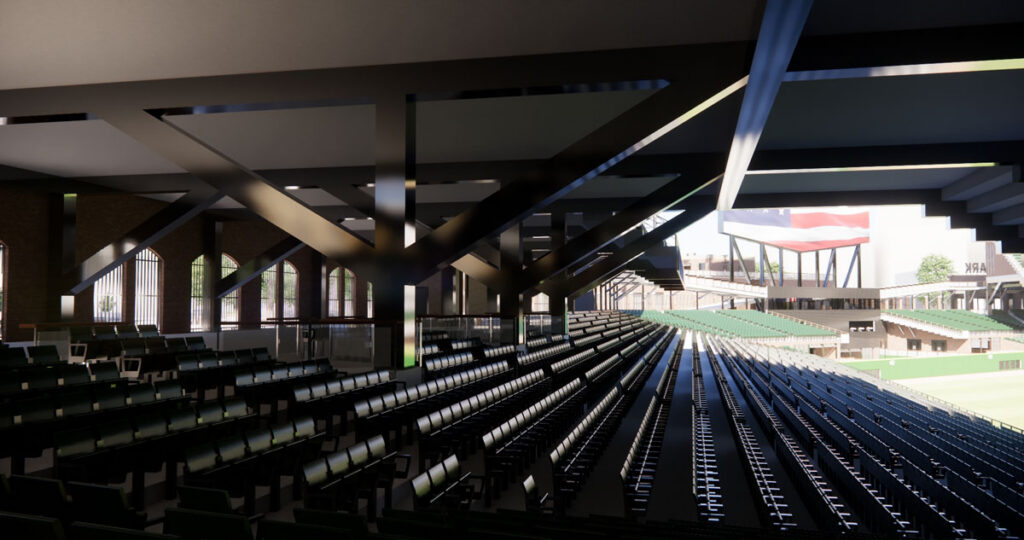
“The columns (at PNC) are immediately behind the last row of seats (in the lower deck),” Greusel says. “By pushing the upper deck that far forward, we were able to create a very intimate environment. That required some gymnastics with our structural engineer. But that was a decision that we made that I think paid dividends in terms of creating a more intimate and baseball-friendly environment.”
(It’s also worth noting: PNC Park is the first stadium built since Milwaukee County Stadium to feature only two seating decks.)
To support our cantilevering, we also have our main vertical support beams just beyond the end of the lower bowl seating, and we created exceptionally wide concourses to mask the greater, necessary supporting structure needed to serve as a counterweight. No, we aren’t engineers. But we ran the idea past Greusel, and he suggested that it should, in theory, work.
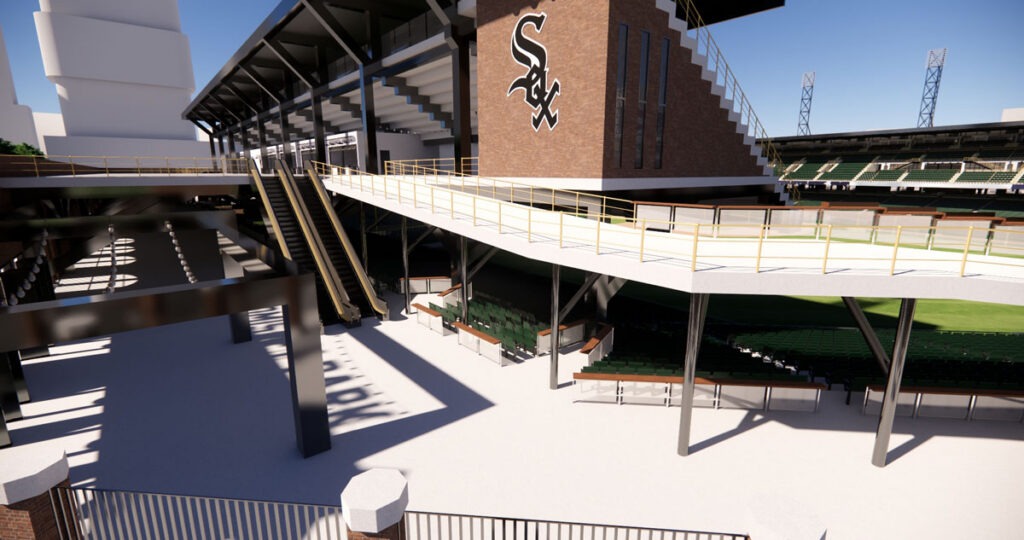
Because our proposed field is sunk 25 feet into the ground, the lower bowl and concourse require less concrete and steel, making it cheaper to construct. We place the lower concourse at street level, which also allows passersby on the exterior sidewalk to catch glimpses at the field through the arches.
This would not be an expensive construction project relative to other new stadiums. For one, there’s no dome or retractable roof. That was purposeful. Consider what architectural critic Paul Goldberger wrote in his book Ballpark: “The reality of the ballparks in Toronto, Phoenix, Houston, and Milwaukee is that the roof always looms large even when it is open to the sky.”
Both Stamm and Anderson grew up obsessed with ballparks. They filled the margins of their notebooks in grade school doodling designs — dreaming up venues that were more interesting than the parks they were familiar with, like the Mets’ Shea Stadium in Queens, New York, and the Mariners’ Kingdome in Seattle.
These days, Stamm has swapped his grade-school notebook for software. In his spare time, he designs ballparks on his computer, using SketchUp for design and Enscape for renderings. Stamm believes every stadium ought to have a “wow factor,” a signature element that sets it apart.
One wow factor in this project? “The cheap seats do not offer a cheap view,” Stamm says. “The statistically worst seat in the house is still much closer to home plate than you would be in any modern outfield. That’s what the average fan would love about this place.”
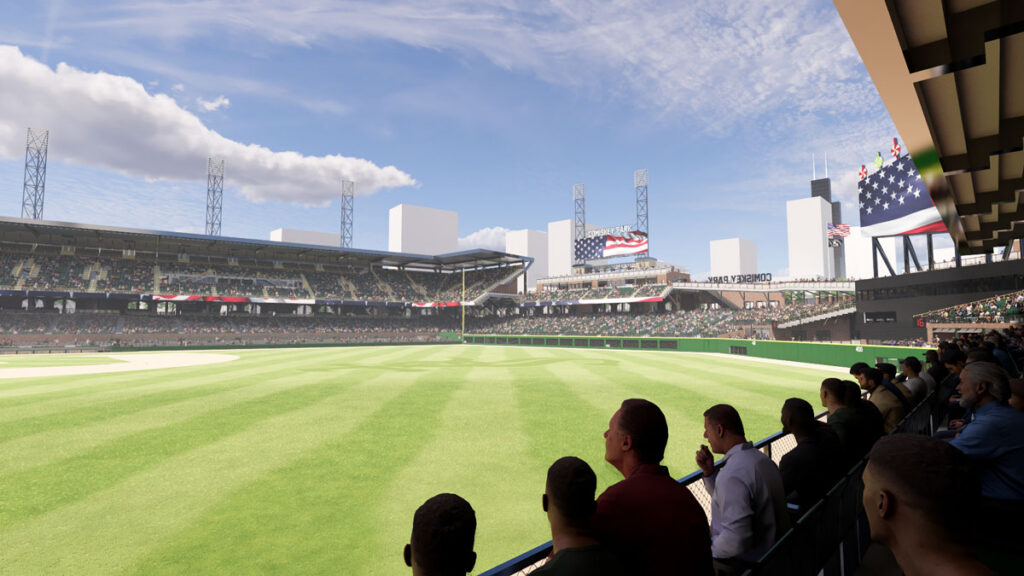
Stamm also wanted a more modern signature, so he designed a translucent upper-deck covering — nothing it exists in MLB. One third of the roof, the portion closest to the field, would allow natural light to filter through.
That became important since we have more roof coverage than any non-dome stadium in baseball. Combined with the arches in the lower level, which allow horizontal light to flow in, this ballpark shouldn’t feel like you are sitting in a dark bunker.
Another perk of our roof: Home runs can land on it. Too often, in modern ballparks, home runs don’t land in interesting places. “In Comiskey and Tiger Stadium, home runs were interesting because you had lower-deck shots, upper-deck shots, and roof shots,” filmmaker Matt Flesch, who produced the documentary Last Comiskey, told me. “Now, there’s often nowhere to hit it into.”
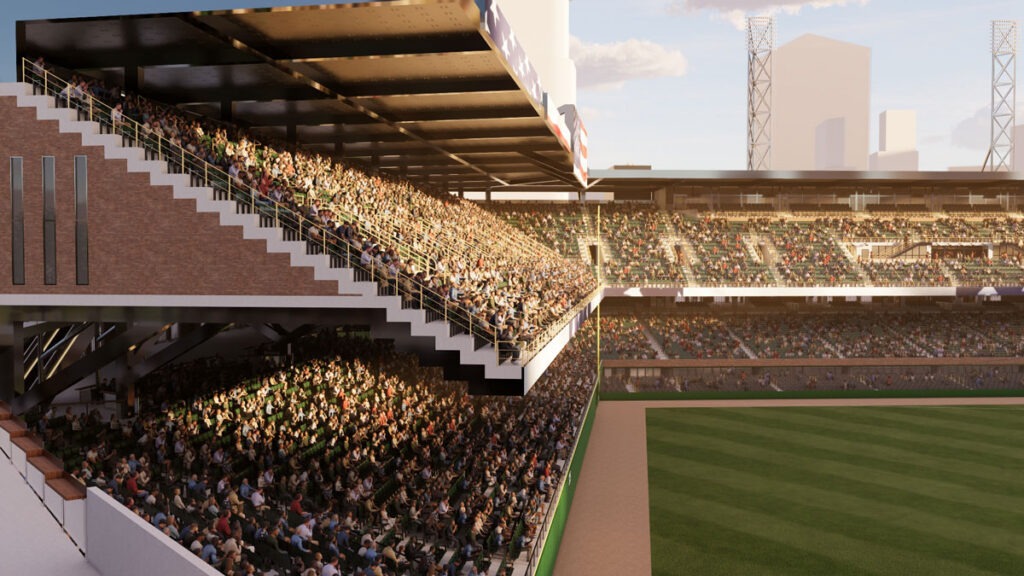
Fans buzzed about the roof shots at Comiskey in 1983 when White Sox sluggers Ron Kittle and Greg Luzinski blasted home runs onto the roof after home plate was moved eight feet closer to the outfield fences. Luzinski appeared in a color poster that showed him standing on the old Comiskey roof. Roof shots were tracked by fans and media, with 44 hit at the park.
“Tagging a four-bagger onto the outfield concourse at new Comiskey just doesn’t have the same swashbuckling cachet,” Kamin wrote of the park in 1993. “When Big Frank Thomas sends one out there, the yawning spaces of the stadium shrink his achievement rather than making the homer, and Big Frank, seem larger than life. It’s not a matter of hitting the ball a long distance but of overcoming some barrier that adds dramatic weight to the deed.”
By condensing the seating structure, we again magnify the action — and give the home run its proper dramatic weight.
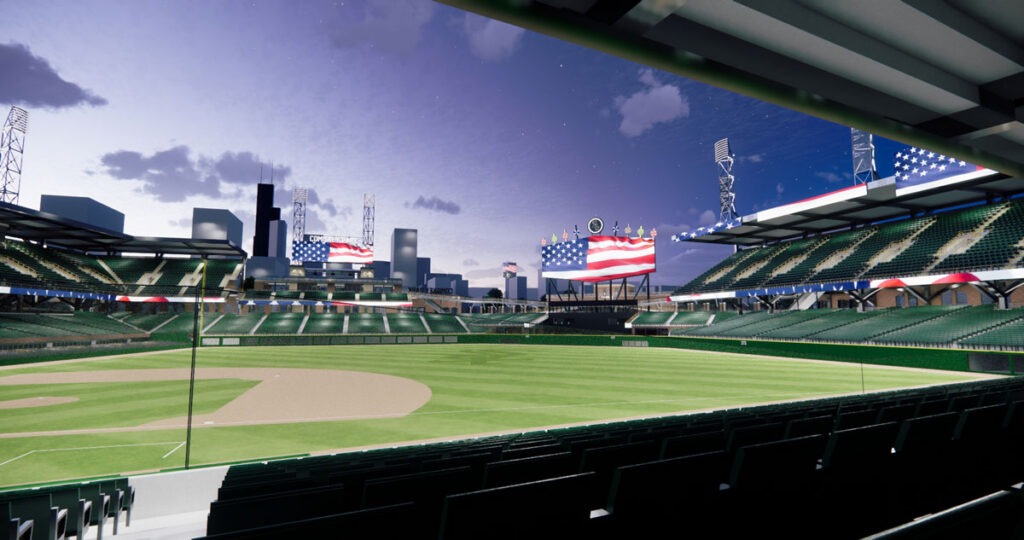
The three of us are ballpark nerds, glued to our seats from first pitch. But we understand that in this age, not every fan is like us.
With those fans in mind, we created four social sites in the ballpark that feature standing-room areas with bars and restaurants.
One of these is embedded in the upper deck along the first-base line, and an expansive open-air party deck rests beyond the left-field seats, along with an elevated restaurant similar to the Chophouse at Truist Field in Atlanta (Lou Malnati’s, anyone?). Other social areas with standing room views of play are located where the picnic areas were at the original Comiskey: under the outfield seats but with views to the field through a chain-link fence. These areas are more club-like, speakeasy-style bars. There’s the Al Capone Bar in left and the Elliot Ness Pub under the right-field seats, depending on your mood.
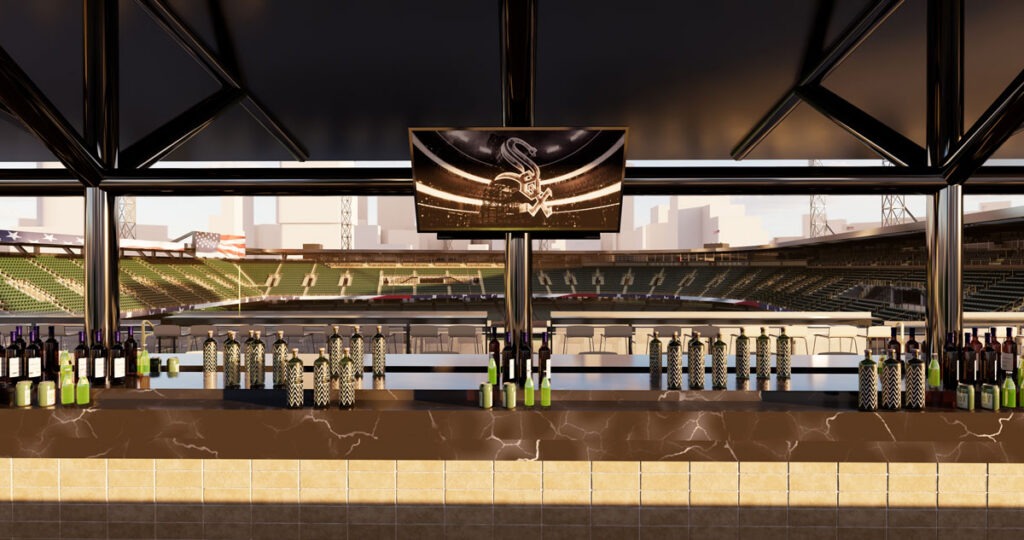
While private suites have lost some popularity in favor of more social and club areas, there’s still enough demand for 46 at Truist Park, one of the most recent constructions. We sought to at least match that number, but without adding extra layers to the ballpark.
We created 54 luxury suites and embedded 28 within the lower-level bowl in a manner that does not force us to raise the upper deck. These suites are situated just beyond the field box premium seating. In essence, the lower bowl is split into two: half premium, half non-premium space. The other 26 suites are placed at the back of the upper deck, wrapping around from first to third base.
We want fans to experience the sights and sounds like fans did in the jewel-box era, but with access to modern amenities.
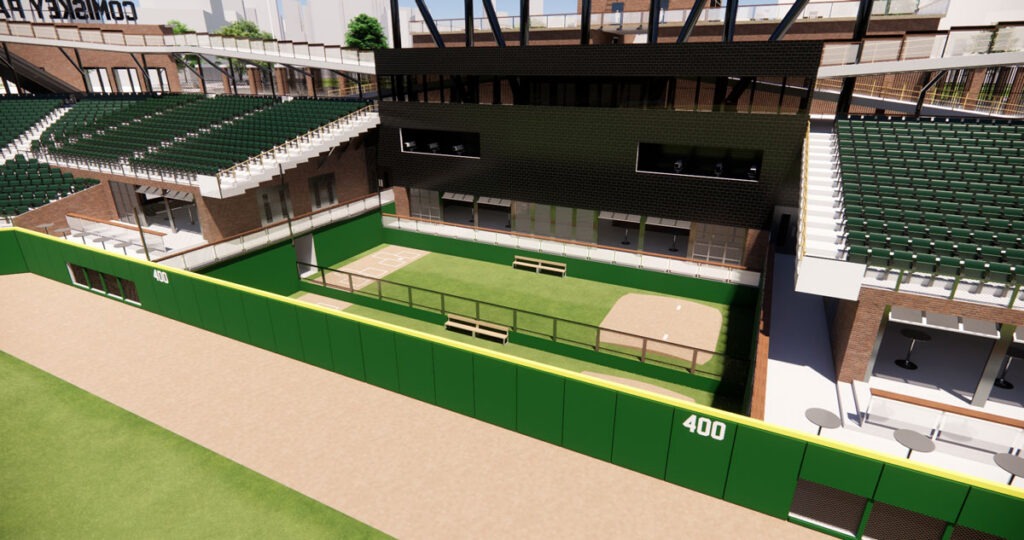
Our vision of Comiskey brings fans so close to the action that perhaps they won’t look at their smartphones every few seconds.
The White Sox will have their own ideas for a stadium, when the time comes; Related Midwest, the developer behind The 78, even released renderings in 2024. But before the shovels hit the ground, the franchise should be aware that poor design can be a billion-dollar mistake. Sometimes it requires a new stadium to be built sooner than should be expected (hello, Atlanta and Arlington, Texas). In other cases, a poor facility can play a role in a club leaving the city.
A well-built stadium should be like a cathedral. It should last for a century or more, just as Wrigley and Fenway have done.
“There are octogenarians that will say ‘Oh, yeah, I remember going to Ebbets Field.’ They could hear the players because they were right on top of it,” Anderson says. “My dream is to see this come to life. Wouldn’t it be amazing? Maybe it wouldn’t look exactly like we are proposing, but it gives you the general, basic idea of what is possible.”
A new revolution in stadium design, a Comiskey III, is possible. And if a park like this is built, people will come — and they’ll return, again and again, to watch baseball as it was meant to be watched.