


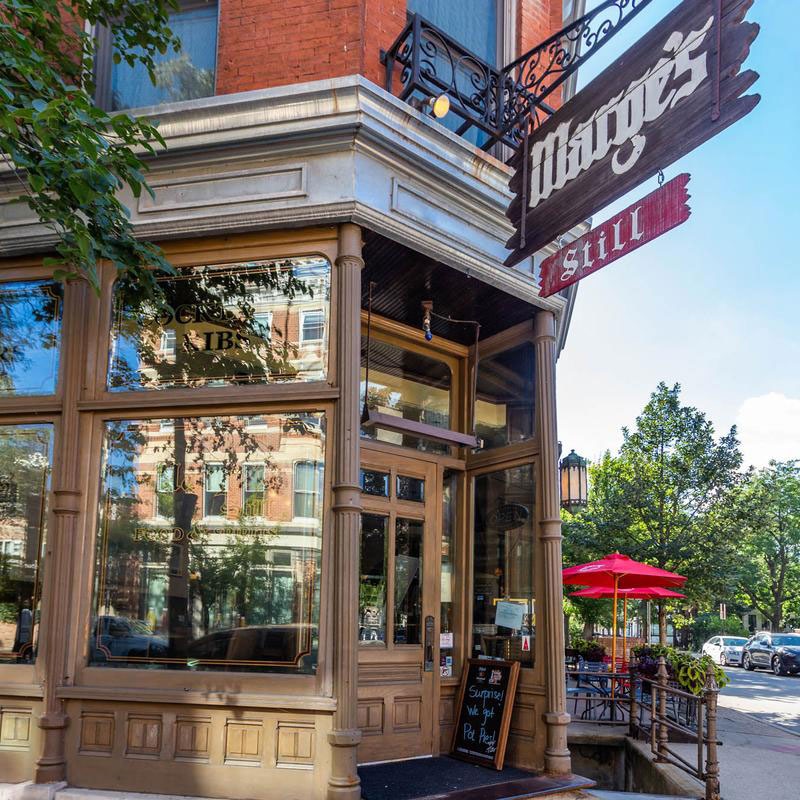
Andreas Antoniou was chatting with a fellow traveller in Zurich, Switzerland, when he mentioned he was from Chicago. “We love Chicago,” they replied. “We went to a bar there, the oldest bar.”
“Which one was it?” Antoniou nervously asked.
“Marge’s,” they answered. “We loved it!” Relief fell over Antoniou: He’s owned Marge’s Still since 2005. He’s had his doubts, though, about its claim to being the city’s oldest bar.
“I’ve always thought that maybe one day someone is going to come up and prove that we’re the second oldest or the third,” he says.
Since Schaller’s Pump in Bridgeport closed in 2017 after 136 years, Marge’s Still has widely been considered Chicago’s oldest bar. A beer barrel’s worth of publications have repeated the same story: A tavern has continuously run at 1758 North Sedgwick since 1885, when it was founded as Victor Caruso’s Soft Drinks.
But there’s a correction due in Chicago Taverndom.
I’m a bar historian, which is to say, I like drinking in old taverns, hearing stories, and figuring out which ones are true. As a former Schaller’s habitué, I was skeptical about Marge’s claim. Suspicions in one hand and an Old Style in another, I did a deep bar dive.
Now I can only laugh at what I found: Marge’s isn’t just the oldest bar in Chicago — it’s likely older than everyone thought.
Marge’s story, like much of Chicago’s, starts right after the Great Fire of 1871. Soon after the conflagration, a man named Andreas Heim joined the thousands of mostly Germans rebuilding Old Town, which was then called North Town because it was the city’s northern border. For $300, Heim purchased a “saloon and dwelling” at 554 Sedgwick — today’s 1758 Sedgwick, which is the current address of Marge’s Still.
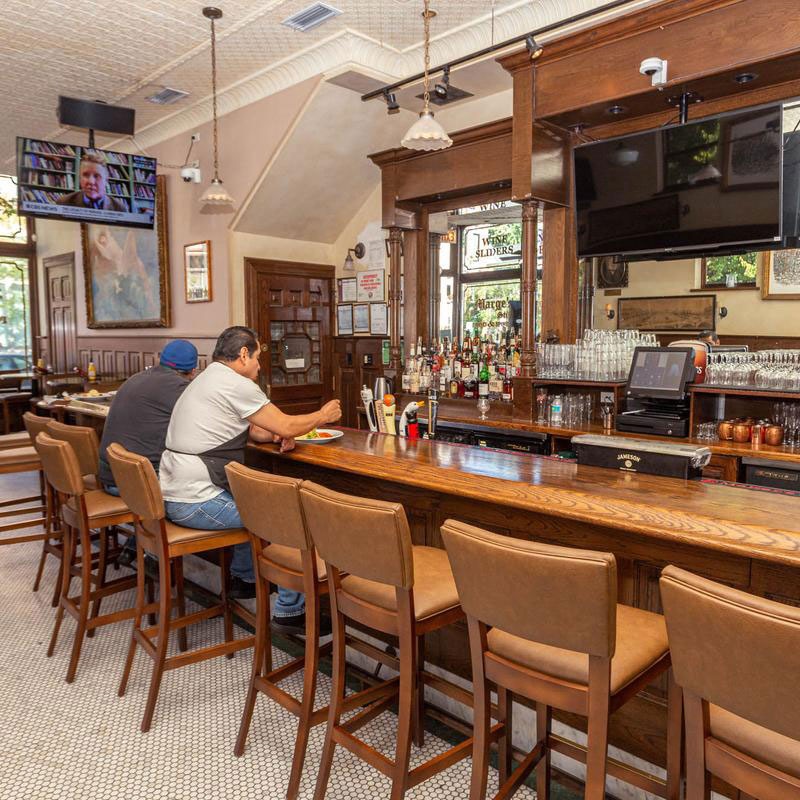
Heim’s place was typical, resembling the 2,334 other saloons in 1872 Chicago. It was long and narrow, with most of the customers crowded along the bar, behind which was an ice box for keeping ales and lagers cool. Allegedly, it’s the same bar that stands there today.
Heim’s was a workingman’s saloon. German mixed with English over the sounds of clinking bottles and jugs. The smell would have been incredible: the scent of manure from the backyard stable intermingled with sweat, smoke, and spilled drinks inside the bar. In addition to beer, patrons enjoyed wine, spirits, and mineral waters in the gaslit room. A clock reminded workers when they needed to return to work — or their families. Once they settled up, patrons could ensure they looked presentable in the bar’s looking glass. Then out into the rapidly rebuilding city they went.
The saloon even had a bit of a reputation for itself prior to Heim’s takeover of the property: A week before Heim officially purchased 554 Sedgwick, the Chicago Tribune reported that the bar had violated a new Sunday closing law. Temperance-minded Chicagoans had tried to close saloons on Sundays before, but such flirtations had never gone well. An attempt in 1855 even sparked the city’s first riot — the Lager Beer Riot — and the 1872 effort was no more successful. The saloon at 554 Sedgwick was one of hundreds that disregarded the law. Naturally, Chicago election officials selected the saloon as a polling place the following year.
Heim himself eventually pushed his luck with the law. In 1873, authorities charged the German with “furnishing liquor to inebriates.” It wasn’t just the heavy pours that did him in, but the upselling that followed. Prosecutors alleged that Heim “kept an old man continually drunk against the protestations of his whole family” before selling him “a worthless horse for a high price.” Heim argued that the Declaration of Independence protected his right to sell a beast or beer to any man. The court disagreed with that liberal interpretation and sentenced him to 10 days’ imprisonment. Heim was arrested yet again the next year, and an expensive lawsuit involving beer baron Valentine Blatz appears to have compelled him to sell 554 Sedgwick.
Heim’s short stint was followed by John Arnold, a one-armed Civil War veteran. He owned the saloon until 1880, when he mysteriously disappeared. Witnesses last saw Arnold heading out to collect his pension and pay taxes on the saloon, both tasks that required the older, physically limited man to carry hefty sums of cash. A “most rigid search” by his family and detectives turned up nothing.
John Busch was the next man up, and had a good run of it compared to his predecessors. His reign along the rail ran from 1883 to 1911. During that time, he had a couple of brushes with the law, though none that slowed business. In 1885, authorities charged Busch with “keeping a disorderly house and selling intoxicating liquor to minors.” A couple years later, on Christmas Eve, witnesses saw a man at Busch’s Saloon taking laudanum (opium) after discovering that his wife had been writing letters to another man in “a too familiar tone.” He slipped away into the frigid night. Two days later, papers declared him “probably dead.”
Nowhere in those missing years — from about 1872 to its supposed founding in 1885 — is there a Victor Caruso or his soft drinks, as legend had it. Caruso did live at 1758 Sedgwick, but not until the Great Depression: Caruso wasn’t even born until 1892, in Sambuca, Sicily. A few sources do show that the current building was erected in 1884, but other sources suggest that this date was for an addition to the building, and they show that John Arnold got a permit for a one-story store back in 1876. Perhaps only an excavation can yield an answer, but I don’t suppose Antoniou would appreciate his charming tiled floor ripped up.
With a bar legacy stretching back just months after the Great Fire, surely no bar can be older than Marge’s. But for Chicagoans, the answer depends on which block you’re from. Downtown, the folks at the Berghoff would show you they have Chicago liquor license No. 1. Across the river, Green Door’s dramatic lean reminds you that its building is older than Marge’s. Down in Bridgeport, the Shinnicks can tell you that their bar has never ceased operation — unlike Marge’s. And in Uptown, the Green Mill has been the Green Mill longer than Marge’s has been Marge’s.
So why do Chicagoans care so much about which bar is the oldest? Chicago’s bars are soaked in history and we all want to sop up a drop. Bars that claim to be the oldest are heirs to the city’s rich legacy.
“Can you imagine the tens of thousands of people that came to Marge’s?” Antoniou asks me over lunch. “All their moments?”
A bar can be old and maybe one or two or a six-pack of them can be the oldest, but it’s the moments within those years that define them. And those moments don’t have to alter the course of Chicago history. They can be nervous first dates, warm stories after a wake, comfortable silences between sips with an old friend. Antoniou tells me about generations of families returning to Marge’s to sit where their grandparents sat or to order their dad’s favorite drink.
Of course, this isn’t the same bar as their grandparents or dad knew. It’s been renovated. The menu has changed. Nothing about 1758 Sedgwick is the same as it was in 1872, including the address. And none of that matters. What matters is the sense of place that bars like Marge’s give us, helping us imagine and connect with those who experienced this same corner of Chicago — even with all of the changes.
I asked Antoniou if he’d be sad if I told him Marge’s is the second oldest bar.
“No. But I am proud that it’s the oldest,” he says. “I’ll still be proud if it’s the second oldest. Because it doesn’t change the stories that happened.”
For now, the story is this: Marge’s Still is still the oldest.