


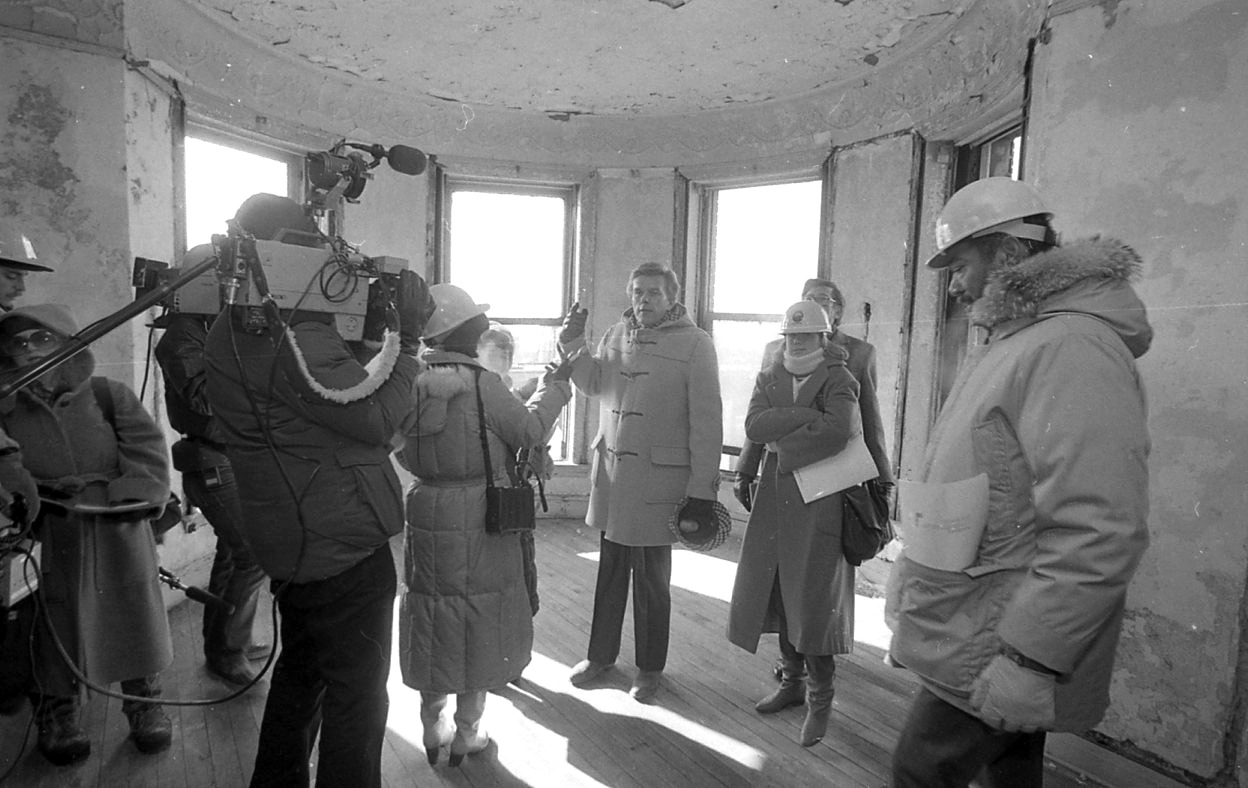
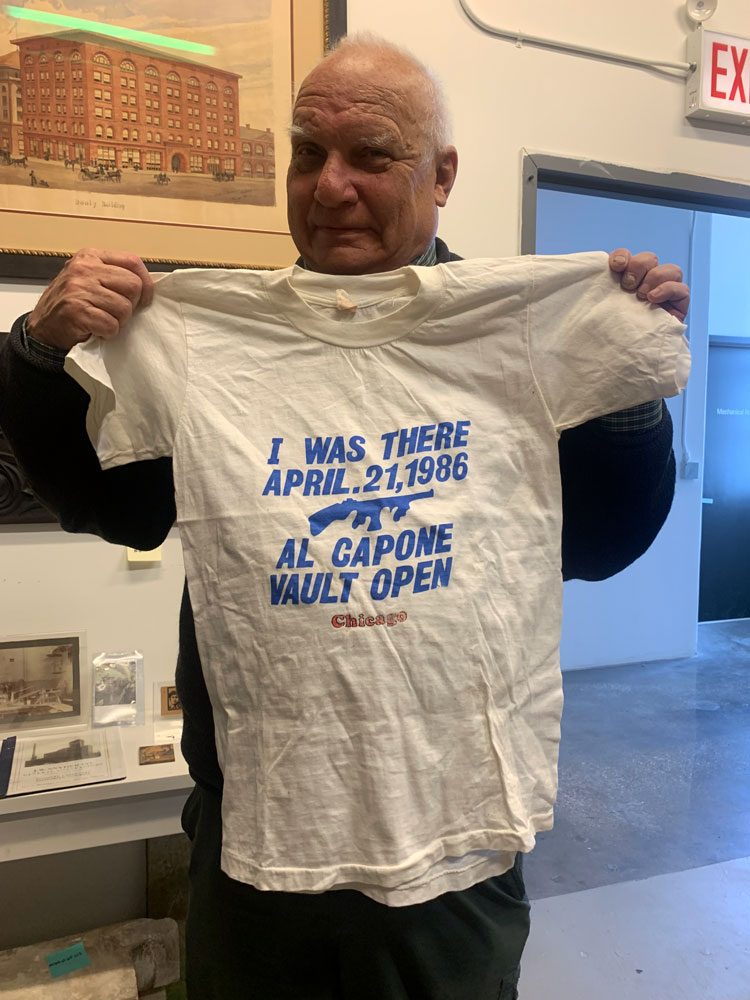
On April 21, 1986, a large portion of television viewers in Chicago went to bed disappointed. That night, after nearly a year of hype, three out of every four televisions in Chicago were tuned in to “The Mystery of Al Capone’s Vaults,” a live, two-hour broadcast from the basement of Capone’s former headquarters at the Lexington Hotel at Michigan Avenue and Cermak Road, hosted by the flamboyant Geraldo Rivera.
The vault at the Lexington, where Capone ran his operations from 1928 until 1932, didn’t turn up any money, jewels, or even dead bodies — but it did lure millions to watch, not only in Chicago but around the country. The show attracted 30 million viewers, the most-ever for a syndicated show and a record that stands to this day.
“Ratings, reality television was found,” says William Hazelgrove, historian and author of Capone’s Vault: The Real Story of the Greatest Disaster in Television History, set to release April 21. “The fact that you could give people a great ride and that was enough. So, in a way, Capone’s vault held a lot.”
The vault in question was a 6-by-6-foot concrete wall under the hotel’s Michigan Avenue sidewalk. It first came to the public’s attention in 1981 when the Chicago Tribune wrote that a huge concrete slab under the hotel “may be the tomb of some of Capone’s enemies.” According to news reports at the time, memento hunters had discovered the structure, most notably Harold Rubin, known locally as “Weird Harold.” But the “vault” was already well known to Tim Samuelson, Chicago’s cultural historian emeritus, who had studied the building extensively and always believed that it was empty.
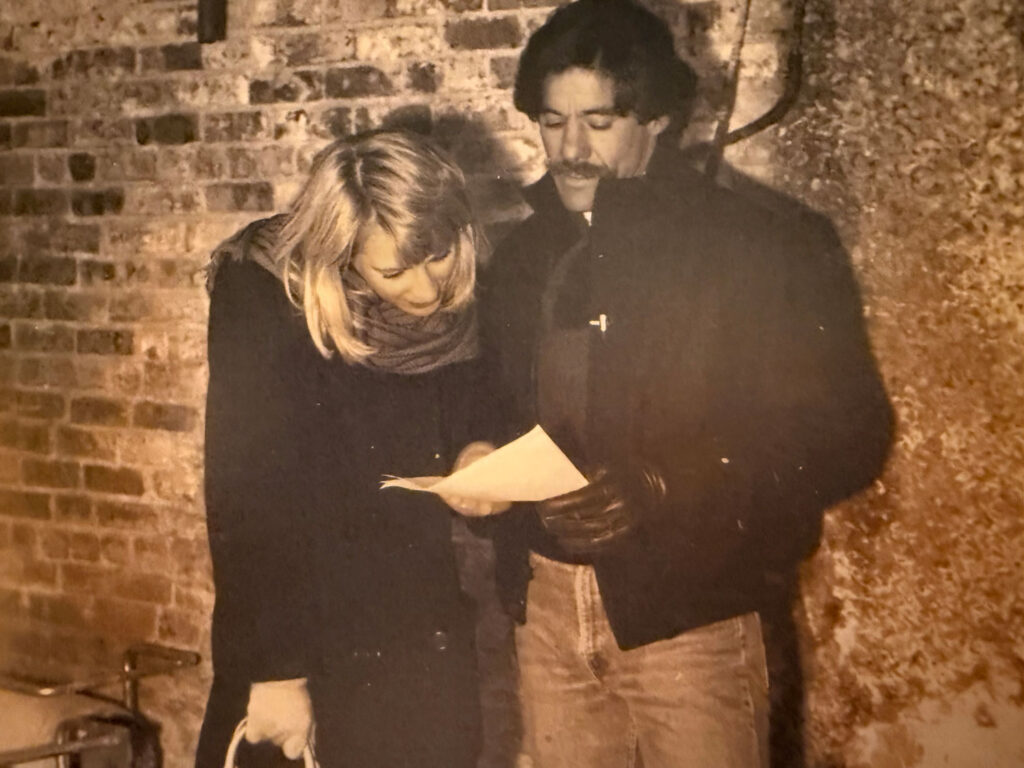
“A sidewalk vault is common in Chicago,” says Samuelson, who worked for the Commission on Chicago Landmarks in the 1980s and later became the first official historian of the city. “It’s just a storage place.”
In 1982, the hotel was purchased by the Sunbow Foundation, a nonprofit that trained women in construction skills. That same year, another story about the vault was published by The Los Angeles Times, catching the eye of Doug Llewelyn, the court reporter for The People’s Court and co-owner of The Westgate Group, a fledgling television production company. Now 87 and living near Asheville, North Carolina, he recalls that he was heading to Chicago for a non-related business meeting the next day and met with Patricia Porter, Sunbow’s executive director.
“I met Pat at the hotel and she took me for a tour,” Llewelyn says. “Everything she told me, I couldn’t argue with any of it. I thought, you know, it might be true. I took a bunch of pictures and went back to Los Angeles and came up with the idea of a television special.”
Llewelyn and his Westgate Group partner John Joslyn put together a pitch for TV networks, but Llewelyn says the uncertainty about what — if anything — was inside the vault led ABC and NBC to pass. He then learned about a new syndication television startup called Tribune Entertainment, owned by parent company Tribune Broadcasting, and approached them with his idea.
“John and I presented our dog and pony show and they went for it,” Llewelyn says. “It was a Chicago story and they all agreed: This could be something big.”
Tribune Entertainment bought the show for $900,000 and Llewelyn made a deal with Sunbow to pay the foundation $50,000. Next, he would need a host.
Llewelyn says he considered hosting it himself but wanted a bigger name. He considered Robert Stack, famous from the television show The Untouchables that aired from 1959 to 1963, but was wary because he was an actor used to having a script.
“We needed someone who could think on his feet because there was no script, the [live part] of the show was ad-libbed all the way through,” Llewelyn says. Tribune Entertainment suggested Rivera, who had been fired from ABC’s 20/20. (“I was the most famous unemployed person in America at the time,” Rivera says.) Rivera’s agent initially turned down the offer, but Llewelyn got Rivera’s home number, offered him $25,000, and finally got him to accept for $50,000.
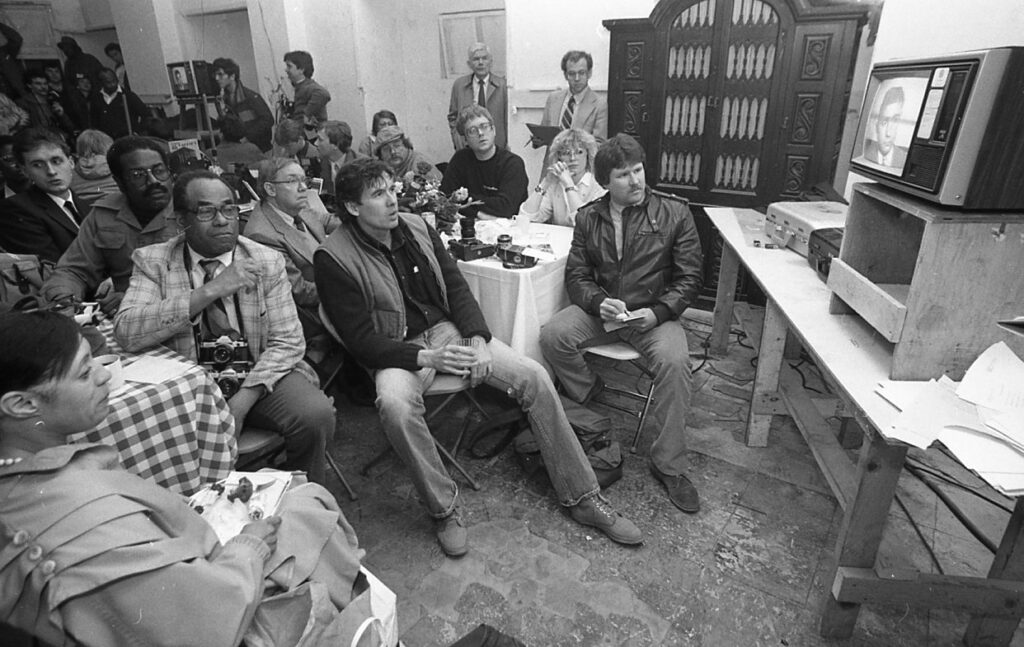
“Tribune [Entertainment] had nothing to lose, they were a little syndication company that essentially was known for two things: syndicating the U.S. Farm Report and Soul Train,” says Robert Feder, a longtime Chicago media reporter. “This was a risk but it wasn’t a high risk.”
Once the show was set, the hype machine was put into action. For almost a year leading up to it, publicist Joanie Bayhack worked on placing stories and column items in the press. The producers also hyped the fact that IRS agents would be on hand should money be found, since Capone owed $800,000 in back taxes, and Cook County Medical Examiner Robert Stein would also be there, should any of Capone’s dead enemies be unearthed.
“It was top of mind for everybody,” Bayhack says. “When you were at the dry cleaners, the grocery store, or a restaurant, you would hear people talking about the vault before it broadcast.”
As Feder puts it, the hype was “relentless.” But Bayhack insists the producers never promised anything because they didn’t know themselves what would be found, but they believed it would be something special.
“That’s one of the things that made it so authentic: No one knew,” Bayhack says. “We did have a sonogram machine and it looked like something was there, but we didn’t cheat it at all. It was all in good faith.”
But what the sonogram machine indicated was simply that the vault was hollow, Llewelyn and Rivera say, which only suggested that it had the potential to contain something. For Hazelgrove, it didn’t seem a stretch for anyone to believe the hype.
“It was pretty logical,” he says. “There was this strange vault and there could be stuff in it from Capone…the Lexington was Capone’s kingdom.”
But Samuelson says the producers’ beliefs seemed to blind them to reality.
“They were doing a lot of explorations before the show and bringing me in all the time when they’d find something,” Samuelson says. “They called me up and said, ‘We found what we believe was a torture chamber.’ So, I went down there and looked and said, ‘Oh, come on folks. This is the electrical closet for the building.’ There were all these wires and what not. Torture chamber? No, no.”
Another time, he says, the producers asked him to look at a hole where the medicine cabinet was in Capone’s bathroom. They claimed it was an escape tunnel; Samuelson says that’s just where they ran pipes up to the bathroom. He warned the producers that their search would come up empty.
Samuelson, who was at the Lexington the night of the show, says that the producers brought him what Rivera described as “bathtub gin bottles from the era.” During a commercial break, they asked Samuelson to examine them.
“They had tax stamps from 1948. They weren’t from the era,” he says, explaining that, in 1948, the hotel had a new facade put on and the bottles came “likely from construction workers who drank their lunch and then threw the bottles in the hole.”
Samuelson says Rivera interviewed him the night of the special and that he told him again that he didn’t believe there would be anything in the vault, but that part of the interview was cut. Additionally, Samuelson says a pre-recorded segment with renowned psychic Irene Hughes wasn’t aired, either — because she told them that when she conjured up the spirit of Capone, she saw a vision of him laughing at them.
Joslyn says Samuelson was one of several voices they received input from, and that most people they consulted said it was likely that there would be something in the vault.
“Everybody had lots of opinions,” Joslyn says. “I know Al Capone was there and that Al Capone moved a lot of money.”
But the only thing that turned up on the live broadcast was the glitz and theatrics of television. Rivera arrived to the Lexington via helicopter and, later in the show, he fired live ammunition from a gangster-era Tommy gun (or “Chicago typewriter”). The production consisted of live shots of Rivera ad-libbing while an excavation crew dug up the vault, mixed with pre-recorded segments about Capone and Chicago. In the first 15 minutes, the old bottles were discovered and things looked promising — but the bottles ended up being all that was found.
In the end, Rivera — looking deflated after attempting to keep the audience rapt for two hours — apologized on the air, sang Frank Sinatra’s Chicago, and ended the show abruptly.
“We had no plan B,” Rivera says. “Looking back on it, I’ve taken a lot of chances in my life — mostly high-wire stuff like combat, war reporting, gangs, and natural disasters. This was the first time I took such a big chance on my reputation.”
In the show’s immediate aftermath, it was viewed as a flop, and Rivera became a laughingstock. He skipped the after-party, opting to drink tequila at a Mexican restaurant across the street from the Lexington.
“Everyone was disappointed,” Feder says. “In the moment, everyone felt they were suckers, including the host himself. You could see it in his face, you could see it in what he said. He knew it was a bust, he knew it was a disaster. I mean, what host apologizes during the show?”
Believing his career was over, Rivera eventually went back to his hotel room and refused to answer the phone. The next morning, when the ratings came out, the numbers told a different story: In Chicago, the show recorded a 57.3 rating and 73 share, according to Nielsen data. An estimated 5 million people in the WGN viewing area watched all or part of the show — almost double the population of the city of Chicago at that time. In other cities, the show dominated as well, getting ratings of 33.2% in New York City, 45.6% in Los Angeles, and 60% in Denver.
Still unable to reach Rivera the morning after the show, Llewelyn went to his hotel room and slid the fax with the show’s ratings under his door. That morning, Rivera also received a fistful of messages from a room service waiter — all job offers.
Llewelyn says even after the show aired they paid construction crews to keep digging for a few days.
“There was no reason for those sections to be all sealed up the way they were,” he says. “Something was being hidden. To this day, I’m convinced we were right in those opinions.”
Despite the fact that the results were the same, he thinks they may have just missed a still-hidden secret.