


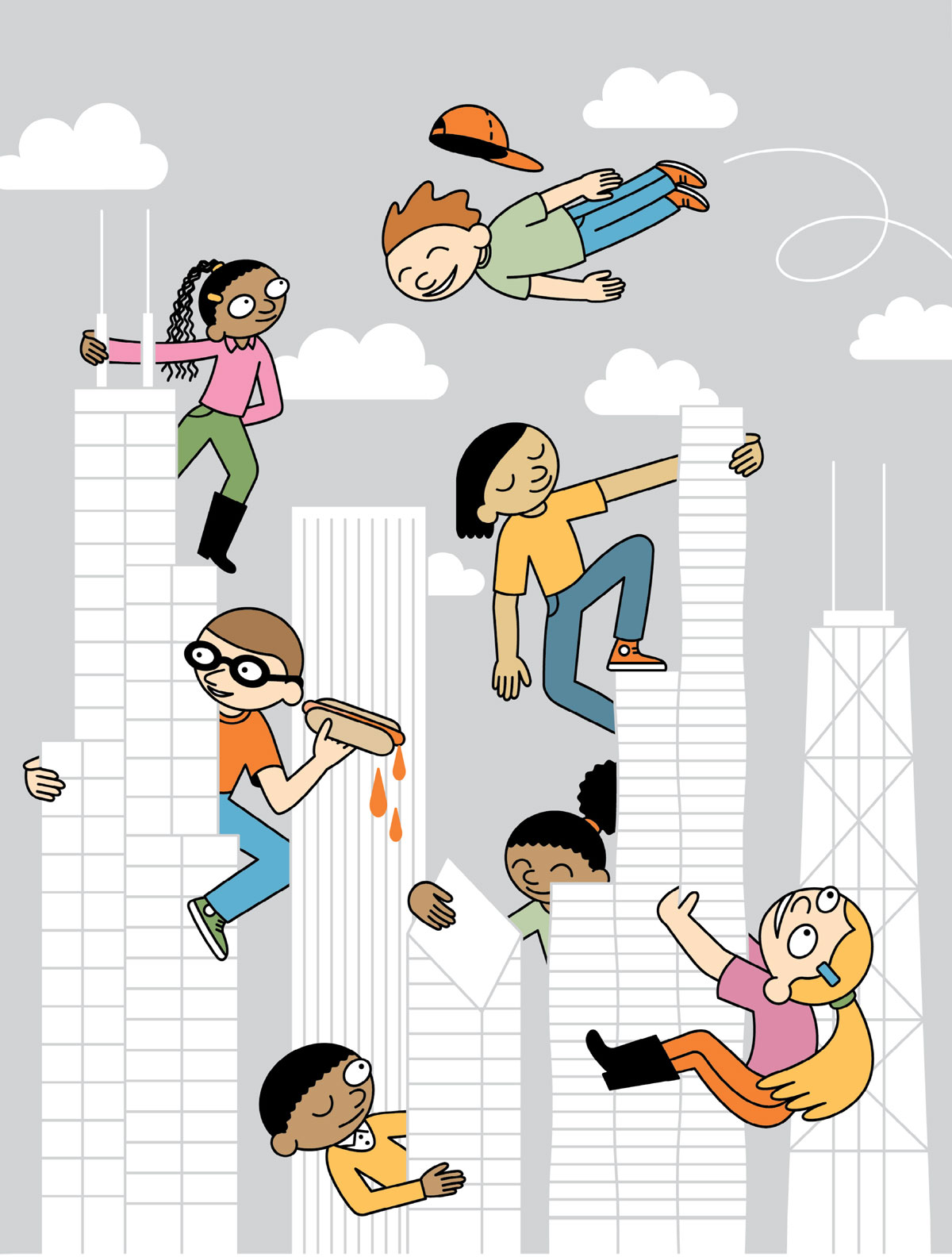
Design streets for families, not cars
Chicago’s grid is blessedly easy to navigate — if you’re in a car. Eleanor Esser Gorski, CEO and president of the Chicago Architecture Center (and a former deputy commissioner in the city’s Department of Planning and Development), argues streets should be designed for families, too. That means more multiuse greenways that prioritize pedestrians, more protected bike lanes, and lower speed limits in residential areas. It means more bike racks and benches throughout the city, not just downtown. And more public facilities: “Parents often need bathroom breaks, and they need places to get the kids dressed, give them a snack,” Gorski says.
Put play spaces everywhere
The Chicago Children’s Museum installed a series of art-driven learning installations at everyday locations, such as at Linares Launderia in Little Village. These interactive spaces help children build math and pattern recognition skills. More of that, please. “We’re seeing more nature play spaces in the parks, which is great,” says Jennifer Farrington, the museum’s CEO and president. “But we can think about every single asset that the city has.” Start with the CTA. “What if a certain amount of advertising space was given over to riddles or wordplay?” asks Farrington. Extend the effort to the purgatorial places where kids often get dragged. That way, says Farrington, “if a parent is at a municipal location filling out some form, there is stuff for the kids to engage with.” Because every DMV outpost could use a ball pit.
Pass an ADA equivalent for kids
By law, public infrastructure must be accessible to people with disabilities. Why not extend that to children? One suggestion: On trains and buses, add seats that aren’t large enough for adults, guaranteeing young kids a place to sit. And designate space on public transit for open strollers.
Think smaller
Inside the Tokyo bakery Comme’N Kids is a child-size doorway exclusively for tykes that leads to a dedicated space where they can purchase bread or pastries on their own. Let’s do that type of thing here. (New hack unlocked for skipping the lines at Del Sur and Kasama.) And while we’re at it, let’s reimagine entryways everywhere. How about a revival of Dutch doors? “You still see them on the North Shore,” says Gorski. But instead of the bottom being designed to keep kids in, it would give them their own access. Or instead of doors, why not slides? They’re already being used in Europe, where artist Carsten Höller’s metallic installations let both kids and adults zip around the Danish Architecture Center in Copenhagen and the Hayward Gallery in London. What a fun way that would be to get in and around the Chicago Cultural Center.
Build indoor sports facilities that are easier to get to
Any parent will tell you that youth sports dominates your weekends, but do all the indoor soccer fields, basketball courts, and swimming pools really need to be clustered in one area — as they seemingly are in the weird no man’s land bordered by Addison, Irving Park, California, and Western — with no convenient public transportation and limited parking spots? “You see these giant, beautiful facilities in the suburbs, and all the parents I know, that’s what we’re driving out there for: the ice rinks or big soccer fields under these domes,” Gorski says. “They don’t need to be in our immediate neighborhood, but maybe they’re in a place where you don’t need to jump on the highway.” Paging Joe Mansueto (and his checkbook): Why not put a sports complex near the planned Chicago Fire stadium in the South Loop?
Hold winter block parties
So what if you don’t have bouncy houses and barbecues? You’ll have snowball fights and sled races and Crock-Pots full of chili. And nothing is preventing fire trucks from stopping by when it’s cold out. Plus, adults won’t need to put their beers in a cooler. Note to parents: The City of Chicago does not restrict permits for block parties to the warmer months.
Offer free daycare
Gratis daycare in America might seem like a pipe dream, but Chicago can look to New Mexico, where it’s a reality. That state taps an investment trust fund seeded largely with oil and gas revenues to cover private and public daycare costs regardless of a family’s income.
Increase teen programming
The notion that childhood stops at junior high is false. “Teens are still children,” Farrington says. “They need to play. We have to stop vilifying and fearing them. Where are we allowing them to socialize, to listen to music, to dance, to do what teens want to do?” But that means giving them alternatives to the dreaded teen takeovers downtown. Both Farrington and Gorski praise After School Matters, the local nonprofit that provides teenagers with paid work programs, but our city could do more to establish recreational venues — more basketball courts, more skateboard parks, later hours for swimming pools — for older kids to get their ya-yas out. For inspiration, look to St. Paul, Minnesota: In 2023, its parks department partnered with a local radio station to host open mic nights, waived fees for youth sports for ages 9 and up, and brought video game consoles into rec centers to give kids something to do indoors. Hey, even an Xbox is better than nothing.
Build multiunit housing with kids in mind
Just as the city requires new housing developments to meet standards of affordability, parking, and public amenities, it could incentivize them to cater to children. Gorski favors the European model of residential development: “Green space is shared, so that rather than little postage stamp yards, you look out into a central green, almost like a boulevard. Let’s say there are townhouses or row houses attached around it, and it’s a protected play space where kids really have room to run and ride their bikes.”