


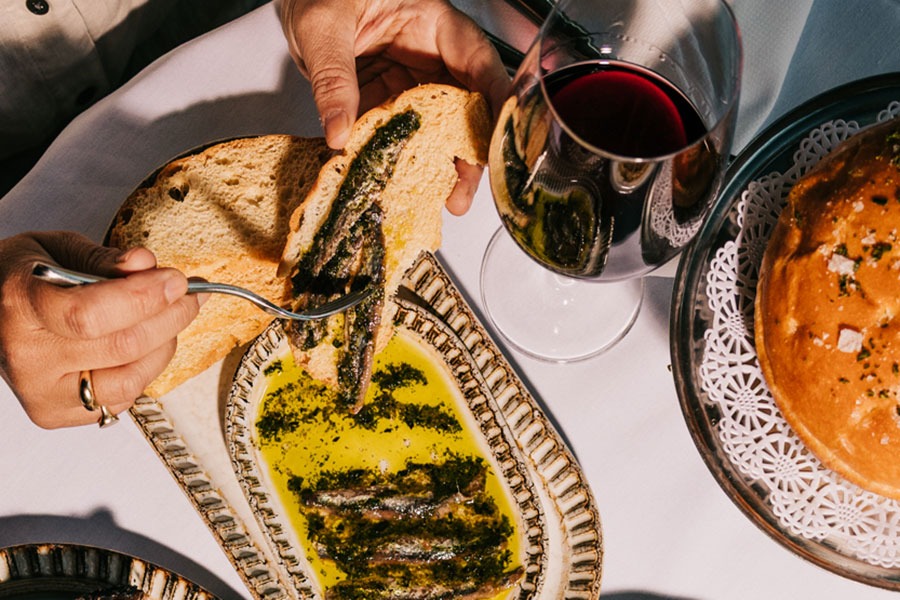

I’ve been dining out a lot lately to check back in on restaurants I love but haven’t evaluated in a while. It’s been an interesting exercise, and while I’ll be discussing the food in an upcoming issue of the magazine, I’d like to take a moment to relate a few experiences I’ve had with wine service. I feel like these are hard times for those of us who just want a nice glass of something that goes with the food, and there are too many buyer beware moments. But when wine service clicks, it adds so much to the experience.
1. Pour sizes are all over the place. In Europe it’s pretty standard to get a quarter bottle of wine as a serving for one, which comes in at just over six ounces. I find that the perfect amount of wine to accompany a non-elaborate meal, and I especially love it when it comes in a carafe that you can mete out yourself. Here, the standard pour is five ounces, but many restaurants give you only four. One of the worst offenders in my opinion is Cellar Door Provisions. While I haven’t (yet) brought a measuring cup, I’d be surprised if the pours in their retro-chic bistro glasses even made it to four. On my last visit I ordered a sparkling tea that was bottled like wine. Delicious, but their standard pour was $14.
2. Wine by the glass can feel like a ripoff. What I most love about Monteverde is how it offers such consistent, quality cooking for such a reasonable price. There are almost no wrong turns on this menu. So when the server recommended a glass of Barolo to go with our pastas, I asked how much it cost. When he said $30, we balked and asked about other red wines by the glass. We went with the Barbera, generally considered an easier, lighter, and more approachable varietal from the same Piemonte region. We should’ve asked again: this one was $29! It cost more than any of the dishes on the table. The bottle (Aldo Conterno Conca Tre Pile Barbera d’Alba 2022) retails for about $40.
3. Wine service is often poorly timed. We were having a great meal at Tre Dita, and when the waiter asked if I was ready for a second glass, I asked for five minutes to decide. He took 10, and when he returned, I ordered something. Then I waited a few more minutes, first for the busser to deliver a glass, and then for the server to appear with the bottle to offer a taste. By this point the steak was cold and the voice telling me I didn’t need more wine was loudest. I get it; there are other tables, I wasn’t making his job easy, and the service model here requires several steps, but I expect more from a $400 meal.
4. The right bottle list can be magic. As much as I love great wine lists, so many of them are like museum objects — lovely to read and consider but nothing I can interact with fully. I rarely want to spend more than $150 for a bottle; if I’m going to drink great wine, I’ll bring it and pay the corkage. The all-South American wine list at El Che Steakhouse is a glorious unicorn, with hundreds of bottles in my price range and a fantastic tour guide in manager-sommelier Laura Robinson-Sundh. When I asked to try a great example of carmenere — a grape widely planted in Chile — she fished around the cellar, brought up three bottles and told us a little about each. We ended up with Perez Cruz Liguai — a blend of carmenere, cabernet sauvignon, and syrah — from the 2005 vintage. This was a 20-year-old wine for $100, and what a treat it was to taste the way the juice and the oak integrate after so much time in the bottle. We drank half, corked the rest to bring home, and marveled at how well it held up the next day.
I raise my glass to such exemplary wine service, pricing, and timing for all of us this year.